American cooking Recipes & regional stories

Skillet & Sage

A culinary journey through the fifty states

The regional table / Michigan

Detroit-Style Pizza
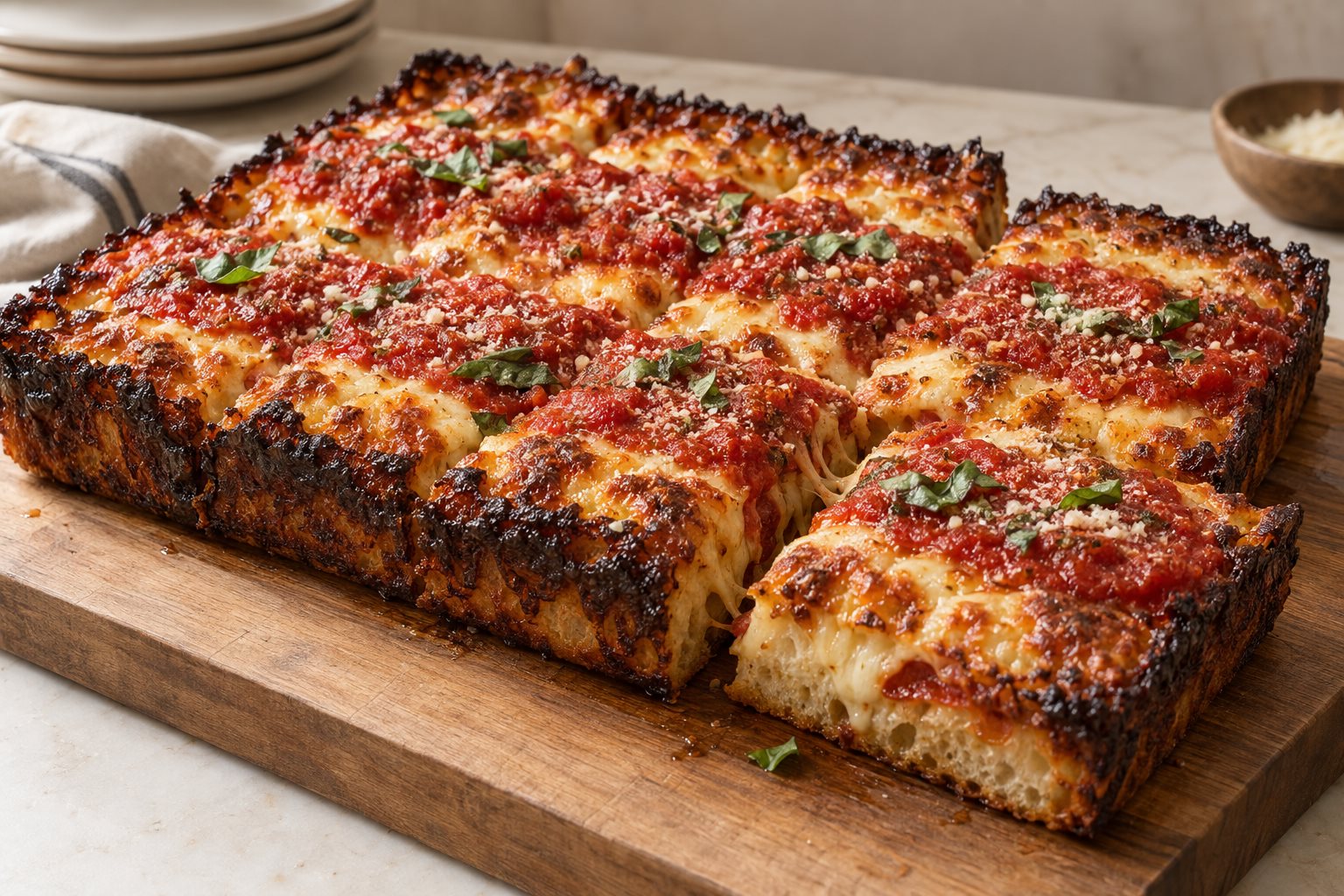
A rectangular pan pizza cut in squares, the cheese burnt dark brown along the outer wall, with two stripes of red sauce across the top
The black-brown ring where the cheese met the steel is the dish. Everything else is a pan pizza. AI-generated illustration.

The cheese goes all the way to the wall of the pan on purpose, because the part that burns against the steel is the part people drive across town for.

The Detroit pizza is young, and the honest way to write it is to say how young. Georgia Historic Newspapers indexes syndicated national copy and runs to 2024; search it for the exact phrase "Detroit-style pizza" and it returns six pages, the earliest dated 1 June 2021, and every single one is a restaurant listing for a franchise opening in Georgia. The name is that recent as national property. The closest thing to a definition on the public record is not a cookbook either — it is an offering memorandum filed with the Securities and Exchange Commission in May 2021 by a Texas company registered as Detroit Style Inc., which tells prospective investors that "Detroit-style pizzas are baked in a rectangular pan, and are usually topped with Wisconsin brick cheese as opposed to mozzarella" and that "The end result is a buttery, crispy crust with cheese right up to the edge". Two sentences in a securities filing, and they are the correct two.

The pan is the origin story, and it belongs to a named business rather than to a document. Buddy's, in Detroit, dates the dish to 1946 and says the first ones were baked in blue steel utility pans that came off the automotive trade rather than out of a bakery supplier. That claim is the company's own; no record reachable for this page dates it, because the Detroit dailies are closed to automated requests and the America Eats Michigan file that would normally carry a state dish could not be opened at all. What can be checked is the cheese, and it is worth checking, because it is the whole engineering of the dish. Brick cheese has a federal standard of identity at 21 CFR 133.108: "The minimum milkfat content is 50 percent by weight of the solids and the maximum moisture content is 44 percent by weight", the curd "cut into cubes with sides approximately 3/8 inch long" and, if the milk was not pasteurised, cured at not less than 35 °F for at least 60 days. Half fat and under half water is exactly what you want against hot steel: enough fat to fry, not enough water to steam.

Why this version works

Cheese against the metal. Everything that makes this pizza different happens in the half inch between the cheese and the pan wall. Fat renders out, the milk solids hit steel at 500°F and go past brown into black-edged, and the result is a rim of fried cheese welded to the crust. Leave a border, as you would on any other pizza, and you have made a focaccia with toppings.

Brick cheese, not mozzarella. Low-moisture mozzarella is built to stretch; brick is built to melt and break. At 50 percent milkfat in the solids it puts out enough free oil to fry the crust from above, and at 44 percent moisture or less it does not flood the dough. That combination is why the substitution everyone reaches for — mozzarella — gives a wetter pizza with a pale edge.

Sauce on top, after the bake. Two or three stripes of sauce go across the cheese when the pan comes out of the oven. Sauce under the cheese soaks the dough for fifteen minutes at high heat; sauce on top keeps its raw tomato sharpness and cuts the fat, which by then is considerable.

A wet dough and a long rest in the pan. Seventy-five percent hydration gives an open, custardy interior that can survive being fried in oil at the base. The dough is not rolled: it is pressed out, allowed to relax, pressed again, and proofed in the oiled pan itself, so it arrives at the oven already the shape of its walls.
Ingredient notes

Flour: bread flour. At this hydration all-purpose slumps into a batter you cannot handle, and the finished crumb will be tight instead of open. Four hundred and fifty grams of bread flour to 340 grams of water is the working ratio.

Sauce: crushed San Marzano-style tomatoes, cooked down twenty minutes with garlic, oregano and a pinch of sugar until it mounds on a spoon. It is not cooked again on the pizza, so it has to be finished before it goes on.

The pan: a 10 by 14-inch blue steel pan is the traditional article; a 9 by 13-inch anodised aluminium cake pan works and a cast iron skillet works better than you would think. What matters is that it is dark, heavy and straight-sided. Glass will not give you the wall crust and never will.

Brick cheese: a pound of Wisconsin brick, bought in a block and cut into half-inch cubes rather than grated. Cubes melt into puddles that spread and fry; shreds dry out and knit into a mat. If you cannot get brick, the least-bad substitute is half low-moisture mozzarella and half young white cheddar, which gets you the fat and some of the break but not the tang.

Step by step

  1. Mix and ferment. Whisk 450 g bread flour, 2 teaspoons instant yeast and 2 teaspoons salt. Add 340 g water and 2 tablespoons olive oil and mix to a shaggy, sticky mass. Cover and leave 2 hours at room temperature, folding it over on itself once at the halfway point, or refrigerate overnight for a better crumb.
  2. Oil the pan and press. Pour 3 tablespoons of olive oil into the pan and spread it up the walls. Tip in the dough, press it toward the corners with oiled fingers until it fights back, then leave it 20 minutes and press again. Repeat until it reaches all four corners.
  3. Final proof. Cover and proof 45 to 60 minutes, until the dough is puffed and holds a fingerprint. Heat the oven to 500°F with a rack in the lower third.
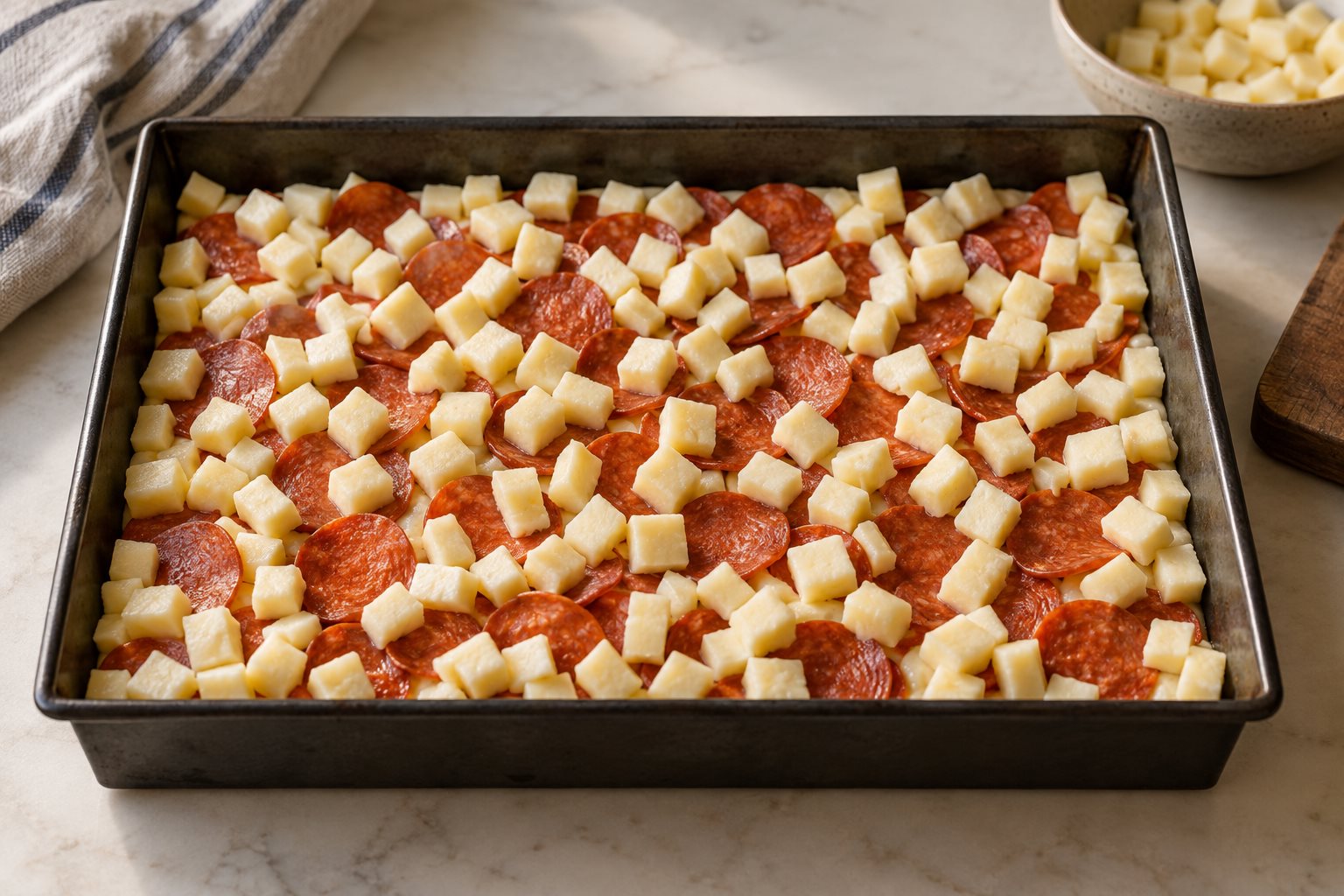
  4. Build it. Lay the pepperoni straight on the dough, then scatter the cubed brick cheese over the whole surface and push it deliberately against all four walls of the pan. There is no border on this pizza.
    Brick cheese cubes reaching the walls of an unbaked rectangular pepperoni pizza
    Push the cubed cheese against every wall of the pan; leave no bare border. AI-generated illustration.
  5. Bake. Bake 13 to 16 minutes, until the top is blistered and the cheese at the walls has gone dark brown at the edges. Do not pull it when it looks merely golden; the wall is the dish.
  6. Release and stripe. Run a thin knife around the wall immediately and lift the pizza onto a board. Spoon the sauce across the top in two or three broad stripes, scatter the grated parmesan and basil, and cut into squares.
If the cheese wall is pale, the oven was not hot enough or the cheese never actually touched the steel — next time push it hard against the wall and give it three minutes longer. If the base is soggy, there was sauce under the cheese or not enough oil in the pan; reheat the squares in a dry skillet over medium heat for three minutes to drive the moisture off. If the pizza has welded itself in, set the pan back on a low burner for a minute to loosen the fat and it will release.

Storage and make-ahead

Keeps 3 days refrigerated, and it is one of the few pizzas genuinely improved by reheating: 8 minutes in a 425°F oven, or three minutes in a dry skillet to re-crisp the base.

Freeze cut squares on a tray, then bag them. Reheat from frozen at 400°F for 15 minutes. The sauce goes on after reheating in both cases.

What to serve with it

A green salad with a sharp red wine vinaigrette, and nothing creamy anywhere near it. The pizza supplies all the fat the meal needs.

Cold lager or a Michigan pale ale. The bitterness matters more than the style — this is a dish that wants scrubbing between bites.

A rectangular pan pizza cut in squares, the cheese burnt dark brown along the outer wall, with two stripes of red sauce across the top

From the recipe box / Michigan

Detroit-Style Pizza

A wet dough pressed into an oiled steel pan, brick cheese laid to the walls so it fries into a lace of crust, and the sauce striped over the top after it comes out.

Prep
30 min, plus 3 hours rising
Cook
15 min
Total
3 hr 45 min
Serves
8
Calories
500 per serving

Ingredients

Scale

Instructions

  1. Mix the flour, yeast, salt, water and 2 tablespoons oil to a sticky dough and ferment 2 hours, folding once, or overnight in the fridge.
  2. Oil the pan with the remaining 3 tablespoons, press the dough toward the corners, rest 20 minutes and press again until it fills the pan.
  3. Proof 45–60 minutes while the oven heats to 500°F.
  4. Lay on the pepperoni, then the cubed brick cheese, pushing it hard against all four walls.
  5. Bake 13–16 minutes, until the cheese at the walls is dark brown.
  6. Release with a knife, lift out, stripe with the sauce, finish with parmesan and basil and cut into squares.

Nutrition

Fat26 g (12 g saturated)
Sodium890 mg
Protein20 g
Serving1 square, one-eighth of the pan
Calories500
Cholesterol55 mg
Carbohydrates48 g (3 g sugar, 2 g fiber)

Nutrition is an estimate calculated from the listed ingredients and is provided as a courtesy, not as dietary advice.

Questions readers ask

Do I have to use brick cheese?

It is the one ingredient the dish is actually built around, and the federal standard explains why: brick is at least 50 percent milkfat in its solids and at most 44 percent water, which is the ratio that fries rather than steams against the pan wall. Half mozzarella and half young cheddar is the workable substitute. Fresh mozzarella is not, at any ratio.

Why does the sauce go on last?

Because it is not cooked on the pizza. Sauce under the cheese spends a quarter of an hour at 500°F soaking into the dough and losing its edge; sauce striped over the top after the bake stays bright and acid, which is what a pizza this fatty needs.

What if I only have a cake pan?

A 9 by 13-inch metal cake pan gives you a slightly thicker pizza in the same bake time, and a 12-inch cast iron skillet gives you a round one with a superb wall. Both need the same three tablespoons of oil. Only glass and ceramic genuinely fail, because they never get the pan wall hot enough to fry the cheese.

How old is Detroit-style pizza really?

Older than its name. Buddy's in Detroit dates the dish to 1946 and attributes the pans to the automotive trade, and that is the company's own account rather than a document anyone can open — the Detroit newspapers are not reachable by script. What can be dated is the phrase: in a newspaper archive that indexes syndicated copy from all over the country and runs to 2024, "Detroit-style pizza" first appears in June 2021.