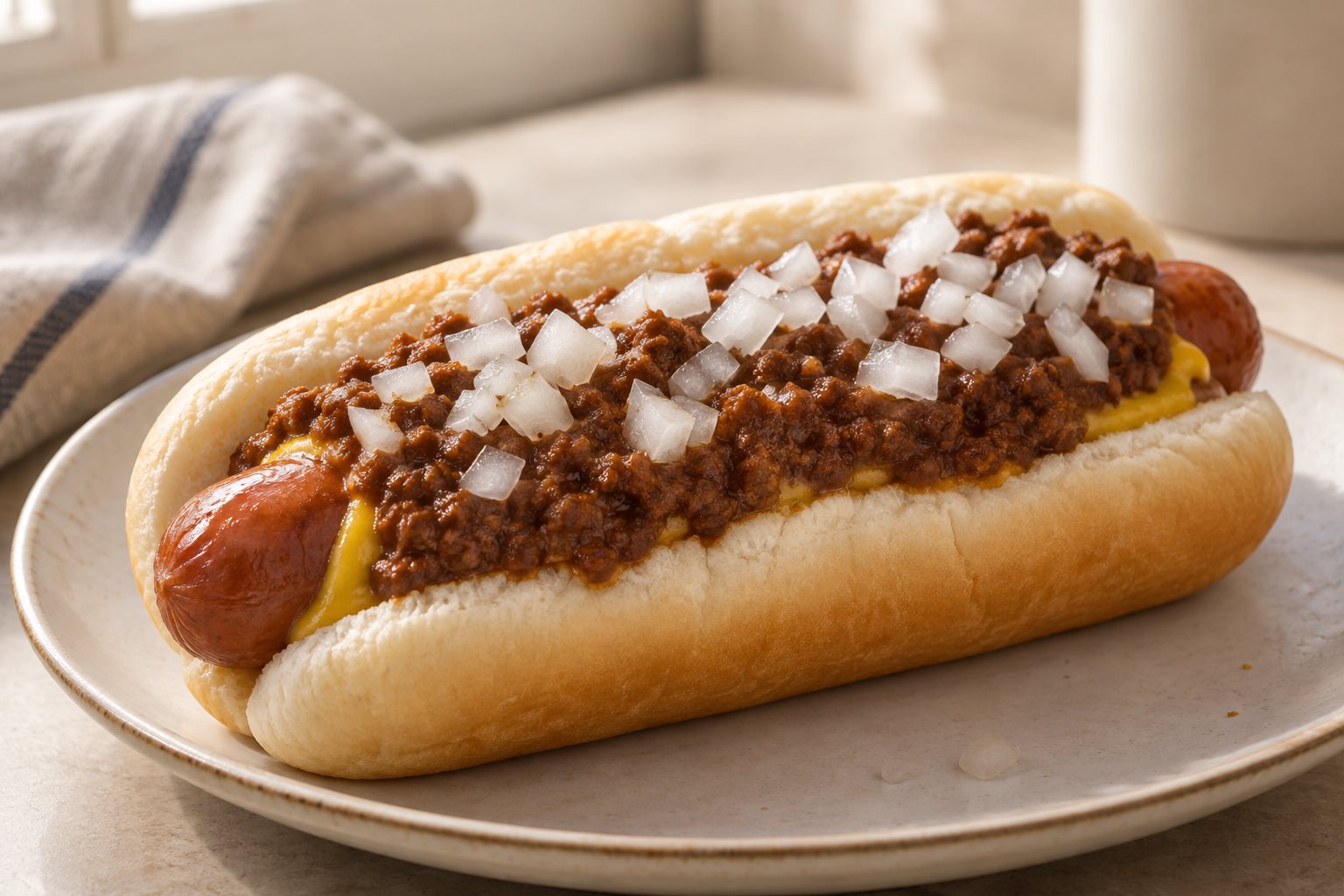
The sauce is not chili, the frank has to snap, and the onion goes on raw at the last second or the whole thing is just a hot dog.
Two coney houses stand side by side in downtown Detroit, each older than most of the city around them, and each has always claimed to be first. This page will not crown either, because nothing reachable does: the Detroit newspapers are closed to automated requests, and the America Eats Michigan file that would be the obvious source could not be opened at all. What the open record does settle is that neither of them invented the name. The exact phrase "Coney Island hot dog" was already loose in national print by 5 September 1915, when a wartime humour column in the Atlanta Georgian daydreamed about grabbing "a ruddy Coney Island hot dog and sauerkraut"; by 27 October 1927 the Griffin Daily News in Georgia could report that four local businessmen had backed a booth at a Hallowe'en carnival so the ladies could "put on a real Coney Island Hot Dog Stand!". The name travelled out of Brooklyn as a generic before Detroit made it a specific, and what Detroit contributed was the sauce.
That sauce is worth taking seriously as a technical object, and federal meat law is unexpectedly useful about it. A Detroit coney topping has no beans in it, which puts it nearer the standard for plain chili con carne at 9 CFR 319.300 — "shall contain not less than 40 percent of meat computed on the weight of the fresh meat" — than the beans version at 9 CFR 319.301, which drops the requirement to 25 percent. The same section quietly licenses the ingredient Detroit coney sauces are famous for and coy about: "Head meat, cheek meat, and heart meat exclusive of the heart cap may be used to the extent of 25 percent of the meat ingredients under specific declaration on the label." Beef heart is not a rumour about coney sauce; it is a category the regulation anticipates. The frank is regulated too, at 9 CFR 319.180, whose heading misspells "weiner" and whose text defines frankfurters as "comminuted, semisolid sausages" that "shall not contain more than 30 percent fat", with the further limit that "the sausage shall contain no more than 40 percent of a combination of fat and added water". Buy the one in a natural casing and you will taste why the rule bothers.
Why this version works
Natural casing. Cellulose-cased franks are skinned before packing and cannot snap. The casing is the only crisp thing in an assembly that is otherwise entirely soft, and the federal fat ceiling of 30 percent means a good frank has to earn its texture from grind and casing rather than from fat alone.
Raw onion last. Diced raw white onion goes on after the mustard and sauce, never before, and never cooked. It is the only sharp, cold, crunchy element on the plate, and thirty seconds of contact with the hot sauce is all it needs to soften if you dawdle.
No beans, no tomato to speak of. A tablespoon of tomato paste for colour and body is the limit. Tomatoes make it a sauce that competes with the mustard; the working flavours are cumin, chilli powder, black pepper and beef. This is the line that separates a Michigan coney from a Cincinnati chili or a Texas hot.
The sauce is ground fine and never browned. Coney sauce is not a chili in miniature. The beef goes into cold water or broth and is worked apart with a whisk before it ever sets, so it cooks as a suspension of fine particles rather than crumbles. Brown it first and you get chili; keep it pale and broken and you get the loose, spoonable texture that clings to a frank.
Ingredient notes
Beef: a pound of 80/20 ground chuck for the sauce. If your butcher will grind you four ounces of beef heart into it, take the offer — it is what the old houses use and it is explicitly permitted in the federal chili standard. Without it, add a teaspoon of Worcestershire for the same savoury depth.
Buns: plain soft white hot dog buns, steamed until they are hot and slightly damp. A toasted or brioche bun is wrong here; the bun is meant to give way completely.
Spices: two tablespoons chilli powder, two teaspoons cumin, a teaspoon of paprika, half a teaspoon of ground allspice. Allspice is the note people cannot place in a coney sauce and the one that makes it taste like Detroit rather than like a taco.
Frankfurters: natural-casing beef franks, eight to the pound, the ones that arch slightly as they heat. They are usually sold near the deli counter rather than in the hot dog aisle. Skinless all-beef franks will do at a pinch; anything labelled "with byproducts" is a different product under the regulation and tastes it.
Step by step
Start the sauce cold. Put the ground beef in a cold saucepan with 1½ cups of beef broth and whisk it hard until no lumps remain and the mixture looks like thin mud. This is the step that makes coney sauce rather than chili, and it only works before the meat sets.
Build the flavour. Set it over medium heat, add the grated onion, garlic, tomato paste, chilli powder, cumin, paprika, allspice, salt and a generous amount of black pepper, and bring it to a bare simmer, whisking now and then.
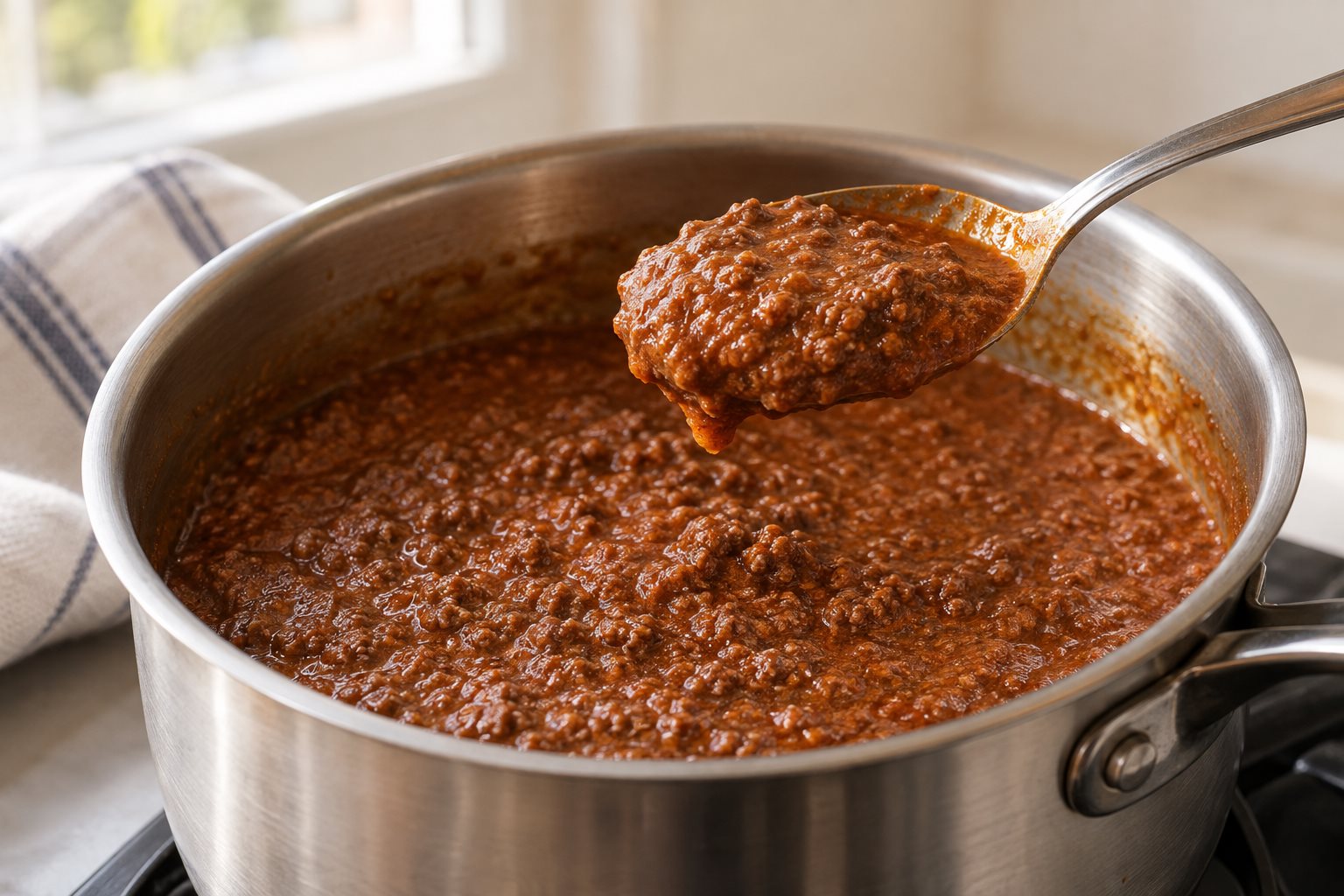
Simmer it down. Cook uncovered 40 to 45 minutes, until it has thickened enough to mound softly on a spoon but still slumps. If it goes past that, whisk in a splash more broth. It should never be stiff.
Reduce the sauce until it mounds softly on a spoon but still slumps. AI-generated illustration.
Heat the franks. Simmer the franks in water at just below a boil for 5 minutes, or griddle them on a flat pan until the casings blister and split in places. Do not boil them hard; the casings burst and the snap goes.
Steam the buns. Hold the buns over the simmering water in a steamer or a colander for about 60 seconds, until they are hot through and pliable.
Build in order. Frank in the bun, a stripe of yellow mustard down the length of it, two heaped tablespoons of sauce over the top, then the raw diced onion. Serve immediately, on a plate, with a fork nearby.
If the sauce went grainy and the beef separated into crumbs, it was heated before it was whisked smooth — an immersion blender for five seconds will retrieve most of it. If it is watery after 45 minutes, raise the heat and cook it down uncovered rather than adding thickener, which makes it gluey. If it tastes flat, it is almost always salt and black pepper rather than more chilli powder.
Storage and make-ahead
The sauce keeps 4 days refrigerated and is better on the second day. Reheat gently with a spoonful of water, because it tightens in the fridge.
It freezes perfectly for 3 months in small tubs. Franks and buns do not; buy those the day you want them.
What to serve with it
Crinkle-cut fries, and a Michigan-brewed lager or a Faygo if you want the full downtown counter experience.
Nothing green is traditional and nothing green is needed. If you want relief from the richness, a few pickled hot peppers on the side do more than a salad would.
From the recipe box / Michigan
Detroit Coney Dog
A natural-casing beef frank in a steamed bun under a loose beanless beef sauce, a stripe of yellow mustard and a handful of raw onion, built in that order and no other.
Prep
15 min
Cook
45 min
Total
1 hr
Serves
8
Calories
440 per serving
Ingredients
Scale
Instructions
Whisk the raw ground beef into the cold broth in a saucepan until completely smooth and lump-free.
Add the grated onion, garlic, tomato paste, chili powder, cumin, paprika, allspice, salt and pepper and bring to a bare simmer.
Simmer uncovered 40–45 minutes, until it mounds softly on a spoon but still slumps.
Simmer or griddle the franks until hot and the casings blister, about 5 minutes.
Steam the buns about 60 seconds, until hot and pliable.
Build each one in order: frank, mustard, two heaped tablespoons of sauce, raw diced onion. Eat at once.
Nutrition
Fat
28 g (11 g saturated)
Sodium
1080 mg
Protein
19 g
Serving
1 coney
Calories
440
Cholesterol
55 mg
Carbohydrates
28 g (5 g sugar, 2 g fiber)
Nutrition is an estimate calculated from the listed ingredients and is provided as
a courtesy, not as dietary advice.
Questions readers ask
Can I use canned chili?
Not if you want a coney. Canned chili is a chunky, tomato-forward, usually bean-bearing product, and coney sauce is a fine, loose, beanless beef emulsion. The cold-whisk start takes two minutes and is the entire difference.
Is there really beef heart in it?
In the commercial article, often. Federal law contemplates it: the chili con carne standard at 9 CFR 319.300 allows head meat, cheek meat and heart meat, excluding the heart cap, up to 25 percent of the meat ingredients, provided the label says so. At home it is optional, and four ounces ground in with the chuck gets you closer to the counter version than any spice will.
Which Detroit coney place invented it?
Both of the downtown houses claim it, they stand next door to one another, and no document reachable for this page dates either claim — the Detroit press does not answer automated requests. What is documented is that the name was already generic in American newspapers by 1915, a decade or more before the dispute is usually said to begin, so the argument is about the sauce and the room, not about the words on the sign.
Why does the order of assembly matter?
Because mustard under the sauce stays a stripe you can taste, and mustard over the sauce disappears into it. The onion goes on last for the same reason in reverse: it is the only cold, crunchy thing there, and it stops being that within a minute of contact with the hot sauce.