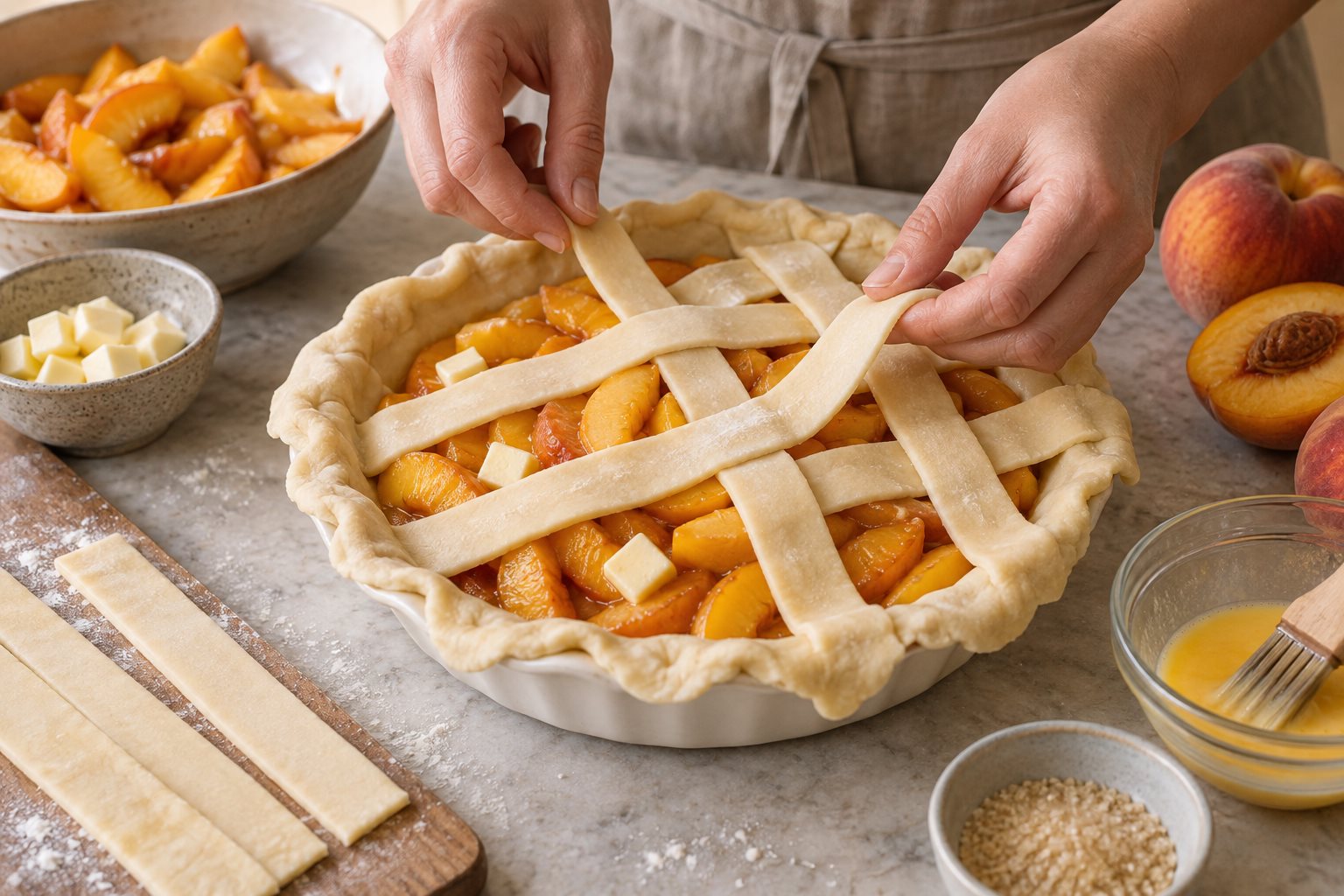
The regional table / Delaware
Delaware Peach Pie, Drained and Reduced Before It Goes in the Crust
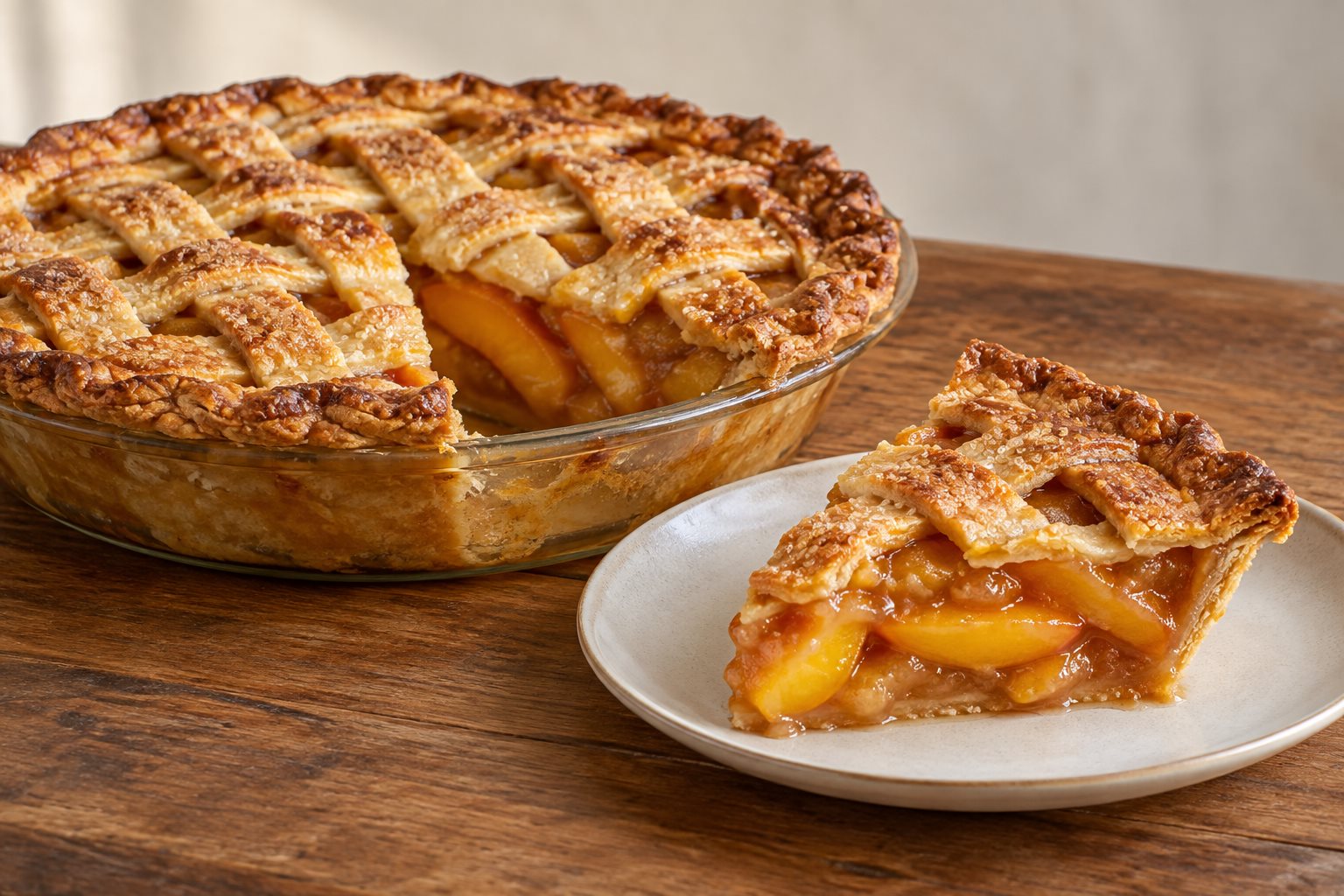
Delaware made peach pie its official dessert a century after a disease called the yellows destroyed the orchards that would have supplied it, and the state has been legislating about peaches ever since.
The dish is on the statute book. Title 29, section 321 of the Delaware Code is one sentence long — "Peach pie shall be the official dessert of the State" — and it got there by chapter 190 of volume 77 of the Laws of Delaware. Thirteen sections earlier, section 308 makes the peach blossom the state flower, "as originally adopted as the floral emblem of the State on May 9, 1895". That original act is in the session laws of 1895 as chapter 210, a bill entitled "An Act to legalise a certain Flower as the Floral Emblem of the State of Delaware", passed at Dover on 9 May 1895, and it is also a single sentence. What the statutes do not say is that when the General Assembly adopted the blossom, the orchards it came from were already being cut down. The scale of what was lost is in Bulletin No. 9 of the Botanical Division of the United States Department of Agriculture, Erwin F. Smith's Peach Yellows: A Preliminary Report of 1888, which spends fifty pages on Delaware alone. Major Phillip Reybold set his first orchard on the loamy ground near Delaware City around 1835; by 1845 he and his sons had 117,720 trees on 1,090 acres and shipped 63,344 baskets in the month of August; the Delaware crop of 1848, chiefly out of New Castle County, was put at 500,000 baskets. Then a disease with no known cause moved in. Smith dates its first appearance on the Ridgeway farm to 1842. Dr. F. S. Dunlap of Delaware City told him that "by 1855 the yellows had taken possession of nearly all the orchards, and peach culture in this section was at an end", and an editor of The Country Gentleman who drove through New Castle County in July 1858 wrote that "the days of the peach in all these coasts seem to be numbered", the trees "now being cut down and hewed to pieces for fire-wood".
Delaware fought it with the police power, and the law reads like a retreat. Chapter 700 of volume 18 of the Laws of Delaware, passed at Dover on 24 April 1889, is "An Act to protect the peach orchards of lower Delaware from the disease known as the yellows", and it does not protect the whole state. It makes it unlawful to keep an infected tree only south of a line beginning at the village of Whiteleysburg on the Maryland border and running east by the most direct public road through Hollandsville to Felton, through Felton along its main street, on to Frederica and through it "following the street that leads past the Methodist Church of said town" until it strikes the Murderkill River, then down the Murderkill to Delaware Bay. North of that line the fight was over. South of it the Governor appointed three commissioners for any hundred where ten or more freeholders who were peach growers said the disease had come; the commissioners marked the trees, served written notice to "effectually remove and destroy by fire or otherwise the trees so marked and designated within twenty days, Sundays excepted", entered the premises and did it themselves if the owner would not, and were paid two dollars for a full day's work. The fine was not to exceed fifty dollars. Most striking is how the act defines the disease, because it defines it by the fruit: a tree counts as infected "wherever it bears prematurely ripe red spotted fruit, or puts forth from its trunk or branches pale or diseased 'water shoots'". That was the cruelty of the yellows. A Wilmington physician and orchardist, John J. Black, whose The Cultivation of the Peach and the Pear on the Delaware and Chesapeake Peninsula was printed in Wilmington in 1886, described the diseased peach as ripening "from fifteen to thirty days before it should be ripe", "spotted with beautiful red, or entirely colored — the fatal hectic flush — and is of full size and handsome", and then noted that the fruit lacks flavour; Smith's Farmers' Bulletin No. 17 of 1894 calls the taste "insipid, mawkish, or bitter" and records that the general movement of the disease down the peninsula "has been southward". The peninsula's own cookbooks register the loss by saying nothing: the Trinity Parish Cook Book, put out by Trinity Church in Wilmington in 1892, indexes cream pie, egg pie, lemon pie, mince pie and oyster pie, and no peach pie at all, and puts its peaches up brandied, gingered and in jars. The nearest printed peach pie to those orchards is Mrs. Rorer's, in the Philadelphia Cook Book of 1886, which sold to the city that ate Delaware's fruit: line the dishes with good plain paste, pare and halve the peaches, "sprinkle lightly with sugar, add a quarter-cup of water, cover with an upper crust, and bake in a quick oven for thirty minutes". No spice, no thickener, and water added — because in 1886 the worry was a dry pie. The quantities below were worked out for this page around her list, and the water is the part that had to change.
Why this version works
A modest starch, not a heroic one. The USDA Complete Guide to Home Canning warns that ordinary starches "break down when used in these pie fillings, causing a runny sauce consistency", which is why its canned fillings call for modified cornstarch. In a fresh pie you get around that by giving the starch less to do: three tablespoons of quick-cooking tapioca over drained, reduced fruit sets a sliceable filling, where the six or eight tablespoons needed to bind undrained juice would taste of paste.
The fruit cannot set its own juice. USDA Farmers' Bulletin 1800 on home-made jellies states the rule plainly — pectin and acid "change with the maturity of the fruit, both decreasing as the fruit ripens" — and its list of fruits carrying enough of both to jelly does not include the peach at any stage. A ripe freestone has given up most of its pectin to its own softening, which is why a peach pie will never gel the way an apple or a quince one does and why a measured starch is not optional here.
The peach is water, so take the water out first. USDA's FoodData Central puts raw yellow peaches at 88.9 grams of water per hundred. Three and a half pounds of sliced fruit is therefore carrying something near a quart and a half of water into a pastry shell. Tossing the slices with the sugar and letting them stand three quarters of an hour draws a cup of that out through the cut surfaces, and you pour it off before it can ever reach the crust.
Boiling the drained juice is the only real removal. Starch does not remove water, it holds it; evaporation removes it. Reducing that drained cup to about a third of a cup on the stove takes the water away for good and concentrates everything that made it worth draining, so the fruit goes back into the pie tasting more of peach than it did when you cut it.