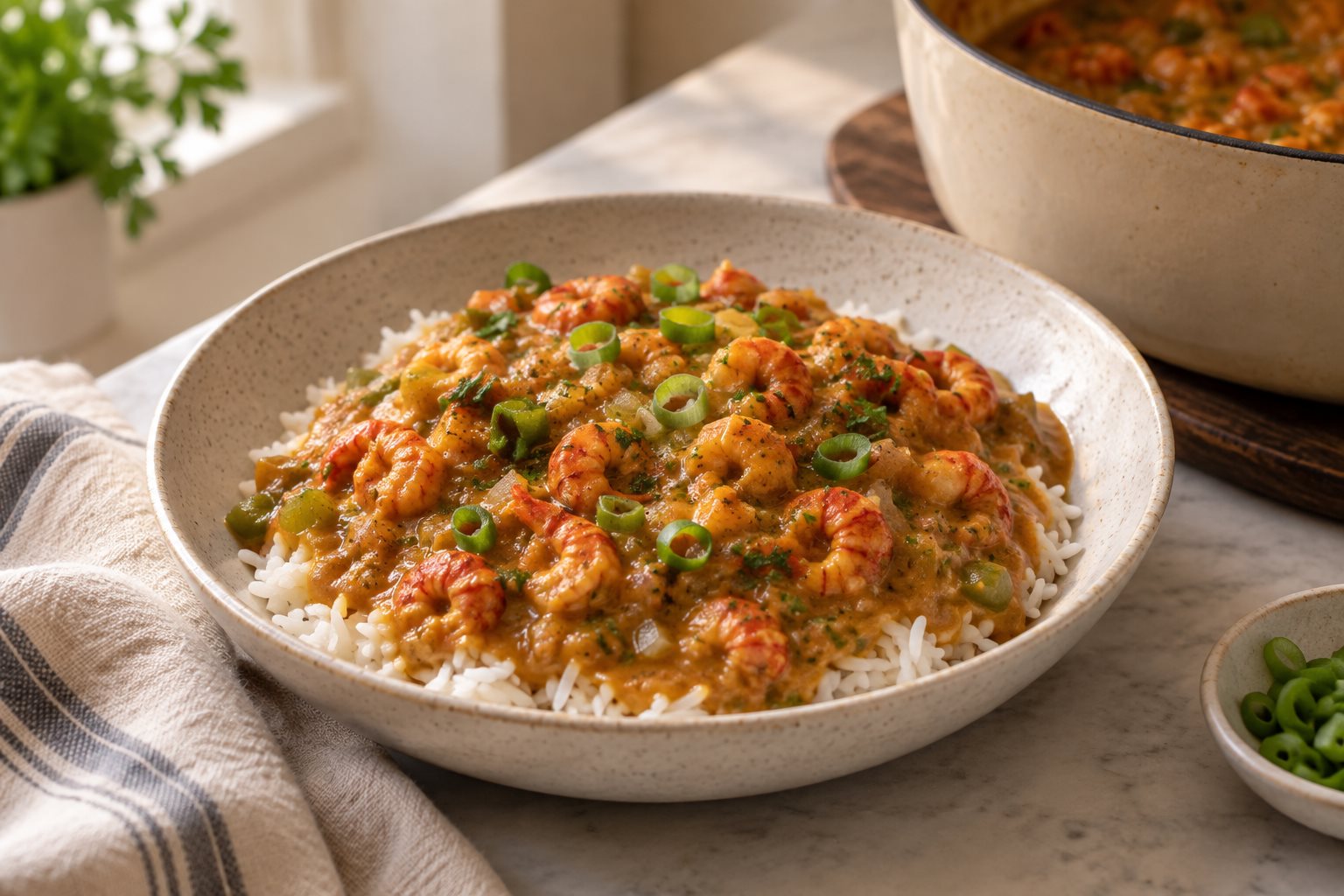
The colour comes out of the crawfish fat, not out of a tomato or a dark roux; the sauce should coat the rice and hold its shape for a moment. AI-generated illustration.
Everything in the pot but the crawfish takes forty minutes, and the crawfish themselves take four.
This dish is younger than any book that could have printed it, and the best way to see that is to look for it in the book that should have. The Picayune's Creole Cook Book gives crawfish a section of its own and knows them intimately: boiled in a court-bouillon of herb bouquet, garlic, allspice and cloves until bright red; baked à la Créole, stuffed with livers and mushrooms and browned under crumbs; a curry with a border of rice; a crawfish salad; a crawfish bisque famous enough that the book calls it a dish fit for the table of a king; and a crawfish bush, a hundred of them hung round a goblet of celery and parsley tips as a table ornament. What is nowhere in the fourth edition or the sixth is an étouffée. The word itself is in the book — it sits over a chicken. Poularde Étouffée is the French name the Picayune gives to its Smothered Chicken, a bird laid on bacon, lemon, carrot and onion, covered closely and cooked three-quarters of an hour in its own liquor. The book smothers beefsteak, tongue, veal cutlets, sweetbreads, lamb breast, quail, onions and parsnips. It never once smothers a crawfish.
Where the dish does turn up is a long way from the New Orleans that book was written in. The earliest dated appearance in print that could be reached from here is a syndicated travel column by Edward Collier, printed in the Athens Banner-Herald of Georgia on 1 June 1958, describing the Magic Circle tour out of Baton Rouge through Opelousas and Lafayette: then you leave the beaten path for Breaux Bridge, and plan to be there at mealtime, for this French-speaking community is famed for a delicacy known as Crawfish Etouffee. That is Acadiana and the edge of the Atchafalaya basin, where the wild crawfish are caught, and not the Vieux Carré. The same newspaper archive carries the phrase again only in December 1984, when Paul Prudhomme's recipes went out across the country and brought a dark red-brown roux with them. Louisiana's own archives are shut to anyone working from a keyboard — the state digital library, LSU, Tulane and 64 Parishes all refused every request on 22 September 2026 — so the dating here rests on out-of-state papers and on federal and land-grant publications, which are open. No printed ancestor sets the quantities below; those were worked out for this page.
Why this version works
The fat in the head is the sauce. The bright orange stuff squeezed from crawfish heads is not fat in the ordinary sense. The LSU AgCenter identifies it as the hepatopancreas, an organ that works much like a liver, and its crawfish production manual calls it an important flavouring condiment in Louisiana cuisine, savoured for its distinctive rich flavour. It is also what makes the sauce orange: when the AgCenter prints a lower-fat version of this very dish and tells you to leave the crawfish fat out, it has to add a footnote saying that about two teaspoons of tomato paste will give the red colour you normally get from the crawfish fat. Buy tails packed with the fat and you need no tomato at all.
Smothering is a cooking method, not a name. Étouffer is to smother, and the Picayune's Poularde Étouffée shows what that meant in a Louisiana kitchen: a close lid, a low fire, and almost no added water, so the food cooks in the liquid it gives up. Three cups of chopped onion, celery and bell pepper under a lid for a quarter of an hour collapse into something closer to a sauce than to vegetables, and that is the body of the dish. Fried hard and fast in an open pan, they stay in pieces and the sauce stays thin.
Blond roux, and the extension service says why. The AgCenter draws the line between two dishes in one sentence: crawfish stew is similar to étouffée except that you begin with a roux, browning flour and fat. So this one does not brown it. Butter and flour cooked three or four minutes, to the colour of raw pastry, thickens two cups of stock and adds nothing else. Take it further and you have made the other dish, and the toasted flavour will bury a crawfish tail, which has very little of its own to fight with.
The tails are already cooked when you buy them. Peeled Louisiana tail meat is boiled whole and then hand-picked — all processing is by hand, the production manual notes — so the four minutes at the end of this recipe are for warming them through and letting the fat melt into the sauce, nothing more. Anything past that and they tighten into erasers. This is the one step in the dish where being late costs you more than being early.
Ingredient notes
Stock: shellfish stock if you have it, otherwise water, which is what the AgCenter's own printed version of the dish uses. If you peel your own crawfish, the heads and shells make the best stock there is for this — the 1984 syndicated version built one from crawfish heads and shells simmered at least four hours and preferably eight. Chicken stock works and tastes faintly of chicken; skip it and use water before you use a fish stock made from anything oily.
Butter: a stick of unsalted, and no substitute that behaves. The AgCenter is blunt that good Cajun cooks say you must use butter and crawfish fat in crawfish dishes to have a good flavour, and its own healthier rewrite of the dish swaps a quarter cup of polyunsaturated oil for the stick of butter and drops half a cup of crawfish fat, which is a fair description of what makes the original taste the way it does.
The trinity: onion, celery and green bell pepper, roughly two parts to one to one, all chopped fine enough to disappear. This is not a garnish and it is not a mirepoix that gets strained out; it is most of the volume of the finished sauce, so take the time to cut it small.
Crawfish tails: one-pound bags of cooked, peeled, deveined meat, bought with the fat left on. The AgCenter puts average tail meat yield at about 15 percent of live weight, so six to seven pounds of live crawfish make one pound of tails, and the two pounds here stand for something like twelve to fourteen pounds of crawfish and an afternoon of peeling. Louisiana's season runs December to June and peaks in March, April and May. Note that fat goes rancid in frozen meat in as little as two to six months, so a bag that smells sharp rather than sweet is past it, and that less than a tenth of the Louisiana crop is now peeled for meat at all — the manual records the state's licensed processors falling from more than a hundred to the low thirties under competition from imported Chinese crawfish, so check where a bag came from.
Step by step
Season the tails and leave them. Tip the crawfish tails into a bowl with their liquid and fat, season with 1 teaspoon of the salt, the black pepper and the cayenne, turn them over once and set them aside on the counter while you cook everything else.
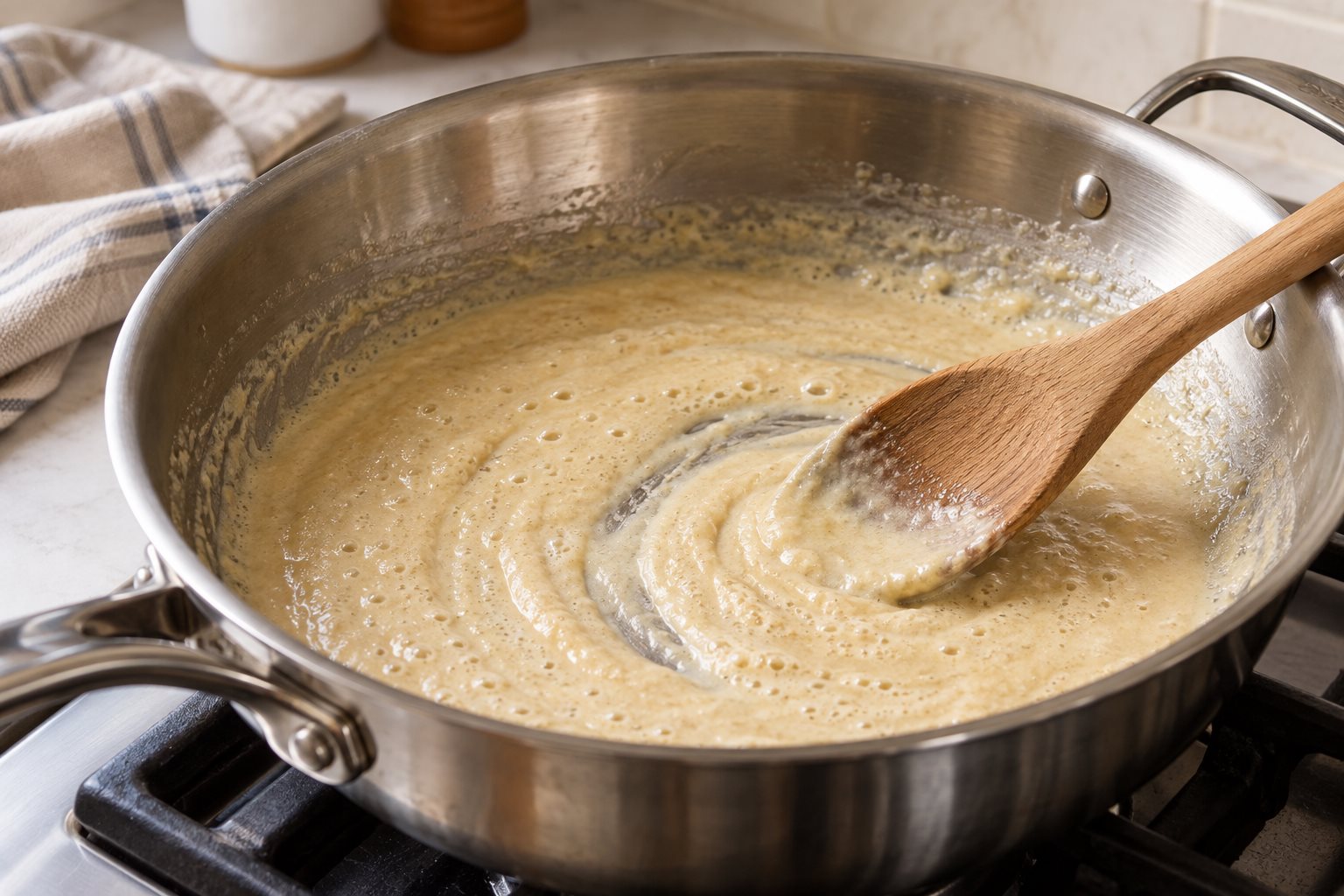
Make a blond roux. Melt the butter in a wide heavy pot or deep skillet over medium heat, whisk in the flour, and cook 3 to 4 minutes, stirring the whole time. It should stay the colour of raw pastry and smell like a biscuit in the oven. The moment it goes tan you have gone too far for this dish.
Keep the roux pale and blond; it should not turn tan before the vegetables go in. AI-generated illustration.
Smother the vegetables. Add the onion, celery and bell pepper all at once and stir them through the roux. Turn the heat to low, cover the pot, and cook 12 to 15 minutes, lifting the lid to stir every few minutes. They should collapse, go translucent and give up enough water to loosen the pot. Add the garlic and cook 1 minute uncovered.
Build the sauce. Pour in the stock a ladleful at a time, stirring each one smooth before the next goes in. Bring it to a bare simmer and hold it there 10 minutes uncovered, until the raw flour taste is gone and the sauce coats the back of a spoon without being thick enough to mound.
Add the crawfish. Stir in the tails with every drop of their liquid and fat. Keep the heat low enough that the surface only shivers — it must not boil — and cook 3 to 5 minutes, until the sauce has taken the orange colour of the fat and the tails are hot through.
Finish off the heat. Take the pot off the fire and stir in the green onions, the parsley and the Worcestershire. Taste and add the remaining salt if it needs it. Put the lid on and leave it 10 minutes before serving; the flavours settle and the sauce tightens slightly. Serve over rice boiled separately.
A sauce that separates into butter and liquid has been cooked too hard after the crawfish went in. Pull it off the heat, add two tablespoons of stock or water, and shake the pan in a back-and-forth motion rather than stirring it — that is the fix the 1984 newspaper version prints, and it works. Too thin, and a further five minutes at a bare simmer before the crawfish go in will do it; too thick, and stock loosens it. Tails boiled until they squeak cannot be brought back, which is why they go in last and off a hard heat.
Storage and make-ahead
Refrigerated, it keeps 3 days and is better on the second — the AgCenter says outright that the flavour is often better if étouffée is made the day before and cooled in shallow containers. Reheat it gently and never at a boil, or the tails toughen on the second pass.
It freezes well for 3 months in an airtight container with half an inch of headspace, which is the extension service's own advice for this dish. Freeze the étouffée alone and cook fresh rice on the day; rice frozen in sauce thaws to paste.
What to serve with it
Rice, cooked separately and kept in its own dish, and French bread for the sauce left in the bowl. Nothing else is needed and most things get in the way.
Something sharp alongside cuts a stick of butter: cucumbers in vinegar, or a plain green salad with a lot of lemon. Cold beer rather than wine, and hot sauce at the table for anyone who wants the dish hotter than the cayenne in it.
From the recipe box / Louisiana
Crawfish Étouffée
Peeled crawfish tails and the orange fat from their heads smothered in butter and onion, thickened with flour cooked pale rather than brown, and spooned over rice.
Prep
20 min
Cook
35 min
Total
55 min
Serves
6
Calories
420 per serving
Ingredients
Scale
Instructions
Season the crawfish tails and their liquid with 1 teaspoon salt, the black pepper and the cayenne, and set aside.
Melt the butter in a wide heavy pot over medium heat, whisk in the flour and cook 3–4 minutes, stirring, keeping it the colour of raw pastry.
Add the onion, celery and bell pepper, cover, and cook on low 12–15 minutes until collapsed and translucent, stirring every few minutes; add the garlic and cook 1 minute more.
Stir in the stock a ladleful at a time and simmer uncovered 10 minutes, until the sauce coats a spoon.
Add the crawfish with all their fat and liquid and cook 3–5 minutes over low heat without letting it boil, until the sauce turns orange.
Off the heat, stir in the green onions, parsley and Worcestershire, correct the salt, cover and rest 10 minutes. Serve over separately boiled rice.
Nutrition
Fat
18 g (10 g saturated)
Sodium
580 mg
Protein
29 g
Serving
1 cup étouffée over ½ cup rice
Calories
420
Cholesterol
245 mg
Carbohydrates
31 g (4 g sugar, 2 g fiber)
Nutrition is an estimate calculated from the listed ingredients and is provided as
a courtesy, not as dietary advice.
Questions readers ask
Can I use shrimp instead?
Yes, and the extension service says the substitution runs both ways — crawfish can stand in for shrimp in most recipes. Use a pound and a half of peeled raw shrimp, add them at the same point, and give them 4 to 6 minutes rather than 3 to 5, since they go in raw. What you lose is the head fat, so stir in two teaspoons of tomato paste with the stock for colour, which is the AgCenter's own substitute.
Is this a New Orleans dish?
The record reachable from here says no. The New Orleans book that catalogues Creole crawfish cookery in detail has six ways with crawfish and no étouffée among them, and the earliest dated mention found, on 1 June 1958, places the dish in Breaux Bridge, a French-speaking town on the western edge of the Atchafalaya basin where the wild crawfish are caught. It reached the rest of the country through restaurant cooking in the 1980s, which is also when a roux started appearing in printed versions of it.
Should there be a dark roux in it?
Not in this dish. The LSU AgCenter separates the two by exactly that: crawfish stew is similar to étouffée except that you begin with a roux, browning flour and fat. A dark roux is the whole character of a gumbo and it will flatten a crawfish tail. If what you want is the browned version, make it and call it a stew.
My tails came with no fat on them. What now?
Meat can be ordered with the fat washed off because it keeps longer that way, and imported bags often arrive that way too. Two teaspoons of tomato paste added with the stock will give you the colour, per the AgCenter note, and an extra tablespoon of butter at the end will give back some of the richness. It will not taste the same, and the difference is the point of buying fat-on meat when you can.