American cooking Recipes & regional stories

Skillet & Sage

A culinary journey through the fifty states

The regional table / Delaware

Crab Imperial, Bound with a Cooked Sauce Instead of Mayonnaise
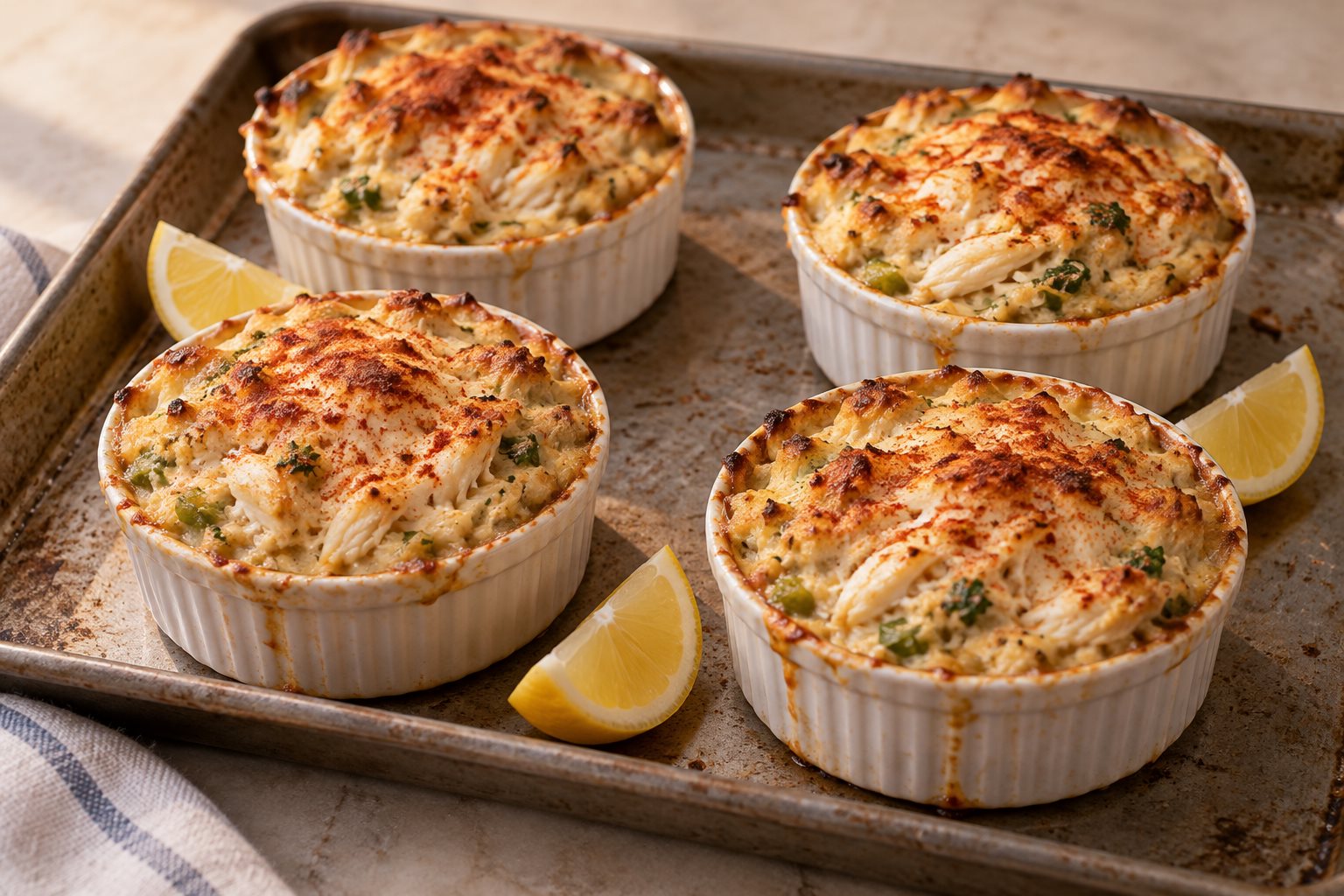
Four shallow ramekins of baked crab imperial on a sheet pan, the pale tops browned in patches and dusted with paprika, lemon wedges alongside
The edge should bubble and the top should brown in patches. A ring of clear oil around the rim means the binder was mayonnaise and the oven was too hot for it. AI-generated illustration.

Nothing in this dish gets cooked except the sauce, which is the only thing standing between a pound of crab and a puddle.

The earliest printing of the name I can reach comes from neither a cookbook nor a crab house, and not from Delaware. It is an editorial in the Omaha Daily Bee of 24 August 1908, headed Caught With the Goods On, having fun at the expense of Dr. H. W. Wiley, chief chemist of the Department of Agriculture, who had spent years warning the public off rich food — he had found deadly germs in the lobster, placed ice cream under the ban, and put pie in the list of pestilences — and was then discovered in a Washington restaurant on a blisteringly hot evening doing full justice to two imperial crabs, a porterhouse steak with mushrooms, a special salad, and a quart of musty ale. Then comes the sentence that matters here. It should be explained, the Bee tells its Nebraska readers, that the Imperial crab is peculiar to Washington: it is almost as large as a lobster, and one of them is usually looked upon as sufficient to disarrange the digestive powers of a fair-sized dinner party. The writer has plainly never seen one and thinks it is a species. Three years later the same joke went round the country as a syndicated column, and the phrase travelled with it untranslated — two imperial crabs, one large steak and trimmings, a special salad and several mugs of musty ale — in the Yorkville Enquirer of South Carolina on 18 July 1911, the Griffin Daily News and Sun of Georgia on 25 July, and The Citizen of Pennsylvania on 2 August. Not one of them explains the word either.

What that word is doing can be seen better from where it is absent. Jessup Whitehead's The Steward's Handbook and Guide to Party Catering of 1889 is the American caterer's dictionary of the period, and its CRAB entry runs through stuffed crabs, buttered crab, hot crab, crabs à l'américaine, crab pie à la Guernsey and even crab sausages out of Apicius. The stuffed crab is our dish already, forty years before anyone calls it imperial: crabs pulled open, back shells saved whole, all the meat collected and chopped fine, and then a thick sauce made by simmering chopped onion in butter, adding flour, then milk, salt, white and red pepper, yolks, minced parsley, lemon juice, and the crab-meat; shells filled with the mixture; bread crumbs on top; baked. Whitehead uses the word imperial elsewhere — a Sorbet à l'Impérial, a Supreme of Chicken à l'Impérial, an Imperial Pudding, an Imperial Crown for folding a napkin — and never once beside a crab. Charles Ranhofer's The Epicurean of 1894, the Delmonico's book, is the same: Imperial timbales, lamb cutlets Imperial, Imperial salad, a garnishing of artichoke bottoms Imperial, Imperial rice pudding, Imperial punch, and no crab at all. Both of his savoury Imperials, as it happens, are truffles bound with mayonnaise. Maryland's own printed record agrees. Mrs. Charles H. Gibson's Maryland and Virginia Cook Book of 1894 indexes Ratcliffe crab soup, crab soup, crab cakes, boiled crabs, soft crabs, devilled crabs, crab croquettes and crab salad; The Church Cook Book, published in Baltimore by Williams & Wilkins in 1908 and deposited for copyright that November, prints crab soup, deviled crabs and soft shell crabs. Neither book contains the word imperial anywhere. So the dish is older than its name, and the name looks like something written on a menu rather than something a family said at home. Whether Delaware can add anything to that I cannot tell you, and I would rather say so than guess: there is no digitised Delmarva newspaper run in any archive that answers a request, the Library of Congress refuses automated searching outright, the Advantage community newspaper network holds no Delaware or Maryland town at all, and the University of Delaware's digital library would not answer. The two dated recipes I could actually open are post-war, they come from outside the region, and they disagree about the one thing that matters. Lancaster Farming of 24 August 1956 prints Imperial Crab as one pound of backfin crab, a good sized tablespoon of capers plus some juice, salt and pepper, three or four dashes of red pepper and one-half cup of mayonnaise, mixed gently, divided into four individual casseroles, sprinkled with dry bread crumbs, dotted with butter and baked twenty minutes in a 325-degree oven. The Houston Home Journal of Perry, Georgia, on 25 July 1968 prints an Imperial Crab that begins by simmering chopped onion and green pepper in butter and binds its pound of lump with four tablespoons of medium white sauce, Worcestershire, parsley, Tabasco and sherry, stuffed in crab shells or ramekins, sprinkled with Parmesan and baked at 350 degrees for twelve minutes. Mayonnaise against a cooked sauce. The quantities below are worked out for this page on the 1968 side of that argument, which is also Whitehead's side, and the reason why is the whole of the next section.

Why this version works

The salt goes in after the sauce thickens. Meuser tested this directly and her conclusion is blunt: white sauce is curdled when the salt is added before cooking, due to an acid reaction, and the sauce comes out thinner as well, because some of the starch is hydrolysed into a soluble compound. Salted after thickening, she found the same sauce smoother, thicker and better flavoured. It costs nothing to wait, so wait.

A thick sauce, because the crab will thin it. Mary Louise Meuser's 1921 thesis for Kansas State Agricultural College, published in 1922 as Factors Determining the Quality of White Sauce in Large Quantity Cooking, sorts white sauce into four grades by what it is for: thin for soups, medium used in creamed dishes, thick used in scalloped dishes and souffles, very thick for croquettes. Her thick sauce is three tablespoons of fat and three of flour to a cup of milk, and that is what is below. A pound of picked crab sheds a surprising amount of water in fifteen minutes of oven heat, so you start one grade stiffer than you want to finish.

The binder is cooked starch, not a raw emulsion. Mayonnaise is defined by the federal standard of identity at 21 CFR 169.140 as an emulsified semisolid food prepared from vegetable oil and an egg yolk-containing ingredient, and it contains not less than 65 percent by weight of vegetable oil. Two thirds of that jar is oil held in suspension by yolk. Put it in an oven and the yolk proteins set, the thing holding the suspension stops holding it, and the oil comes out and pools. A flour-and-milk sauce fails in the opposite direction: its starch granules have already swollen and burst in the pan, and what they leave behind is a mesh that grips water and does not separate when it gets hot again.

Mayonnaise belongs on top, where breaking is the point. Brushed over the filling it does exactly what it does badly inside — the emulsion splits, oil rises to the surface, and a thin film of oil over a warm protein is the fastest browning you can arrange without a broiler. Half a tablespoon a ramekin colours the top in fifteen minutes. Half a cup stirred through the middle leaves you eating crab in oil.
Ingredient notes

Crab: a pound of lump or backfin, refrigerated rather than frozen, fills four ramekins generously. Tip it into a sieve and let it drain for ten minutes while you make the sauce — whatever liquid comes out now is liquid that will not be loosening your sauce in the oven. Pick it over for shell with your fingertips and keep the pieces whole.

Sherry: one tablespoon of a dry sherry, stirred in off the heat with the yolk. Avoid anything labelled cooking sherry, which is salted, and remember that you have deliberately held the salt back until the sauce is made.

Mayonnaise: two tablespoons, full fat, and only for the tops. A low-fat jar has had some of that 65 percent oil replaced by water and starch, which browns poorly and slides off. Sweet salad dressing of the sandwich-spread kind is a different food and tastes of it here.

Milk and flour: whole milk, and plain all-purpose flour. The proportion is the argument, not the brand: three tablespoons of each to one cup of milk gives Meuser's thick sauce, which holds a spoon-track on the surface for a second before it closes. If it pours off the spoon in a sheet, it is too thin to carry a pound of crab.

Step by step

  1. Drain the crab and heat the oven. Set the crab in a sieve over a bowl and leave it to drain while you work, picking through it for shell. Heat the oven to 375°F and set four cleaned crab shells or 6-ounce ramekins on a sheet pan.
  2. Sweat the onion and pepper. Melt the butter in a small saucepan over medium-low heat and cook the onion and green pepper gently for 4 minutes, until soft and not coloured. This is Whitehead's first move in 1889 and it has not been improved on.
  3. Make the sauce thick. Stir in the flour and cook it for 2 minutes, stirring, until it smells nutty rather than raw. Add the milk a splash at a time, stirring each addition smooth before the next, then simmer 3 to 4 minutes until it is stiff enough to hold the track of the spoon. Only now stir in the salt, white pepper and cayenne.
  4. Enrich it off the heat. Take the pan off the burner and let it stop steaming, about 2 minutes. Beat in the egg yolk, then the Worcestershire, hot sauce, lemon juice, sherry and parsley. The yolk sets into the starch mesh rather than into fat, which is why it thickens the sauce here instead of granulating in it.
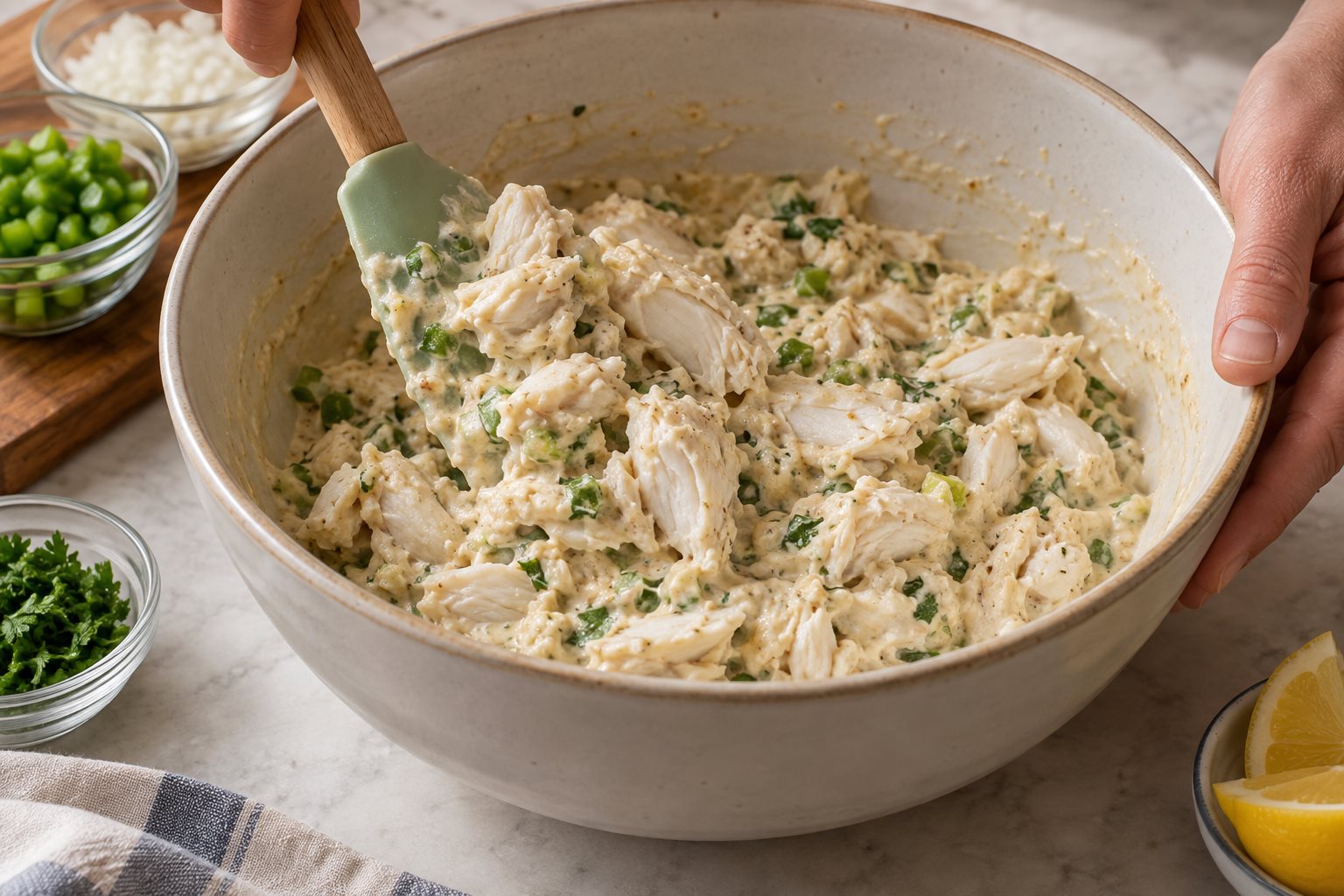
  5. Fold in the crab. Tip the drained crab into the sauce and fold with a rubber spatula, six or seven strokes, turning the bowl and stopping while whole lumps are still visible. The mixture should mound on a spoon.
    Large lumps of crab being gently folded into thick cooked sauce with green pepper and parsley.
    Fold gently and stop while whole lumps of crab are still visible. AI-generated illustration.
  6. Fill, glaze and bake. Divide between the shells or ramekins without packing it down. Brush the tops with the mayonnaise, dust with paprika, and bake 15 to 18 minutes, until the edges bubble and the tops are browned in patches. Rest 5 minutes before serving with lemon.
A ring of clear oil around the rim means fat has come out of suspension: the oven was too hot, or there was more mayonnaise in the mixture than on it. Blot it with the corner of a paper towel, turn the oven down 25 degrees and finish. A watery pool instead means the crab went in undrained — pour it off, and next time give the sieve its ten minutes. If the sauce turned grainy before the crab ever met it, you either salted it before it thickened or let it boil after the yolk went in; start the sauce again, since nothing folded into a broken one will save it.

Storage and make-ahead

Filled, unbaked ramekins keep 1 day covered in the fridge and go into the oven straight from cold with 4 minutes added. This is the one real advantage of the cooked-sauce version: a starch-bound filling sits overnight without separating, which a mayonnaise one does not.

Baked, it keeps 2 days refrigerated and reheats covered at 325°F for 10 minutes. Do not freeze it. Starch sauces weep on thawing as the granules retrograde and squeeze out the water they were holding, and the crab has now been cooked twice already.

What to serve with it

Keep everything else plain and acidic, because the dish is already fat, starch and protein in one ramekin: sliced tomatoes with salt, a sharp vinegar slaw, asparagus with lemon, or nothing at all but the lemon wedge and a piece of toast to scrape the shell out with. A dry sherry or a cold, hard white wine works better beside it than beer does.

Four shallow ramekins of baked crab imperial on a sheet pan, the pale tops browned in patches and dusted with paprika, lemon wedges alongside

From the recipe box / Delaware

Crab Imperial, Bound with a Cooked Sauce Instead of Mayonnaise

A pound of lump crab folded into a thick cooked milk sauce, filled into shells or ramekins, glazed with mayonnaise and baked until the edges bubble and the top browns in patches.

Prep
20 min
Cook
25 min
Total
45 min
Serves
4
Calories
320 per serving

Ingredients

Scale

Instructions

  1. Drain the crab in a sieve and pick it over for shell. Heat the oven to 375°F and set four crab shells or 6-ounce ramekins on a sheet pan.
  2. Cook the onion and green pepper gently in the butter for 4 minutes, without colouring them.
  3. Stir in the flour, cook 2 minutes, then add the milk a splash at a time and simmer 3 to 4 minutes to a thick sauce. Season with the salt, white pepper and cayenne now, not earlier.
  4. Off the heat and after 2 minutes, beat in the egg yolk, then the Worcestershire, hot sauce, lemon juice, sherry and parsley.
  5. Fold in the drained crab, six or seven strokes, leaving the lumps whole.
  6. Fill the shells, brush the tops with mayonnaise, dust with paprika and bake 15 to 18 minutes until bubbling and browned in patches. Rest 5 minutes and serve with lemon.

Nutrition

Fat19 g (8 g saturated)
Sodium700 mg
Protein23 g
Serving1 filled shell or ramekin
Calories320
Cholesterol170 mg
Carbohydrates9 g (3 g sugar, 0 g fiber)

Nutrition is an estimate calculated from the listed ingredients and is provided as a courtesy, not as dietary advice.

Questions readers ask

Shells or ramekins?

Either. The 1968 Georgia printing says crab shells or ramekins in one breath, and the 1889 caterer's version fills the cleaned back shells that used to be shipped with the picked meat. Shells look better and hold slightly less; 6-ounce ramekins are easier to fill evenly and easier to wash. Scallop shells work too.

What does imperial actually mean here?

Nobody has produced a document that says. The earliest reachable printing of the phrase I could find is an Omaha newspaper of 1908 telling its readers that the Imperial crab is peculiar to Washington, and the two great American menu dictionaries of the 1880s and 1890s — Whitehead and Ranhofer — use imperial freely as a menu flourish on puddings, punches, timbales and cutlets while never attaching it to a crab. The honest description is that it is a restaurant word of the Washington and Chesapeake trade that later spread everywhere, not a family word with a story behind it.

Can I make the mayonnaise version instead?

You can, and a dated printing exists for it: Lancaster Farming of 24 August 1956, a pound of backfin with capers, red pepper and half a cup of mayonnaise, crumbed, dotted with butter and baked twenty minutes at 325 degrees. Note the low oven and the short time — that recipe works because it never pushes the emulsion hard. Raise the heat or lengthen the bake and you will see oil at the rim.

Is this the same thing as the frozen crab imperial?

Only by name. By August 1963 Georgia grocery advertisements were selling Crab Imperial as a boil-in-bag frozen food at 59 cents a package, alongside shrimp creole, which is roughly when the word stops meaning anything about how the dish is made. What is below is the baked version the name started out on.