The regional table / Arkansas
Chocolate Gravy over Biscuits
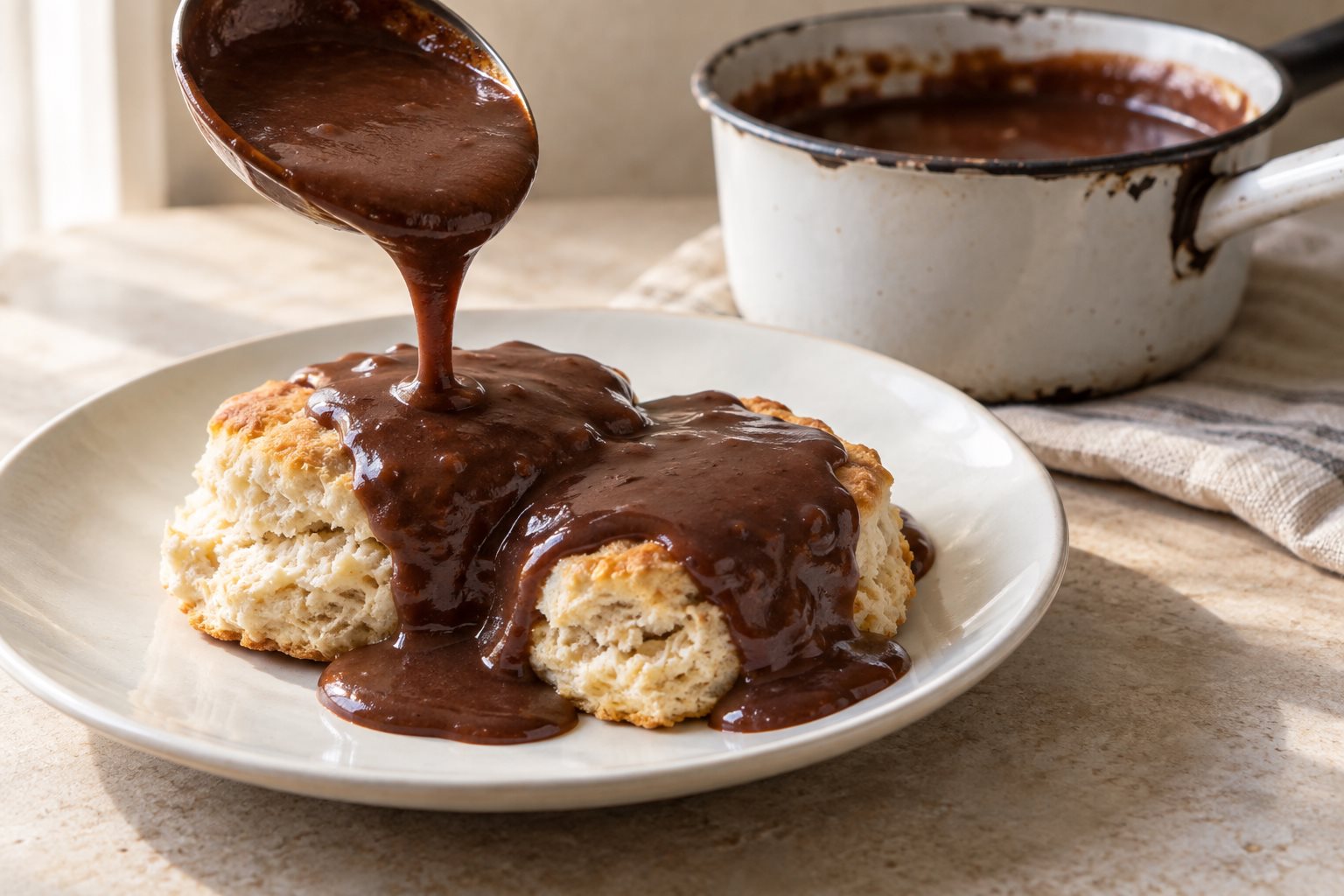
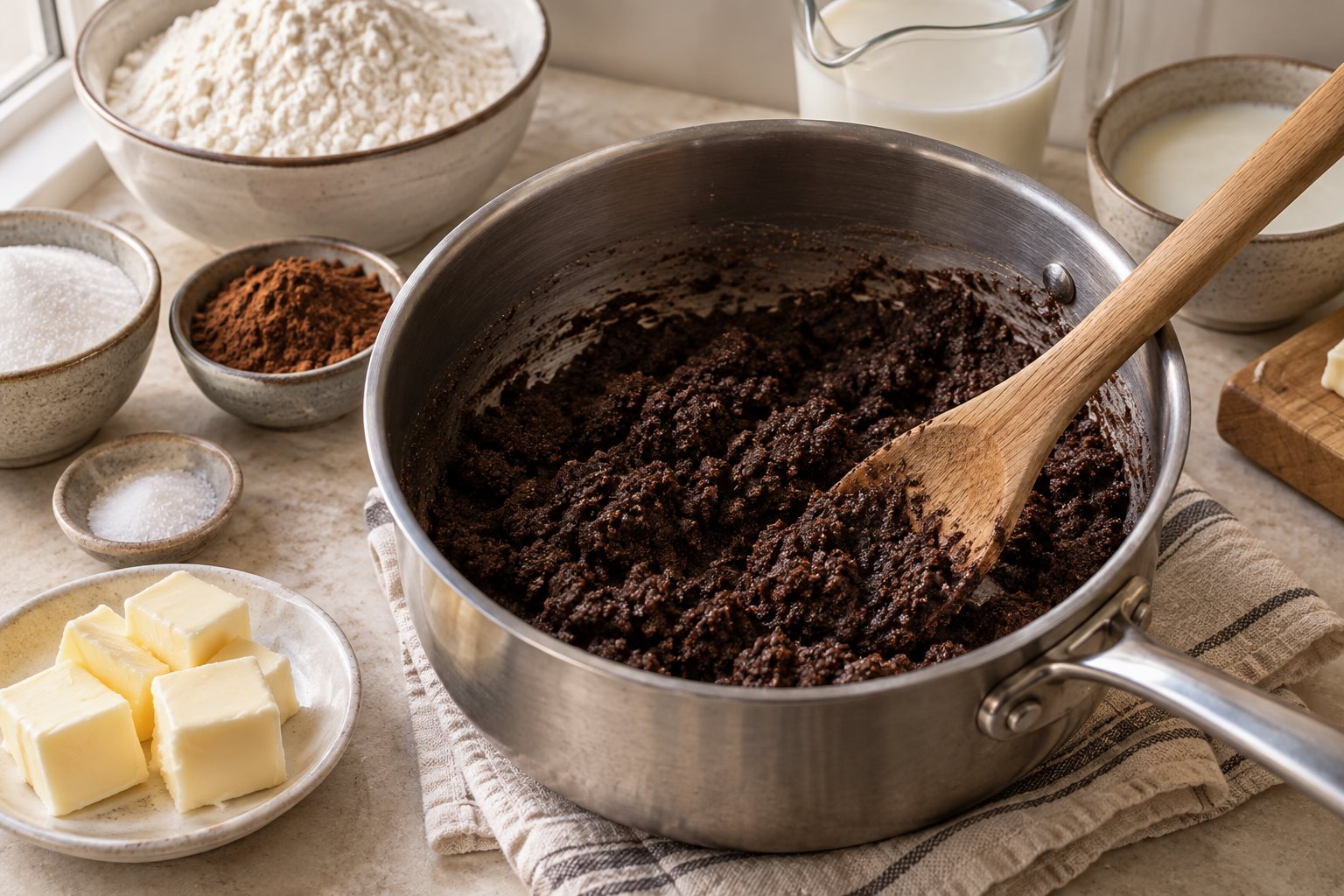
It is a roux. Butter, flour, liquid — the same three moves as any gravy on any stove in the South. The only difference is that a third of a cup of cocoa goes in with the flour.
Chocolate gravy belongs to the uplands rather than to the South at large: the Arkansas Ozarks, southern Missouri, eastern Oklahoma and the southern Appalachians, and not much beyond them. That is easier to show than to assert. The State Historical Society of Missouri holds an oral history that catches the dish right at the edge of its country. On 18 November 1988, for his radio programme The Stories They Tell, Marshall Dial interviewed Rilda Funk at Malden, in Dunklin County in the Missouri Bootheel, and asked her what children had brought to the rural schools — she had finished high school in 1930 and taught afterwards. She remembered one family with two things nobody else had. "Chocolate rolls," she said, "and another thing they had was chocolate gravy for breakfast. I'd never heard of that before." Dial answered: "No, I never heard of that. I wonder how you would make chocolate gravy." Two lifelong southeast Missourians on tape in 1988, agreeing that the dish was strange to them. The name is nearly as scarce in print. It does not occur once in the entire digitised run of Nebraska's newspapers. Georgia's state archive, which indexes reprints from all over the country, returns seven pages for it and the earliest is from 2008. The Butler Center's Arkansas collections at the Central Arkansas Library System hold the phrase only as the title of a modern book. And Arkansas's own newspapers are shut to a script: the community-newspaper network that covers small towns across twenty-odd states holds exactly one Arkansas title in its whole directory, a Methodist conference journal out of Arkadelphia.
So the dish cannot be dated by its name. It can be dated by its ingredient, because the interesting question is when cocoa became cheap enough for a poor upland breakfast, and grocery advertisements answer that precisely. Cocoa has been on the federal books from the start — an act of July 1794, printed in the Augusta Chronicle of 26 July that year, laid an additional duty "On cocoa, per pound, two cents." By January 1878 Walter Baker & Co. were advertising Breakfast Cocoa, in tins, in weeklies as small as the Ellijay Courier up in the north Georgia mountains, and the advertisement closes by telling readers that if their grocer has not the goods, to ask him to send for them — which is an admission that the country grocer did not stock it. When it did reach the country counter it was dear. J. A. McCurry of Hartwell, Georgia, priced his Christmas stock in the Hartwell Sun of 23 December 1904: a half-pound box of Baker's Cocoa at thirty cents, a half-pound cake of Baker's Chocolate at twenty-five. Cocoa cost more than chocolate, weight for weight, and it still did a decade later — the Augusta Herald of 29 November 1914 lists Walter Baker's Chocolate at 35 cents a pound and Walter Baker's Cocoa at 40. The break comes with bulk. In the Augusta Herald of 29 December 1916 a grocer's Saturday list reads "Finest Bulk Cocoa, lb.. 22c" directly under a pound can of Maxwell House coffee at 30 cents, with twenty-five pounds of sugar at $1.89. Cocoa scooped loose out of a barrel, cheaper than coffee: that is the price at which a family pours it over biscuits on a weekday morning. No old book holds the measurements, so the ones below were worked out for this page.
Why this version works
Thin on purpose. This gravy has to run into a torn biscuit, not sit on it, and it goes on thickening for several minutes off the heat and again as it cools. Pull it one stage looser than you want to eat it — a spoon drawn through it should close over slowly rather than leave a clean track.
It is a roux, so treat it as one. Fat, then flour, then liquid in stages. Cooking the flour in the butter for a minute before any milk goes in hydrates the starch evenly and burns off the raw cereal taste that ruins a rushed gravy. Everything that is true of sausage gravy is true here: the thickening happens as the starch granules swell near the simmer, not at the moment you stop stirring.
The sugar is part of the dry mix. Whisking the sugar together with the cocoa and flour before anything is heated puts hard crystals between the cocoa particles and keeps them apart mechanically. It is the oldest anti-lump trick there is and it costs nothing. Sugar added at the end, into a hot thickened gravy, also thins it back out again by pulling water away from the starch.
The cocoa goes in with the flour, not into the milk. Cocoa is not a pure powder. The federal standard of identity grades it by what is left in it — breakfast cocoa keeps at least 22 percent cacao fat, plain cocoa between 10 and 22 percent, lowfat cocoa under 10 — and it carries its own starch besides. Dropped into hot milk it clumps instantly, because the fat on each particle refuses the water. Stirred into melted butter with the flour, every particle is coated before it ever meets liquid, and the gravy comes out smooth without a sieve.