American cooking Recipes & regional stories

Skillet & Sage

A culinary journey through the fifty states

The regional table / Delaware

Chicken and Slippery Dumplings, Rolled Flat and Boiled in the Broth
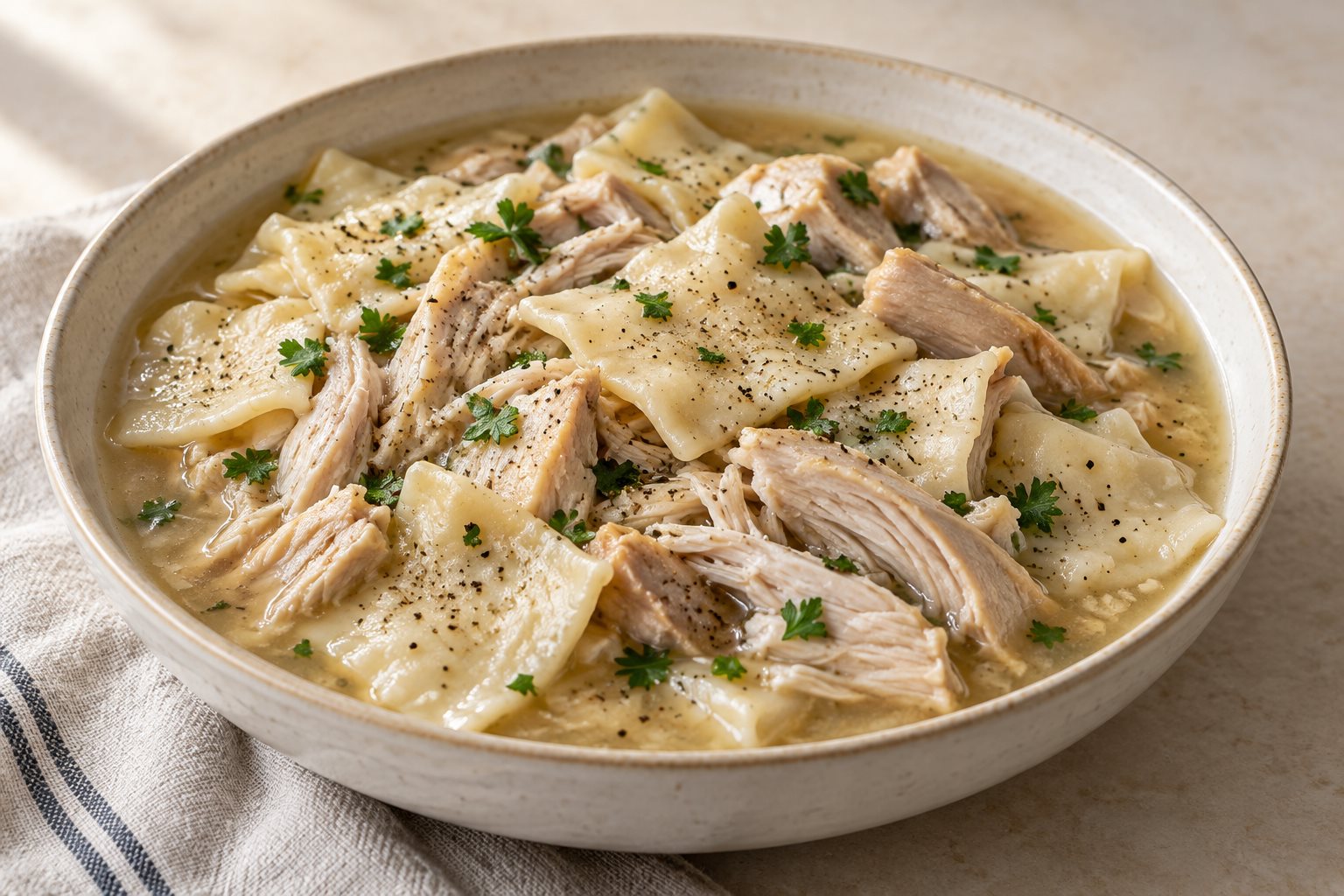
A wide bowl of chicken and flat square dumplings in pale thickened broth, the squares overlapping and glossy, with black pepper and parsley over the top
The squares should lie flat and overlap each other, and the broth should coat the back of a spoon. Anything domed and fluffy in the bowl is the other dish. AI-generated illustration.

The whole argument is in the rolling pin: this dumpling is rolled flat, cut square and boiled in the broth, and it never sees a spoonful of baking powder.

The clearest statement of the difference I can point to was printed by a reader rather than a cookbook. On 2 October 1976 the recipe exchange column in Lancaster Farming carried a request from a man who had eaten the dish years before and could not find it written down: he had plenty of recipes for the biscuit type of dumpling served with chicken in most places, he said, but the slippery type were more like a thick noodle, chewy and delicious. Six weeks later, on 13 November, the answers ran. One of them is headed simply Slippery Dumplings and comes from Mrs. Frank Allen of Mardela Springs, in Wicomico County, Maryland, a few miles west of the Delaware line: two cups of flour, a pinch of salt, a tablespoon of shortening or lard, hot water enough to make the dough slightly sticky, rolled thin on a well floured board, cut in squares and dropped into the liquid with the pot stirred from the bottom so nothing sticks. No egg. No leavening. Her one piece of advice is that the more you work the dough the better the dumplings, which is the opposite of everything said about biscuit dough, and that is the point. Printed a few inches away in the same column is a Chicken and Dumplings from Felton, Pennsylvania, whose dough squares carry a teaspoon of baking powder, and a Spatzen or Slippery Dumplings from Allentown that is a thin batter sliced off a board into boiling water. One word, three different things, on one newspaper page.

The technique is far older than the name, and the mid-Atlantic books print it without ever using the word. Mrs. Rorer's Philadelphia Cook Book of 1886 has both shapes and keeps them apart without seeming to notice: her Stew of Beef with Dumplings sifts a heaping teaspoonful of baking powder into a pint of flour, drops the soft dough onto the meat by small spoonfuls and warns you not to uncover the saucepan while the dumplings are cooking, or they will fall immediately — while her Chicken Pot-pie rolls its paste into a thin sheet, cuts the trimmings into squares, layers them with the chicken and the potatoes and simmers the lot for an hour and a half. Raised and dropped on one page, flat and boiled on another. Closer to home the record thins out fast, and it is worth saying plainly how thin. The one pre-1930 Delmarva community cookbook I could reach is The Eastern Shore Cook Book of Maryland Recipes, compiled by the Epworth League of the Still Pond Methodist Episcopal Church in Kent County, published June 1916, revised December 1919, and printed in Wilmington, Delaware by Hubert A. Roop of 604 Market Street: it prints Drop Dumplings of egg, milk and baking powder dropped by the teaspoonful into hot gravy, Noodles rolled very thin and hung up to dry, and a bean soup that tells you to add drop dumplings or noodles — and not one slippery dumpling. The Trinity Parish Cook Book, put out by the Ladies' Parish Aid Society of Trinity Church in Wilmington in 1892, has no dumpling of any kind in it. Fifty Years in a Maryland Kitchen, 1881, never uses the word slippery at all, and its soup dumplings are dropped. The name itself I cannot find in print before the 1970s: it draws a blank in the Georgia, Nebraska and South Carolina newspaper archives, the Pennsylvania archive holds exactly three pages carrying it, and the Virginia end of the peninsula could not be tested because Virginia Chronicle refuses automated requests. What the Pennsylvania run does give is Delaware itself. On 8 September 1984 the same paper followed a British 4-H exchange visitor through a downstate stay in Sussex County, with the Murray family of Frankford, and listed what she had eaten: squash, pumpkin and blueberry pies, clams, and chicken and slippery dumplings, which were another hit. The quantities below are worked out for this page around Mrs. Allen's dough, which is the part that was written down.

Why this version works

Hot water in the dough. Hot water softens the flour and relaxes the dough enough to roll thin without springing back, which is why Mrs. Allen's recipe calls for it and why working the dough hard makes her dumplings better rather than tough. A cold-water dough fights the pin and shrinks on the board.

Rolled thin, cut square. An eighth of an inch is thin enough that the middle of the square is done at the same time as its edges, and wide enough that the pieces overlap in the bowl instead of dispersing. A square also costs nothing to cut: you roll, you run a knife across twice, and there is no rerolling of scraps.

No leavening in the dough. Baking powder is the entire difference between the two dishes. It inflates the dough into a wet biscuit that sits on the surface and must be steamed under a lid; leave it out and the square stays flat, cooks through in the liquid, and comes out dense and chewy rather than cakey.

Boiled in the broth, not in water. The loose flour on the squares washes into the pot and thickens it, so the broth finishes somewhere between soup and gravy with no roux and no slurry. That same starch is what makes the surface of a cooked dumpling slick — the name is a description of what your spoon runs over, not a compliment.
Ingredient notes

Lard: two tablespoons, or vegetable shortening, which is what the 1976 recipe offers as the alternative. Butter works but browns and softens the dough as you roll; the point of a solid fat here is a dough that stays workable on a floured board.

Flour: plain all-purpose, two cups. Do not reach for self-rising, which is flour with baking powder and salt already in it and will turn every square into a small dumpling of the wrong kind before you have noticed.

Chicken: a whole bird of about 4 pounds, cut into eight pieces, gives you both the meat and the broth in one pot, which is the only way this dish works. An older, tougher stewing hen is better still if you can find one; it wants another half hour of simmering and pays you back in a broth with body.

The broth: salt it properly before the dumplings go in and taste it again afterwards. Two cups of flour cooking in it will flatten the seasoning, and it is much easier to correct a pot of broth than a pot with dough already floating in it.

Step by step

  1. Stew the chicken. Put the chicken pieces, onion, celery, bay leaves, 1 tablespoon salt and the pepper in a large pot with 3 quarts of cold water. Bring it to a boil, skim, then hold it at a bare simmer for 1 hour, until the meat pulls away from the thigh bone.
  2. Strain and pull the meat. Lift the chicken out and strain the broth back into the pot, discarding the onion, celery and bay. When the pieces are cool enough to handle, pull the meat off in large pieces and discard the skin and bones. You want about 10 cups of broth in the pot; top it up with water if you are short.
  3. Make the dough. Rub the lard into the flour and fine salt with your fingertips until it disappears. Pour in about 3/4 cup of the hot broth and stir, then knead it on the counter for a good 2 minutes — this dough wants working, not coddling. It should be slightly sticky, not wet.
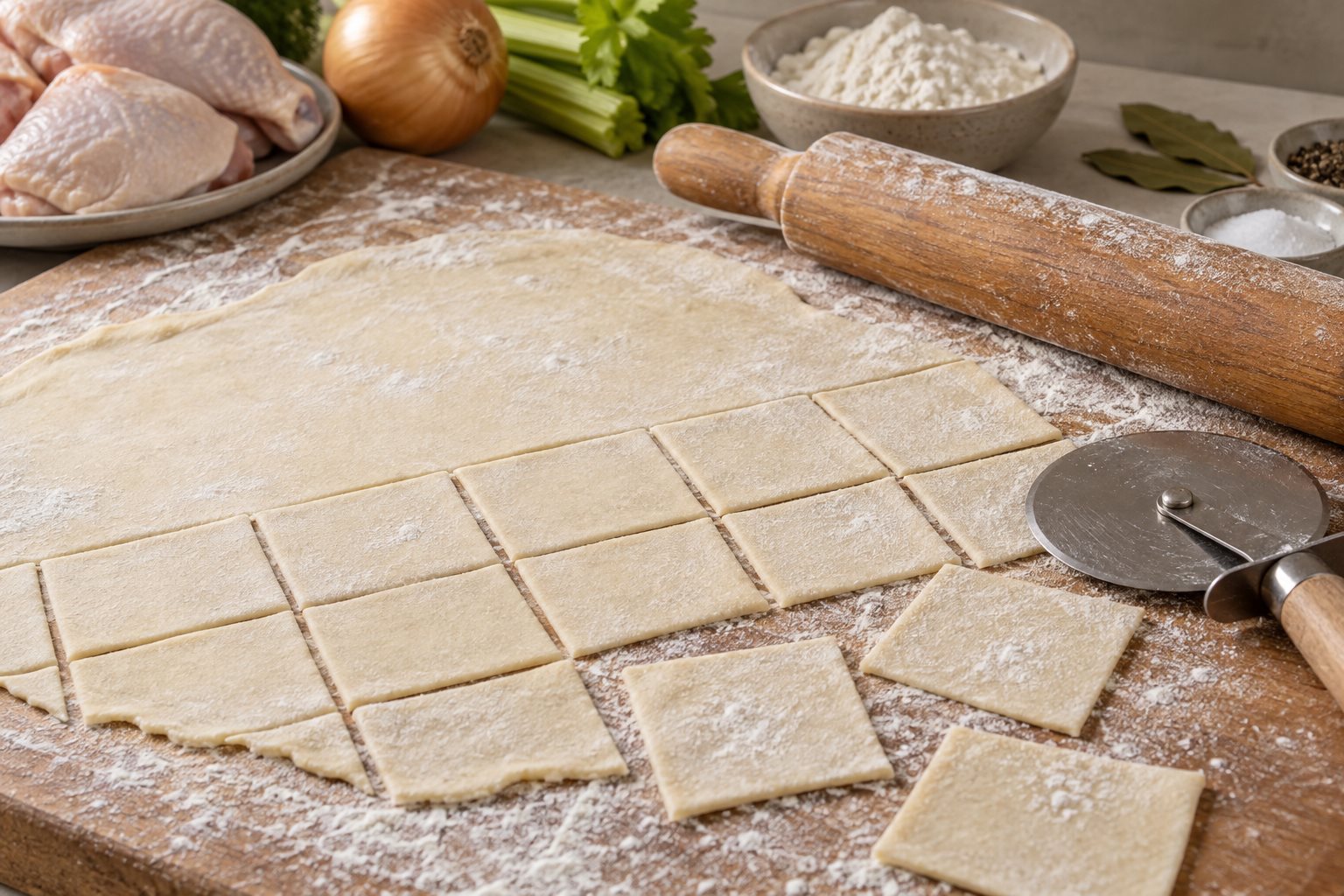
  4. Roll and cut. Flour the board well and roll the dough out to about 1/8 inch, as thin as you can keep it even. Let it sit 10 minutes to dry a little, then cut it into 2-inch squares with a knife or a pizza wheel and flour them lightly so they do not weld together.
    A thin sheet of dumpling dough cut into flat squares with a pizza wheel on a flour-dusted board.
    Roll the dough thin and cut it into flat squares before dropping them into the broth. AI-generated illustration.
  5. Boil the dumplings. Bring the broth back to a rolling boil and drop the squares in one at a time, stirring up from the bottom of the pot every few additions. Once they are all in, cook uncovered at a strong simmer for 20 minutes, stirring from the bottom every few minutes. The broth will thicken noticeably in the last five.
  6. Finish. Return the chicken to the pot, warm it through for 3 or 4 minutes, and taste for salt and pepper. Serve in wide bowls with parsley over the top.
If the pot has gone to paste, it was too thick a dough or too little broth: add hot water a cup at a time off the heat, stirring gently so you do not shred the squares, until the broth pours again. If the dumplings have fused into one sheet on the bottom, they went in too fast and unstirred — lift them out whole with a slotted spoon, cut them apart on a board, and return them for the last few minutes. And if they came out domed and fluffy, check the flour bag: that is self-rising flour, and what you have made is the other dish.

Storage and make-ahead

Leftovers keep 3 days refrigerated, and the dumplings go on drinking the broth as they sit, so expect to loosen them with half a cup of water or broth when you reheat. Warm them gently in a pot rather than a microwave, which boils the broth and leaves the squares cold.

Do not freeze the finished pot. The squares are mostly gelatinised starch and water and they thaw grainy. Uncooked squares, on the other hand, freeze well on a floured tray for a month and go into the boiling broth straight from frozen with 3 minutes added.

What to serve with it

This is a whole meal with nothing beside it, and the Delmarva way to eat it is with something sharp to cut the starch: stewed tomatoes, pickled beets, coleslaw, or green beans cooked long with a piece of bacon. Skip the bread — there is already a pound of flour in the bowl.

A wide bowl of chicken and flat square dumplings in pale thickened broth, the squares overlapping and glossy, with black pepper and parsley over the top

From the recipe box / Delaware

Chicken and Slippery Dumplings, Rolled Flat and Boiled in the Broth

A whole chicken simmered down to broth, then squares of unleavened dough rolled thin and boiled in that broth until the dumplings go slick and the pot thickens itself.

Prep
30 min
Cook
1 hr 45 min
Total
2 hr 15 min
Serves
6
Calories
470 per serving

Ingredients

Scale

Instructions

  1. Simmer the chicken, onion, celery, bay, 1 tablespoon salt and the pepper in 3 quarts water for 1 hour, skimming at the start.
  2. Lift out the chicken, strain the broth back into the pot, and pull the meat off the bones in large pieces. You want about 10 cups of broth.
  3. Rub the lard into the flour and fine salt, stir in about 3/4 cup hot broth, and knead 2 minutes to a slightly sticky dough.
  4. Roll out 1/8 inch thick on a well-floured board, rest 10 minutes, and cut into 2-inch squares.
  5. Return the broth to a rolling boil and add the squares one at a time, stirring up from the bottom. Boil uncovered 20 minutes.
  6. Stir the chicken back in, warm 3 minutes, correct the salt, and serve with parsley.

Nutrition

Fat19 g (6 g saturated)
Sodium820 mg
Protein41 g
Servingabout 1 1/2 cups with chicken
Calories470
Cholesterol130 mg
Carbohydrates33 g (1 g sugar, 1 g fiber)

Nutrition is an estimate calculated from the listed ingredients and is provided as a courtesy, not as dietary advice.

Questions readers ask

Can the dumplings be cut ahead?

Yes, and a little drying helps them hold their edges: roll, cut, and leave the squares on a floured tray for up to 2 hours at room temperature, or a day in the fridge under a cloth. One of the pot pie recipes in the same 1976 column tells you to let the rolled sheet dry a little before cutting, which is the same trick.

What actually makes a dumpling slippery?

Flat dough boiled in broth. The surface gelatinises and picks up the loose flour around it, so a cooked square is slick to the spoon and slightly slimy to the tooth in a way a biscuit dumpling never is. The 1976 reader who asked Lancaster Farming for the recipe described them as more like a thick noodle, which is the best short answer anyone has given.

Can I use baking powder or self-rising flour?

You can, and you will have made chicken and dumplings, which is a good dish and a different one. A teaspoon of baking powder in the dough — as in the Felton, Pennsylvania recipe printed alongside — puffs the squares, and they will want to be steamed under a lid rather than boiled uncovered.

Is this the same as Pennsylvania Dutch pot pie?

It is the same family, and the column that printed the Mardela Springs recipe said as much: most of the answers it received were what is commonly called Pennsylvania Dutch pot pie, squares of rolled dough boiled with the meat and potatoes. The differences are in detail rather than in kind — the Lancaster versions in that column put eggs in the dough and potatoes in the pot, and the Delmarva one does neither.