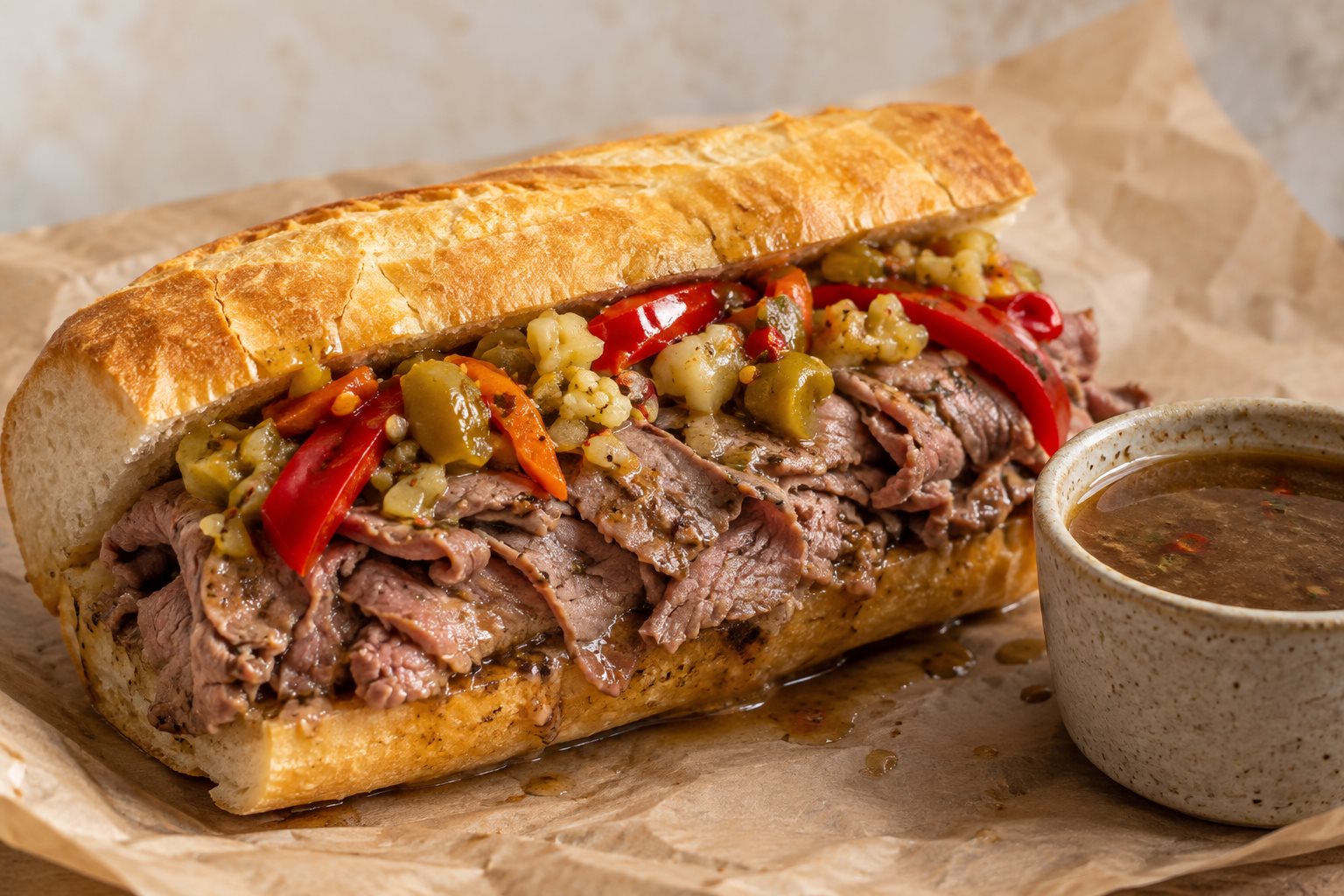
Everything that makes this sandwich work happens before the beef ever meets the bread: it is cooked rare on purpose, chilled until it is hard, and then cut so thin that a tough cut stops being tough.
This one is younger than the public domain, there is no old printed recipe behind it, and the quantities below were worked out for this page rather than copied from a document. What the record does hold is a dated absence. Nick Kindelsperger went through the Chicago Tribune archive for a piece published in January 2024 and could not find the words Italian beef in print until 28 June 1953, and then only in a three-line notice about a Villa Scalabrini benefit picnic in Northlake where, it said, Italian beef sausage sandwiches and spumoni would be served. Barsanti's Grill at 3404 Lincoln Avenue advertised delivery of it on 14 November 1954. The earliest printed recipe he could find is Mary Meade's of 26 May 1962, and its whole technique is one instruction: dip the bread in the stock, then lay the thin slices of beef on it. The New Parkette at 105th and Western was charging sixty cents for one on 28 July 1963. Every origin story for this sandwich is set in the 1920s and 1930s; the paper trail starts two decades later, and anybody who hands you a founding date has stopped checking.
The stories themselves point at a banquet trade rather than a restaurant. The Chicago Food Encyclopedia puts the roots in Italian American home cooking and specifically in the so-called peanut weddings of the 1920s on the Near West Side — receptions thrown on nothing, where a single roast had to reach forty or fifty people and the way you made it reach was to cut it thin enough to see through. That the phrase was still current forty years on is documented: the Chicago Italian American Organization advertised a fundraiser on 11 May 1979 promising an authentic 1940s Italian peanut wedding, and the beef sandwich heads the list of food. Who first sold one over a counter is contested and the claims do not agree. Many Chicagoans credit Pasquale Scala, whose catering worked those weddings and whose packing house later supplied most of the city's beef stands. Chris Pacelli, whose family runs Al's #1, told WTTW's David Hammond in July 2024 that his uncle Al came out of jail, needed a front for a bookmaking operation, and opened a charcoal-fired stand at Laflin and Harrison under the name Al's Barbecue. Mario Ferraro told the same reporter that his own parents were selling the sandwiches around 1934 or 1935 out of a Little Italy grocery, carrying them down to Fulton Market, five minutes' walk from Al's first address. Three claims, no documents, and this page crowns none of them.
Why this version works
Thin, and across the grain. Bulletin 1246 spends pages on grain, because grain is what the grader reads: fine-grained beef is smooth and velvety on the cut face, coarse fibre with thick tendinous connective tissue is what makes a cheap cut chew. The 1928 broadcast prescribed the standard cure for a less tender cut — heat, moisture and slow cooking. The Near West Side answered it the other way, cutting the fibres so short that there is nothing left to chew through. A sixteenth of an inch, across the grain, does more for a round than four hours of braising.
Rare, because it cooks twice. The beef goes into the juice again at the end, and anything that left the oven at medium leaves the juice grey and stringy. A USDA Bureau of Home Economics broadcast script of 23 January 1928, in which Lucy M. Alexander walked a listener through a meat market, put rare beef between 130 and 150°F. Pull this roast at 125°F and it lands inside that range after the second heating.
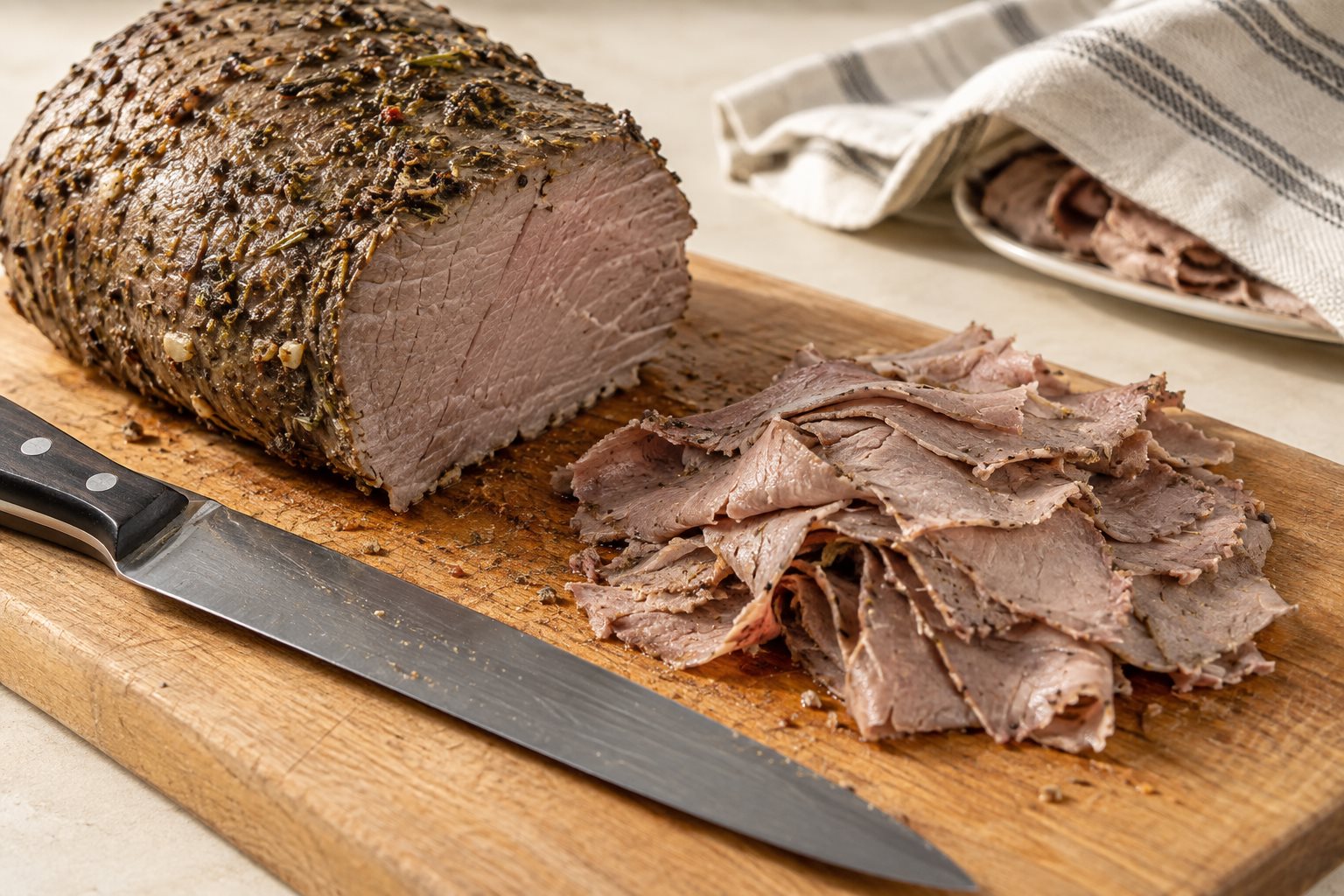
Chilled hard, because a slicer cannot cut a warm roast. The same 1924 bulletin describes the packers' chill rooms held at 34 to 38°F, into which carcasses went for 24 to 36 hours to let the animal heat escape and the meat firm up. Do the same thing to your roast. Warm beef drags and tears under a blade; cold, firm beef takes a clean sheet off the face of the cut. This is the single step most home versions skip and it is the one that decides the sandwich.
A lean round, and the federal grading book explains why. USDA Department Bulletin No. 1246, "Market Classes and Grades of Dressed Beef", published 13 August 1924 by W. C. Davis and C. V. Whalin of the Bureau of Agricultural Economics, describes what it calls the Chicago method of cutting and says the round comes to about 24 per cent of the side and is especially economical because of the large amount of lean meat and the relatively small percentage of fat and bone. That is the cut a banquet cook buys when the budget is nothing. It is also, the bulletin is clear, not a tender one.
Ingredient notes
Beef: a boneless top inside round or a sirloin tip, four pounds, trimmed of surface fat but left whole. Choice grade is right; Prime is wasted here, since the marbling you pay for renders into the juice rather than into the slices. Do not substitute chuck — it carries the connective tissue that thin slicing cannot fix.
Bread: a plain French roll with a thin crust and a close crumb, eight inches long. Anything airy dissolves the moment it meets the juice, and anything with a hard shell — a baguette, ciabatta — refuses to take the juice up at all and slides the beef out of the far end.
The juice: this is not a marinade and not a braising liquid. It is the roast's own drippings let down with beef stock and seasoned hard with oregano, garlic and two kinds of pepper, and its job is to be salty and aromatic enough that a sixteenth of an inch of beef picks up flavour in fifteen seconds.
Giardiniera: the oil-packed hot kind, coarsely chopped, not the vinegar-packed cocktail sort. Sweet roasted peppers are the other half of the Chicago choice and there is no wrong answer; a stand will give you both if you ask, which is how most of them are eaten.
Step by step
Season and rest. Rub the roast all over with 1 tablespoon of the salt, the pepper, the granulated garlic and 1 teaspoon of the oregano. Leave it uncovered on a rack in the fridge overnight, or at least 4 hours. Take it out an hour before it goes in the oven.
Roast low, and rare. Heat the oven to 250°F. Set the roast on a rack in a shallow pan and cook it to 125°F at the centre, about 2 to 2 1/2 hours for 4 pounds. Start checking at 90 minutes. Do not brown it first and do not add liquid.
Chill it solid. Rest the roast 30 minutes, then pour every drop of pan drippings into a container and refrigerate both, the meat wrapped tight, for at least 12 hours and up to two days. It has to be cold all the way to the middle and firm enough to knock on.
Build the juice. Lift the set fat off the drippings and put the jellied juices in a wide pan with the stock, the garlic cloves, the remaining oregano, the basil, the red pepper flakes, the bay and the remaining salt. Simmer 20 minutes, then hold it at about 180°F — a bare shiver, never a boil.
Shave the beef. On a slicer set as thin as it goes, or by hand with a long sharp knife and a steady angle, cut the cold roast across the grain into slices you can read through, about 1/16 inch. Work in batches and keep the cut slices covered so they do not dry.
Chill the roast thoroughly before shaving it across the grain into very thin slices. AI-generated illustration.
Warm and dip. Drop a handful of slices into the hot juice for 15 to 20 seconds — long enough to relax and go glossy, not long enough to grey. Lift them out with tongs, let them drain a second, and pack them into a split roll. Spoon over two tablespoons of juice, add giardiniera or sweet peppers, and eat it standing over the paper.
If the slices went grey and ropey, the juice was boiling — pull the pan off the heat, let it drop below a simmer, and give the next batch ten seconds rather than twenty. If the beef tore instead of slicing, it was not cold enough: rewrap it and put it back in the fridge for four hours, or twenty minutes in the freezer for a rescue. If the roll fell apart, it was dipped whole; dip only the cut faces, or pour the juice over the packed beef instead.
Storage and make-ahead
Sliced beef and juice keep 4 days refrigerated, stored separately — beef submerged in juice overnight turns to grey felt. Both freeze 3 months; freeze them in the same bag with just enough juice to coat, and thaw in the fridge.
Reheat only in the juice, never in a microwave and never in a pan. Bring the juice to 180°F, drop the slices in for fifteen seconds, and build the sandwich immediately.
What to serve with it
The classic pairing is another sandwich: a charred Italian sausage laid in the roll underneath the beef, which the stands call a combo. If you want a side instead, keep it sharp and cold — pickled vegetables, or celery and olives in oil.
To drink, something plain and cold that will not argue with the giardiniera. This is not a wine sandwich.
From the recipe box / Illinois
Chicago Italian Beef
A lean round roast cooked rare, chilled hard overnight, shaved to the thickness of paper against the grain, then warmed through in its own seasoned juice and loaded into a roll that gets dipped in the same juice on the way out.
Prep
30 min
Cook
2 hr 30 min
Total
3 hr, plus overnight chilling
Serves
6
Calories
790 per serving
Ingredients
Scale
Instructions
Rub the roast with 1 tablespoon salt, the pepper, granulated garlic and 1 teaspoon oregano, and rest it uncovered in the fridge overnight.
Roast at 250°F on a rack to 125°F at the centre, about 2 to 2 1/2 hours. Do not sear and do not add liquid.
Rest 30 minutes, reserve every drop of drippings, then chill meat and drippings at least 12 hours until the roast is firm all through.
Lift off the set fat and simmer the drippings with the stock, garlic, remaining oregano, basil, red pepper, bay and remaining salt for 20 minutes. Hold at 180°F.
Shave the cold roast across the grain at about 1/16 inch, working in batches.
Dip a handful of slices in the hot juice 15–20 seconds, pack into a roll, spoon over juice, and top with giardiniera or sweet peppers.
Nutrition
Fat
39 g (11 g saturated)
Sodium
1680 mg
Protein
62 g
Serving
1 sandwich
Calories
790
Cholesterol
145 mg
Carbohydrates
48 g (5 g sugar, 4 g fiber)
Nutrition is an estimate calculated from the listed ingredients and is provided as
a courtesy, not as dietary advice.
Questions readers ask
Can I do this without a meat slicer?
Yes, but only if the roast is genuinely cold. Use the longest thin-bladed knife you own, hold it at a shallow angle across the grain, and take long single strokes rather than sawing. Twenty minutes in the freezer before you start makes the difference between slices and shreds. A deli counter will also shave a cooked roast for you if you ask and bring it chilled.
What does it mean to order it dipped?
The whole sandwich goes back into the juice for a second before it is handed over, so the bread is soaked through rather than spotted. Stands also do it wet, meaning an extra ladle of juice over the packed beef, and dry, meaning the beef drained hard. Dipped is the messiest and the best, and it is the reason the roll has to be a plain French one; anything richer turns to paste.
Is giardiniera or sweet peppers the right answer?
Both are, and Chicago has never settled it. The hot oil-packed giardiniera cuts the fat of the juice and is the more common order; roasted sweet peppers are the older, gentler one and are what most of the family stories describe. Ask a stand for both and nobody blinks.
Why not just braise a chuck roast until it shreds?
Because that is a different sandwich. Shredded braised beef gives you soft strands sitting in gravy; Italian beef gives you flat sheets that stack, so a quarter pound reads as a full handful. The thinness is not a garnish on the technique, it is the technique, and it is what let one roast feed a wedding.