The regional table / Illinois
Chicago Deep-Dish Pizza
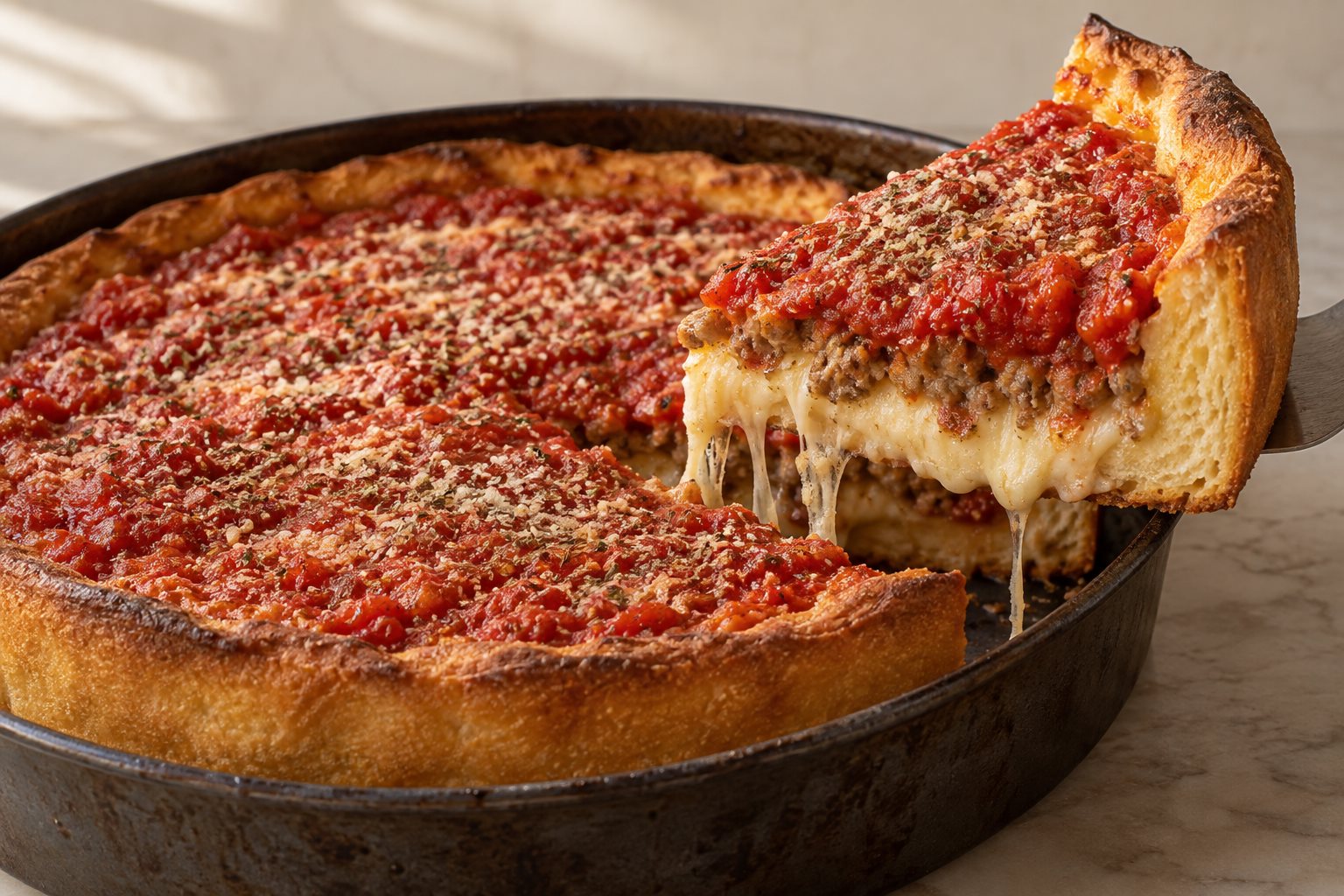
It is not a thick pizza. It is a pizza assembled in reverse, and every layer is where it is because of how long the thing has to sit in the oven.
Nobody can hand you a recipe for this from a document out of copyright, because the dish is younger than the public domain and the quantities below were worked out for this page. What there is instead is a very good paper chase. Peter Regas spent twelve years in the archives on it and laid the findings out for the Culinary Historians of Chicago in May 2021: a Chicago liquor licence application of November 1943 naming who actually owned the place, a Chicago Sun article of December 1943 describing it days after it opened, the 1944 partnership agreement, the run of licence applications for the address from 1939 to 1954, and photographs from the 1940s and 1950s showing a pizza noticeably thinner than what the city sells now. The address is 29 East Ohio Street and the restaurant opened in December 1943 as The Pizzeria, later Pizzeria Uno. A basement tavern called The Pelican had been a pizzeria at the same address until its owners closed up in November 1942, which is a detail worth sitting with before anyone says the building invented pizza in 1943.
From there the claims diverge and this page is not going to pick one. Uno's own website says the story begins in 1943 when Ike Sewell developed deep-dish pizza. Tim Samuelson, Chicago's cultural historian, told WTTW in July 2024 that there is no debate and that Ric Riccardo was the man behind opening The Pizzeria, with Sewell arriving slightly after; writing in the American Historical Association's Perspectives on History in November 2018, Elizabeth Elliott Poorman quoted him more bluntly still — Riccardo is deep-dish's father, period. Regas's reading of the documents agrees that Sewell very likely held no stake at the December 1943 opening, since it was his wife Florence who signed the 1944 agreement, and it also finds that Adolpho "Rudy" Malnati Sr., whose family has long been credited by its own account, was the pizzeria's third manager rather than its first. Alice Mae Redmond, a cook from Mississippi hired in the mid to late 1940s, is credited with reworking the dough into something closer to what is baked today. And the oldest first-person account is the one that reaches furthest back: a syndicated food page in the Forsyth County News of 17 June 1987, found in Georgia's newspaper archive, quotes Sewell himself saying that before he and Riccardo opened, pizza was not a meal, it was more of an appetizer, and that nobody except GIs who had been in Italy even knew what the word meant. Four names, one address, and no document that settles it.
Why this version works
The pan fries the crust. Two tablespoons of oil in a steel pan is not greasing, it is a shallow fry. The dough sits in it for thirty-five minutes at 425°F and comes out with a crisp, faintly blistered underside and a wall that holds its own weight. A non-stick pan, a glass dish or a springform will all give you a pale, steamed base instead.
The sausage goes in raw, as a sheet. A layer of raw bulk sausage pressed flat over the cheese renders into it and seasons the whole pizza from the inside. Pre-cooked crumbles give you dry pellets and no fat in the right place. Because the sausage is raw, the bake time is set by the meat and not by the crust, which is why the cheese had to be protected in the first place.
The tomato is barely cooked and goes on last. Whole peeled tomatoes drained and crushed by hand, with nothing simmered into them, finish cooking in the pan and keep their sharpness against all that fat. Put a long-simmered sauce on instead and you get something sweet and flat; put the tomato underneath the cheese and you get a wet crust and a scorched top.
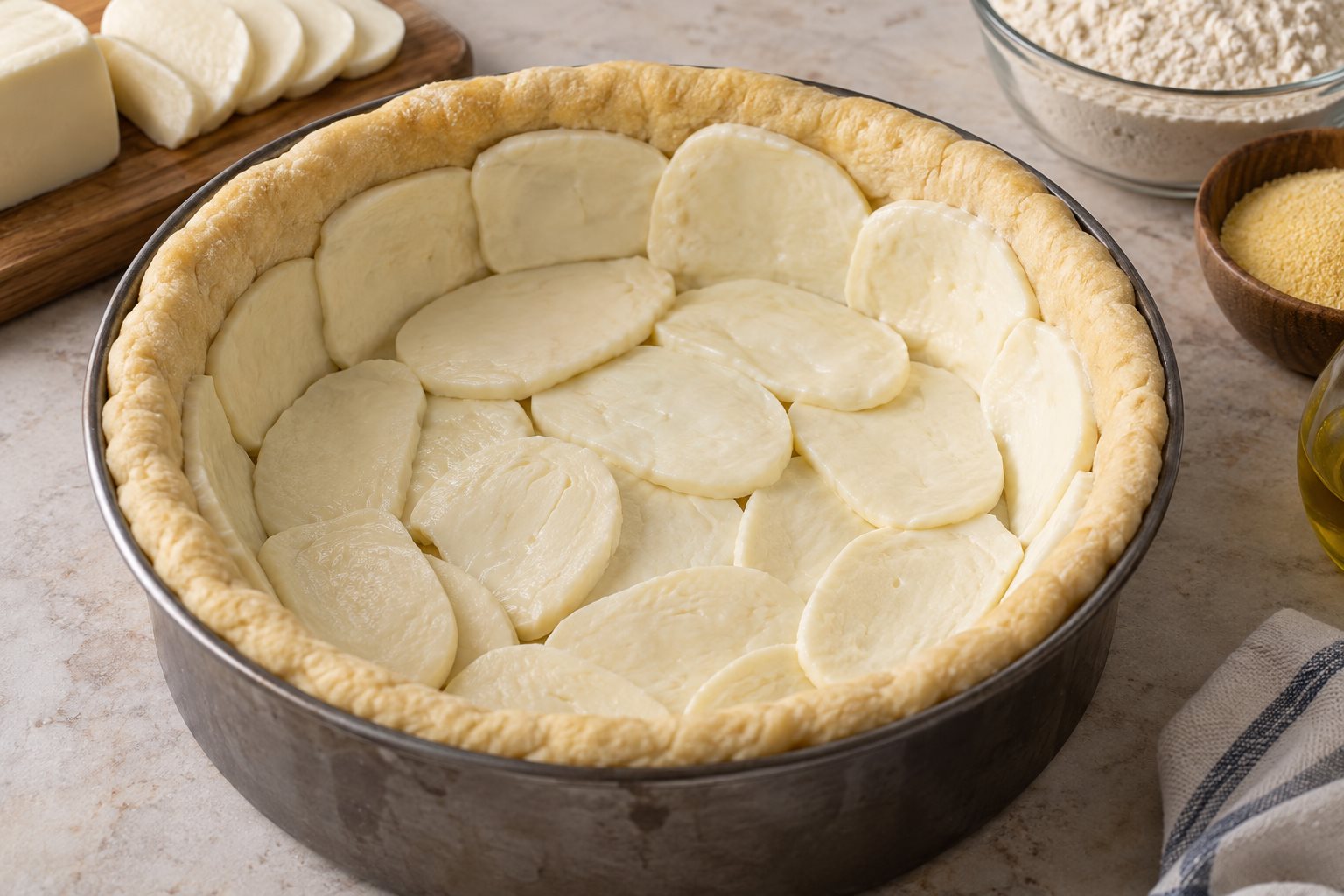
Cheese on the bottom, and this is the load-bearing decision. Sliced mozzarella laid straight onto the dough does two jobs. It seals the crust against the water in the tomato, so the base stays crisp under half an inch of sauce, and it keeps the cheese away from the oven's direct heat, so it melts rather than browning to leather. The 1987 page describes the same order from the Chicago end: mozzarella first, thick-sliced or hand-shredded, then a more than ample portion of mildly seasoned sausage, then tomatoes lightly stewed and crushed by hand, then Parmesan and herbs.