The regional table / New Mexico
Carne Adovada
The name is a Spanish verb meaning to pickle, and everything people argue about in this dish follows from how seriously you take the word.
Velázquez's A Pronouncing Dictionary of the Spanish and English Languages, printed in New York in 1881 and long out of copyright, settles the first question before the pot goes on. It gives ADOBAR as "1. To dress or make any thing up. 2. To pickle pork or other meat. 3. To cook. 4. To tan hides," and ADOBO as "Pickle-sauce." It also carries adobado as a noun in its own right: "1. Pickled pork. 2. (Obs.) Any sort of dressed meat." So the dish is named after a verb that means to pickle, and the noun that verb throws off already meant pickled pork in an ordinary bilingual dictionary long before anyone printed a menu in Albuquerque. Two smaller things the same page tells you: adobe the mud brick and adobo the pickle sauce are the same word for dressing a material until it will keep its shape, and the dictionary spells all of it with a b. There is no adovada anywhere in it. The v is New Mexican, and Spanish makes no difference in the sound.
The preservation story attached to this dish is worth testing rather than repeating. Farmers' Bulletin 913, Killing Hogs and Curing Pork, issued by the United States Department of Agriculture in 1917, sets out what actually kept pork on a farm before refrigeration: "Salt, saltpeter, sugar, and molasses are the principal preservatives used in curing pork" — a list with no acid in it and no pepper of any kind — and it schedules the whole business by the thermometer. "Select a day in winter when there is chance for cooling the carcass before the surface freezes," it says; 34 to 40°F is wanted for cooling, and "In the summer time it is necessary to have refrigeration." That is the reason a hog is killed in the cold months, in New Mexico as anywhere else, and it is as far as the documents took me. The Office of the State Historian refused every connection, the Federal Writers' Project America Eats files this article was meant to lean on answer 503 on every path, and the University of New Mexico's digital collections return nothing whatever for adovada or adobada. Nothing here is attributed to a New Mexico source I could not read. What the state does have on the federal record is Bulletin No. 40 of the USDA Office of Experiment Stations, Dietary Studies in New Mexico in 1895, by Arthur Goss, professor of chemistry at the New Mexico College of Agriculture and Mechanic Arts. Red pepper, Goss found, was "consumed in enormous quantities" compared with anything eaten in the eastern states, while the beef he analysed near Las Cruces ran "extremely low in fat," lean because "the animals pasture where grazing is very scant." Chile in quantity, meat worth stretching, and a cold month to kill in: that is the Hispano village kitchen of the Rio Grande and its side valleys, and it is where this pot comes from. The quantities below were worked out for this page.
Why this version works
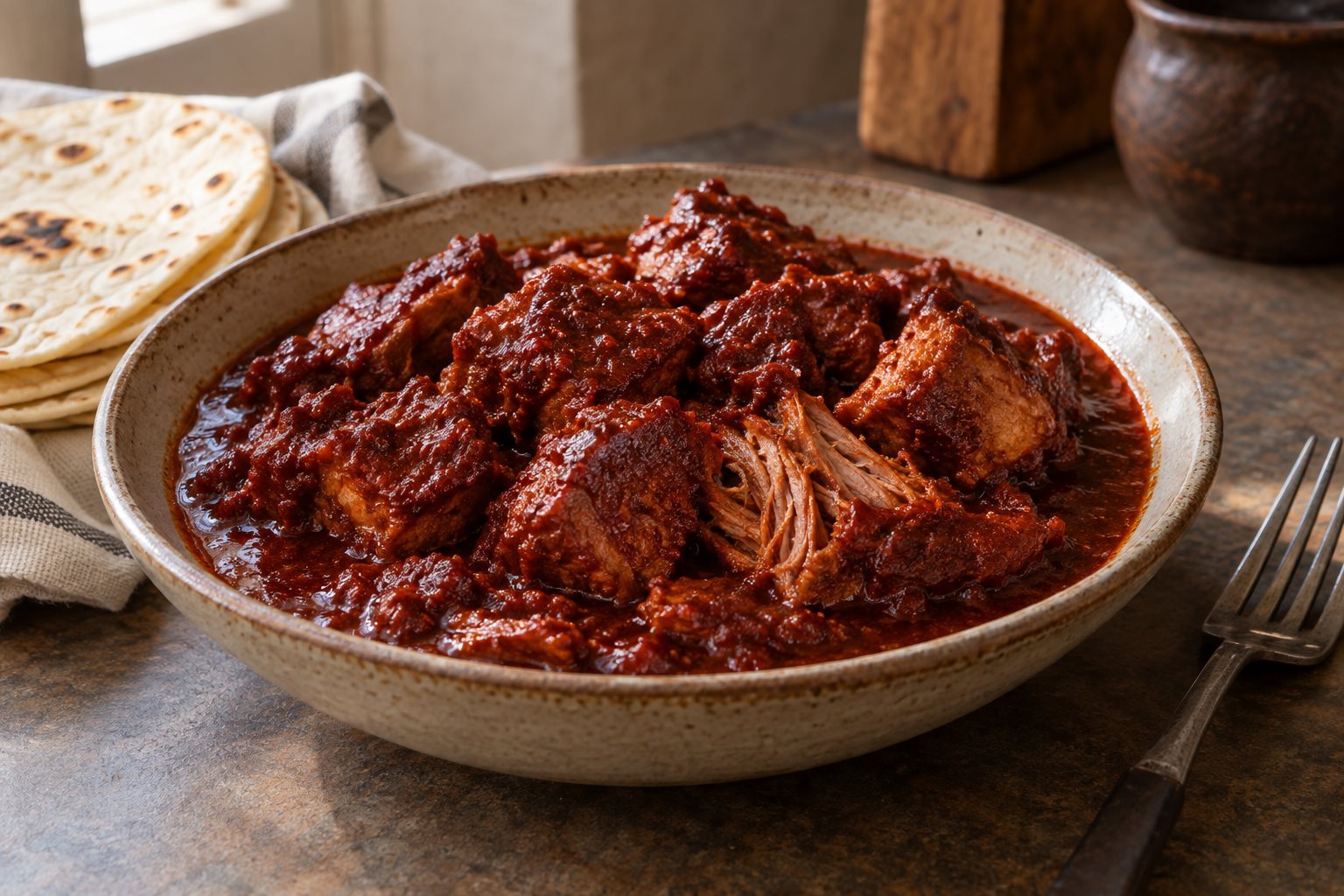
Shoulder, cut big. Inch-and-a-half cubes, fat left on. Collagen needs three hours to give way, and pieces this size come out shredding at the edges while still holding a shape on the fork. Cut them small and they are threads in sauce by hour two; use loin and they are dry at ninety minutes no matter what is around them.
The purée is a marinade, not a cure. NMSU Extension Guide E-308, Canning Green Chile, puts it flatly: "Because chiles are naturally low in acid," they sit above pH 4.6, which is why the state's own service will not let you can them without pressure. A bowl of chile purée preserves nothing and never did. What the overnight actually buys is salt carried all the way through three pounds of shoulder and chile pressed against every face of every cube, which is worth the wait on its own terms and is the only claim being made for it.
Vinegar is a nod to the word, not a method. If adobar means to pickle, a real pickle needs acid, and NMSU Guide E-318 shows how much: vinegar of 5% acidity, never homemade because "the percent of acidity is unknown," and "do not reduce the amount of vinegar called for in a recipe." That is meat sitting in acid, not a spoonful stirred through a braise. One tablespoon here will preserve nothing and is not meant to — it sharpens a sauce that is otherwise all sweetness and earth. Leave it out and this is still carne adovada. Pour in a quarter cup and you have made a different dish that happens to share a root.
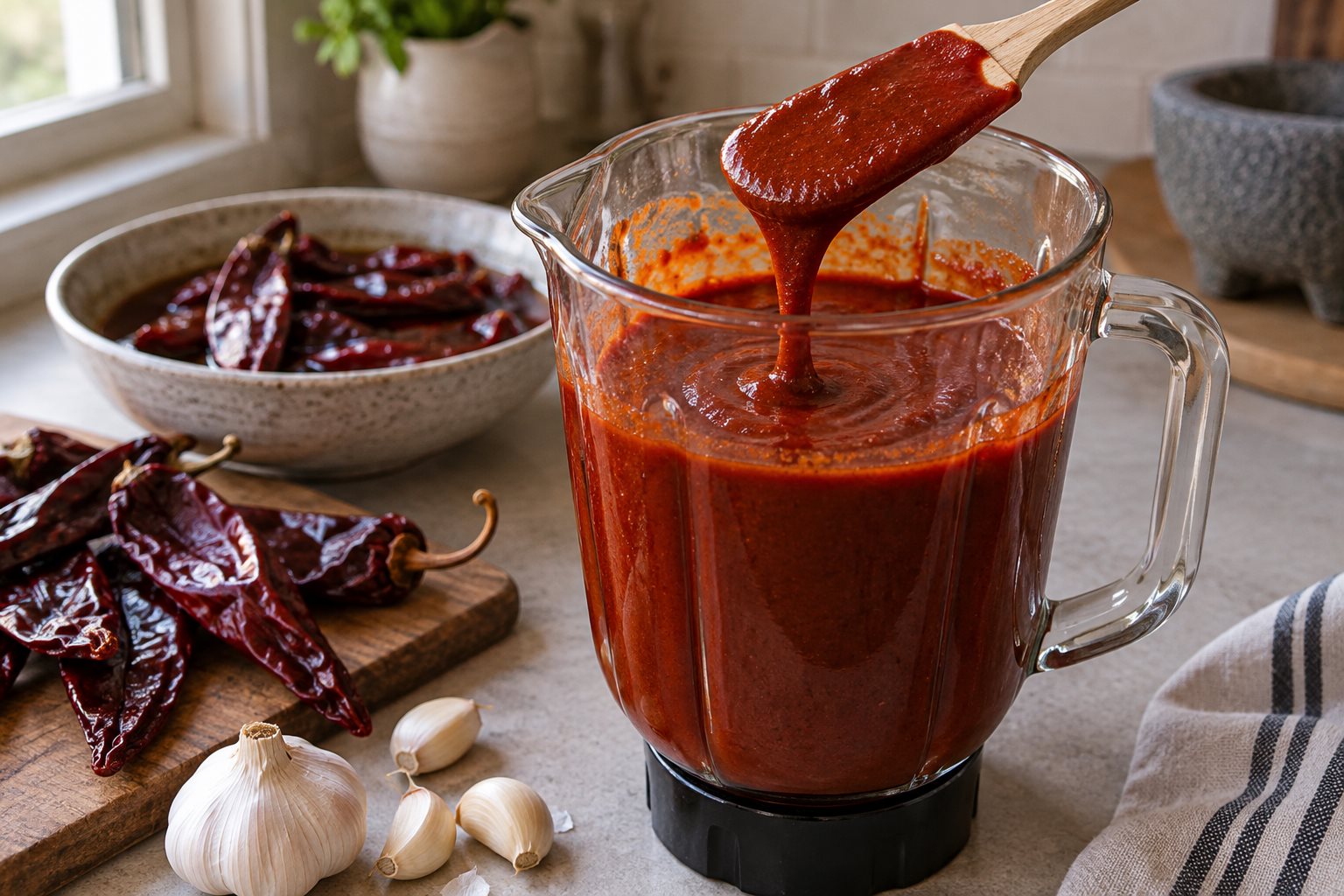
The marinade goes in the oven with the meat. Nothing is wiped off and nothing is poured away, which is why this purée is blended thick — about 3 cups of water to 24 pods, and never strained. The skins stay in and give the sauce its grip. It reduces around the pork in a covered pot instead of boiling it, and by the end there is no separate sauce to make.