American cooking Recipes & regional stories

Skillet & Sage

A culinary journey through the fifty states

The regional table / Montana

Butte Pasty
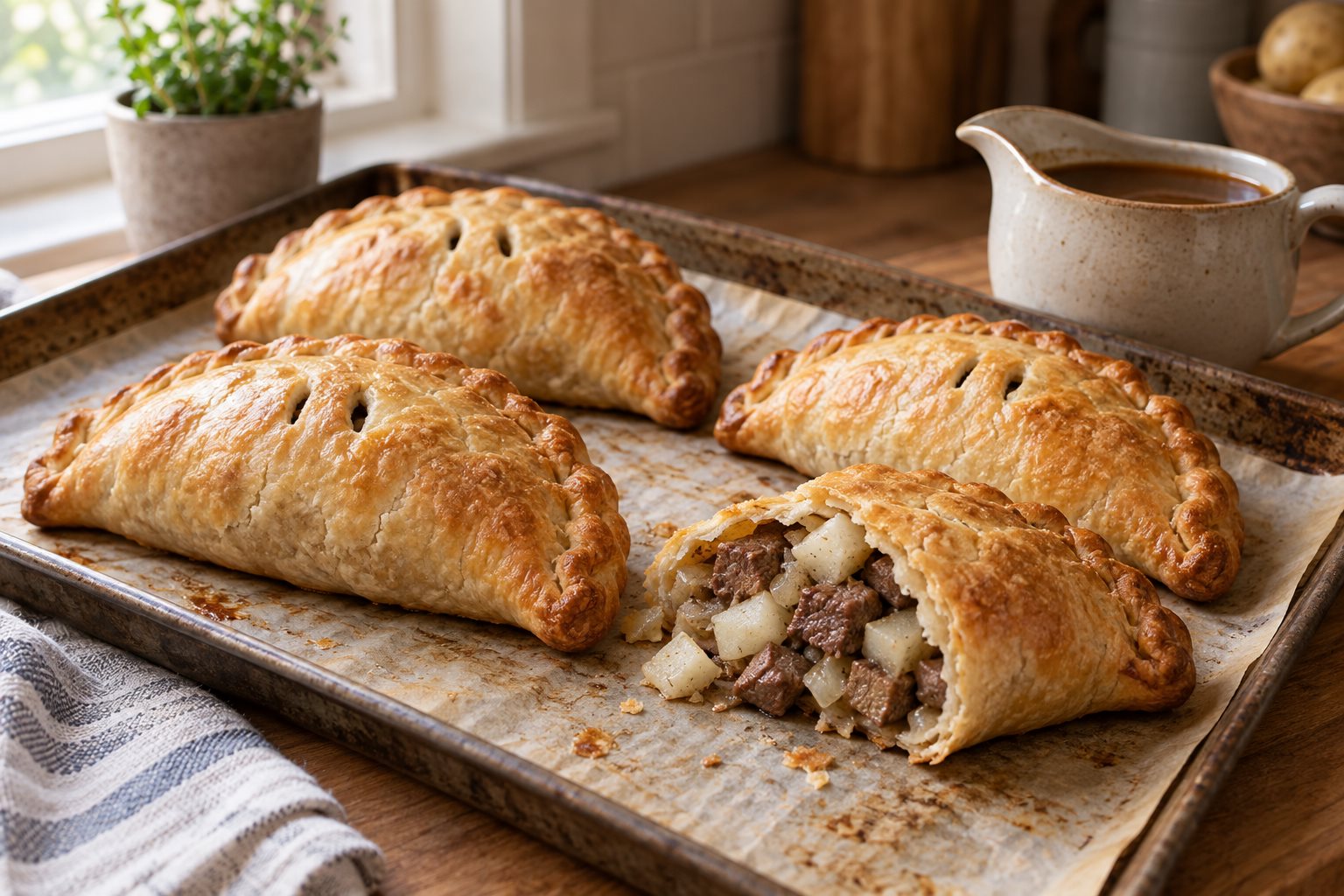
crimped pastry turnovers on a sheet pan, one cut open showing diced beef, potato and onion, with a jug of brown gravy beside them
The filling is mixed rather than layered, and there is nothing orange in it. AI-generated illustration.

Butte's pasty has no turnip in it, no rutabaga and no carrot, and the book that wrote it down says to serve it with lashings of brown gravy.

The document is Butte's own. Copper Camp, published in 1943, was written by the Montana Writers' Project — the state programme that replaced the Federal Writers' Project — and sponsored by the Montana State Department of Agriculture, Labor and Industry. Its chapter "Copper Camp Cuisine" opens by saying that with Butte's polyglot population "originating in practically every country of the globe" many strange dishes ended up on local menus, and that "the best example is that epicurian masterpiece of pie crust, beef and vegetables which Butte, with pardonable pride, claims as its own — the Cousin Jack pasty". Then it prints directions supplied, in its words, by a Cornish woman. They are the reason this page exists, and they do not match the pasty most people have read about. The America Eats Montana file named in most accounts of this dish could not be opened: whatamericaate.org answered 503 on every path tested on 23 September 2026, and nothing here is attributed to it.

What the Cornish woman specified: beef "of an excellent grade, Montana preferred", the finest cuts, tenderloin or sirloin, three or four pounds of it, diced "to approximately the size of the third joint of a Cornish woman's little finger". Then "eight or ten fair sized Irish potatoes, peeled and diced — never sliced — into cubes of a size similar to the meat", and whole firm onions in about half the quantity of the potatoes. The sentence that follows is the one that settles the argument: "these are the ingredients". No turnip, no rutabaga, no carrot, nothing else. She says to mix the meat and vegetables thoroughly rather than layer them, to wrap generous heaps in dough cut as a semicircle about four inches in radius, to crimp the edges and put it in a hot oven. And at the end: "Serve it piping hot, with lashings of brown gravy."

Why this version works

Mixed, not layered. The Butte instruction is to mix the meat and vegetables thoroughly and then take generous heaps of the mixture. A mixed filling distributes the beef fat through the potato instead of dropping it all in one place, and it means every bite is the same — which is what you want in something eaten in the dark with one hand.

Gravy is in the document. Elsewhere the sauce is an argument. In Butte it is written down: piping hot, with lashings of brown gravy. Make the gravy while the pasties bake, from beef stock and a brown roux, and keep it thin enough to pour rather than spoon.

A tender cut, not a braising cut. Sirloin is what the 1943 directions call for, and it changes the whole timetable. Chuck needs an hour and a half of wet heat before it gives in; sirloin cut into small dice is done in forty minutes, which is about how long the pastry wants. Buy a tender cut, cut it small, and stop worrying about the clock.

Nothing in the filling is precooked. Raw beef and raw potato give up their water slowly over the bake, and that steam is what cooks the inside of a sealed pasty. Precooked filling has nowhere to send its moisture and softens the crust from within. It is also why the pastry has to be sound before it goes in the oven.
Ingredient notes

Beef: two pounds of top sirloin, trimmed of gristle but not of fat, cut into quarter-inch dice. The 1943 directions insist on tenderloin or sirloin and on Montana beef. Sirloin is the sane half of that: tenderloin in a pasty is money set on fire. Do not substitute ground beef, and do not substitute chuck unless you are prepared to cook the thing twice as long.

Onion: twelve ounces, chopped. That is roughly the half-of-the-potato-weight ratio the Cornish woman gave, and it is a lot of onion by modern habits. It is also where most of the sweetness in the filling comes from, since there is no root vegetable doing that job.

Pastry: three and a half cups of flour to one cup of lard. Copper Camp says only "the usual pie crust made with the addition of a breathed prayer or two", which in 1943 Butte meant lard. Lard carries almost no water, so the crust stays short and stays standing for hours — the point of a thing built to ride down a shaft in a bucket.

Potatoes: a pound and three quarters of a waxy or all-purpose potato, peeled and cut into dice the same size as the meat. Diced, never sliced — the book is explicit, and the reason shows in the finished pasty, where cubes stay separate and slices weld into a paste.

Step by step

  1. Make the pastry. Rub 1 cup cold lard into 3½ cups flour and 2 teaspoons fine salt until it looks like coarse meal. Add 3/4 cup ice water, bring it together without kneading, divide into 6, flatten each into a disc and chill at least 1 hour.
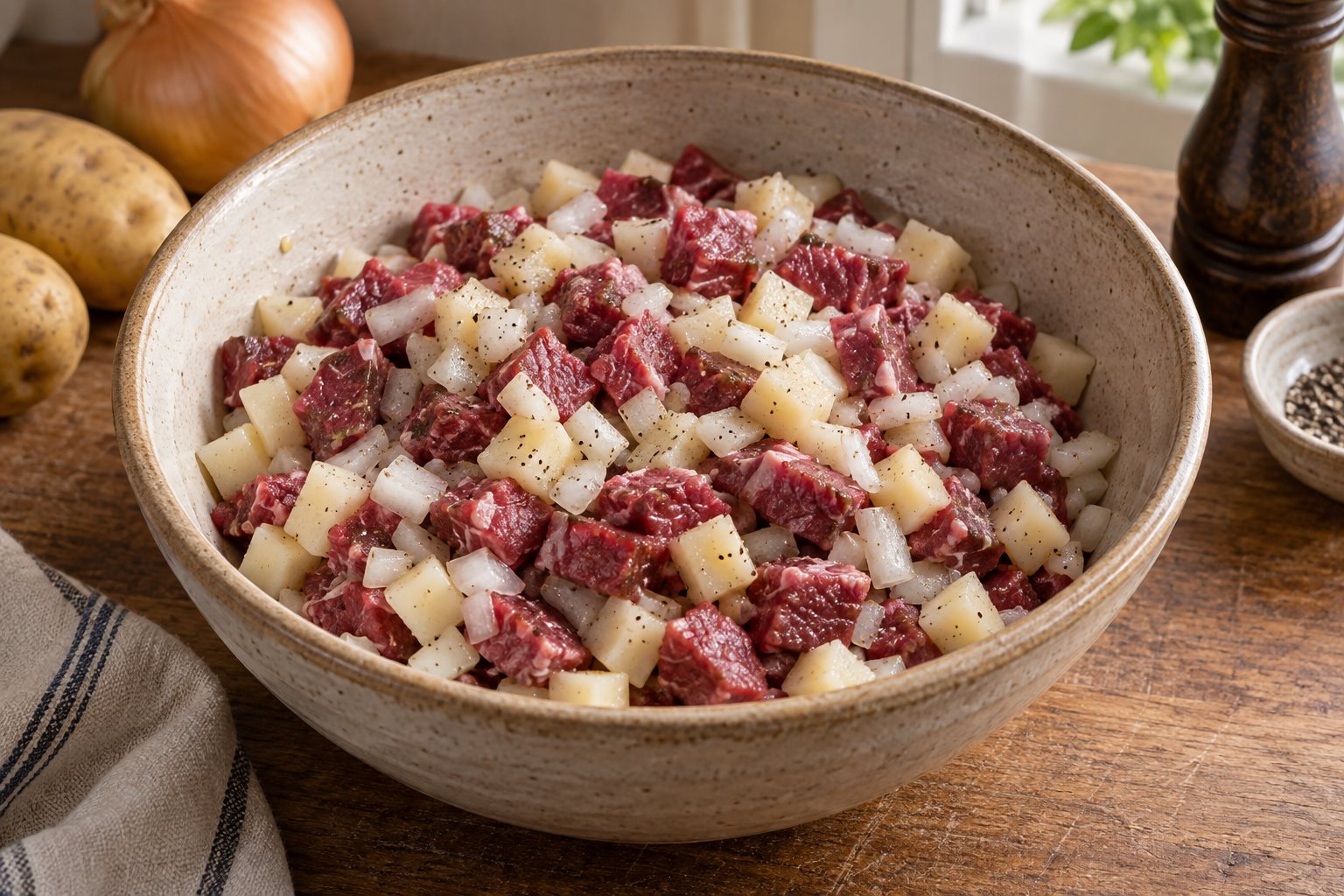
  2. Cut and mix the filling. Dice the beef, the potatoes and the onion small and roughly the same size. Put all three in one bowl with the kosher salt and a great deal of black pepper and mix thoroughly. This is the step the Butte directions are firm about.
    Diced beef, potato and onion mixed together for pasties
    Mix the beef, potato and onion thoroughly before filling the pastry. AI-generated illustration.
  3. Fill. Heat the oven to 425°F. Roll each disc to a round about 8 inches across. Pile a sixth of the mixture on one half, leaving a 1-inch border, and dot with butter. Resist adding more; an overfilled pasty splits along the crimp.
  4. Seal. Wet the border, fold the empty half over, press the air out from the middle towards the edge, and crimp the curve into a rope or press it with a fork. Cut two short vents. Brush with the beaten egg.
  5. Bake hot, then steady. Bake on a parchment-lined sheet 15 minutes at 425°F, then drop to 350°F for 35 to 40 minutes more, until deep gold and a skewer through a vent meets no resistance from the potato.
  6. Make the gravy. While they bake, cook 2 tablespoons butter with 2 tablespoons flour to a nut-brown roux, whisk in 2 cups beef stock and simmer 10 minutes. Season it hard; it has to carry across a whole pasty.
  7. Rest and pour. Ten minutes on the sheet. Serve them hot with the gravy poured over, and take the second one cold the next day with nothing on it at all.
A pasty that burst along the seam was overfilled or sealed over trapped air — it is still good, just drier, so give it more gravy. If the pastry is dark and the potato is still firm, tent the tray with foil and give it another 15 minutes at 325°F rather than pulling it out. If the bottom is pale and wet, bake the next batch on a sheet you preheated with the oven, on the lowest shelf.

Storage and make-ahead

Three days in the fridge, wrapped in paper rather than plastic, which softens the crust. Reheat 20 minutes at 350°F. The microwave turns the pastry to cloth.

They freeze well baked and cooled; reheat from frozen at 350°F for 40 minutes. The gravy keeps four days separately and reheats with a splash of water.

What to serve with it

Gravy, because the 1943 directions say so. Make more than you think you need.

Something sour alongside — pickled beets, or shredded cabbage with vinegar and pepper. The filling is meat, starch and onion, and there is no acid anywhere in it.

crimped pastry turnovers on a sheet pan, one cut open showing diced beef, potato and onion, with a jug of brown gravy beside them

From the recipe box / Montana

Butte Pasty

Diced sirloin, potato and onion mixed together, wrapped in plain pastry and baked hot, then eaten with brown gravy poured over it — the Butte version, written from the recipe a Cornish woman gave the Montana Writers' Project in 1943.

Prep
40 min
Cook
55 min
Total
1 hr 35 min, plus 1 hour chilling the pastry
Serves
6
Calories
990 per serving

Ingredients

Scale

Instructions

  1. Rub the lard into the flour and fine salt, add the ice water, divide into 6 discs and chill 1 hour.
  2. Dice the beef, potatoes and onion the same size, then mix them in one bowl with the kosher salt and pepper.
  3. Heat the oven to 425°F. Roll each disc to an 8-inch round, mound a sixth of the filling on one half leaving a 1-inch border, and dot with butter.
  4. Fold over, press out the air, crimp the curved edge, cut two vents and brush with the egg wash.
  5. Bake 15 minutes at 425°F, then 35–40 minutes at 350°F, until deep gold and tender through a vent.
  6. Cook the butter and flour to a brown roux, whisk in the beef stock and simmer 10 minutes for the gravy.
  7. Rest the pasties 10 minutes and serve hot with the gravy poured over.

Nutrition

Fat53 g (21 g saturated)
Sodium940 mg
Protein40 g
Serving1 pasty with gravy
Calories990
Cholesterol110 mg
Carbohydrates88 g (5 g sugar, 7 g fiber)

Nutrition is an estimate calculated from the listed ingredients and is provided as a courtesy, not as dietary advice.

Questions readers ask

Gravy or ketchup?

Gravy. Elsewhere this is a genuine regional fight with no document behind either side. In Butte the 1943 instruction is plain — "Serve it piping hot, with lashings of brown gravy" — and it was written down while the men who ate them were still going underground.

Where is the rutabaga?

Not in Butte's document. The directions printed in Copper Camp in 1943, from a Cornish woman in the camp, list beef, potato and onion and then say "these are the ingredients". That is a written absence, not an oversight, and it is the clearest thing separating a Butte pasty from the ones made on the iron and copper ranges east of here. Add rutabaga if you want to; you will be making somebody else's pasty.

Was it only the Cornish?

No, and Copper Camp names the rest of the table. Its roll call of who sat down to that underground lunch runs: native Americans from all points of the country, Finns, Irish, Serbs, Cornish, Swedes, Norwegians, Welsh, Canadians, Scotch, Manxmen, Italians, Poles, Austrians, and perhaps an old Mexican or Chilean miner. The Cornish brought the pasty and the camp took it over, along with Irish stirabout, Serbian povitica and Finnish marrow sausage.

Why was it eaten cold so often?

Because of the shift. Copper Camp describes the underground meal in detail: the men were allowed half an hour and in the old days took a full hour or longer, and "the lunch hour on both the night and day shifts began the instant the shift boss and foreman took the cage for the surface and ended when they were again lowered into the mine." They ate sitting on a laggin — a three-inch plank propped up — by candlelight, in groups, and the book says the pasty held prominent place in the Cornish miner's bucket under the name "a letter from home".