The regional table / Kentucky
Burgoo
Kentucky's great stew was never a household dish, and that is why the cookbooks are so thin on it and the newspapers so thick.
Begin with an absence, because it is the loudest thing in the record. Lettice Bryan's The Kentucky Housewife of 1839 is the state's first great cookbook, nearly thirteen hundred receipts, and I read the whole of the scanned text at the Internet Archive looking for burgoo. It is not there. Not the word, not a variant, not a dish standing in for it. What is there is the raw material: a Squirrel Soup made of two fat young squirrels with a stiff egg-and-milk batter dropped in by small spoonfuls, and a direction To Barbecue Shoat that puts a quarter over a bed of clear coals and tells you to cook it slowly for several hours, basting with nothing but salt water and pepper. Bryan wrote down what a Kentucky woman cooked indoors for a family. Burgoo was cooked outdoors by men, for thousands, and it stayed out of the books for another two generations.
It is in the newspapers instead. On 21 June 1887 the Atlanta Constitution ran a special from Lexington on the barbecue thrown for Simon Bolivar Buckner's run at the governorship, where "Barbecue and Burgoo" was half the war cry: "Gus Jaubert has been put in chief command," the correspondent wrote, and "He, better than any mortal, knows the secret of Burgoo." There were, he reported, to be "sixteen hundred gallons of it cooked in these great cauldrons," fed by a wagon load of potatoes, six sacks of onions, a stack of canned corn higher than a man's head, a cart load of tomatoes, "bags of salt and strings of red pepper, and those skinned squirrels and that breastwork of dressed chickens," plus the fat of beeves and mutton and scraps of meat from both. Ten thousand cups stood ready. Three years later the Cincinnati Commercial Gazette got the method out of Col. James Orr of Covington, and the Columbus Enquirer-Sun reprinted it on 2 November 1890: burgoo, Orr said, "is one of the oldest Kentucky dishes we have. No one knows who first made 'burgoo,' nor does any one know where or how it got its queer name." What follows is my own pot, scaled to a kitchen, built on his order of operations.
Why this version works
Heat, and enough of it. Red pepper pods went into the bottom of Orr's cauldron before anything else, and the 1887 account lists strings of red pepper by the bag alongside the salt. A timid burgoo is the standard failure. Season at the start, again when the tomatoes go in, and a third time at the end, when an hour of evaporation has concentrated everything and moved the target.
Three meats, one of them mutton. Orr's 1890 pot was prairie chickens, yellow legs, soft shell crabs and young squirrels; the 1887 Lexington cauldrons took the fat of beeves and mutton and scraps of both. What survived into the Kentucky burgoo of the pit stands is mutton or lamb with beef and chicken, and the mutton is not optional if you want the taste people mean by the word. It brings a sweet, faintly gamey depth that beef alone cannot reach, and its fat carries the cayenne.
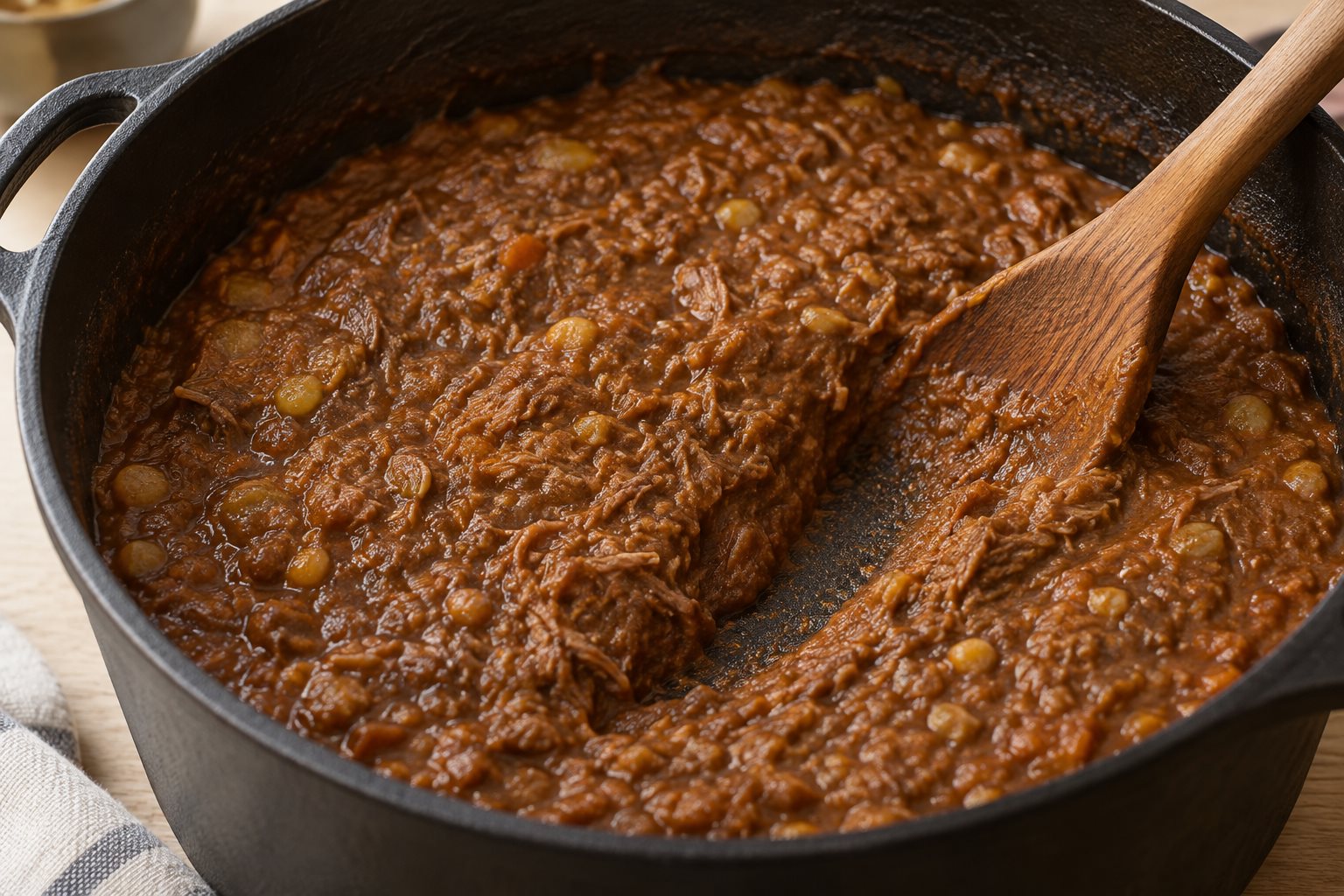
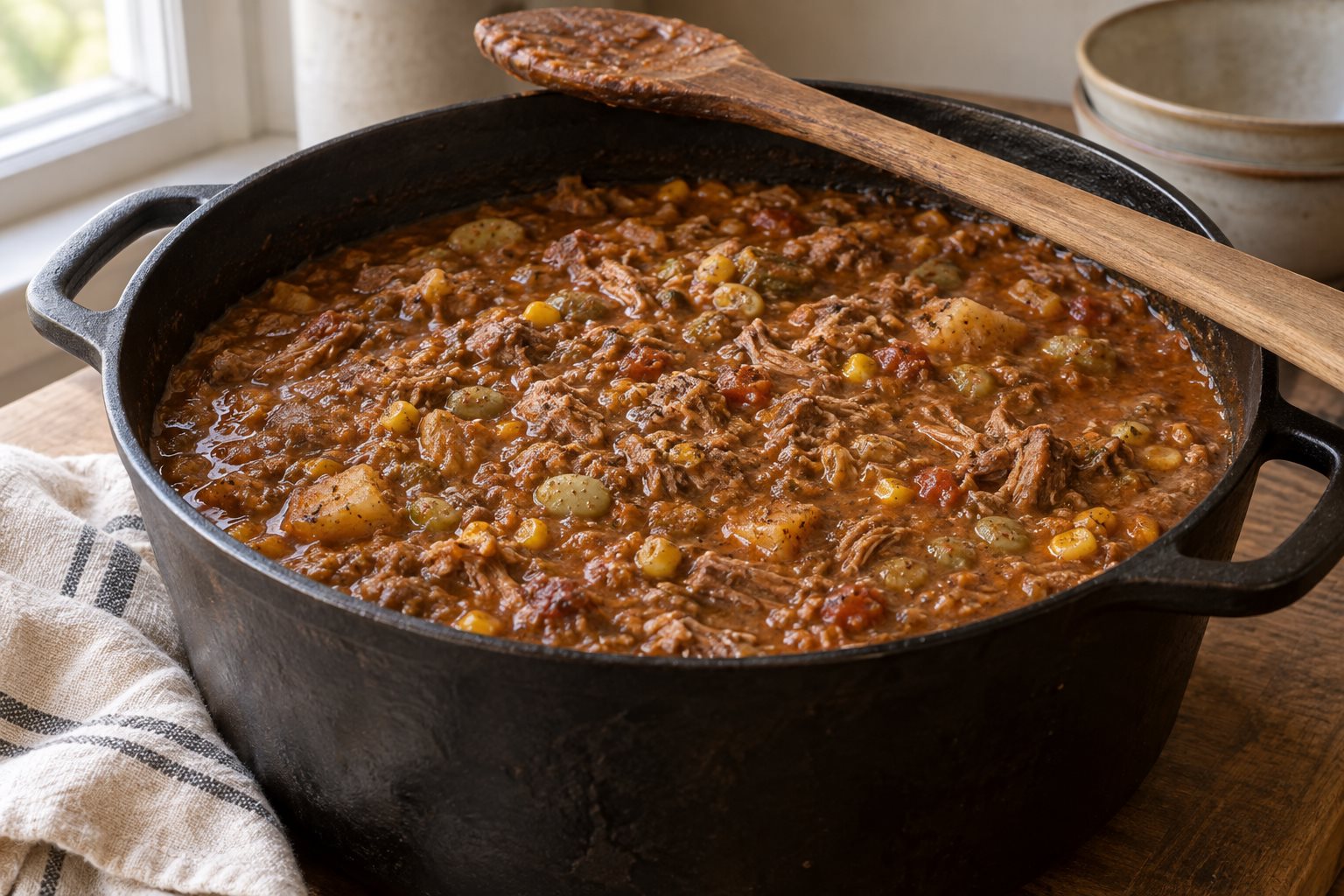
The vegetables are meant to disappear. Orr was explicit that it is "done" when the meats are thoroughly shredded, not before, and six hours of slow simmering does the same thing to potatoes and limas. What you are after is not a vegetable soup with identifiable pieces but a single thick body, the starch of the potatoes and beans bound into the liquid. Add them early and let them go.
Everything comes off the bone and goes back in. The Blue Grass Cook Book of 1904 prints a Kentucky Burgout from a Mrs. Garrard that tells you to boil the meat till tender and "remove all the bones" before a single vegetable goes near the pot. That is the step people skip, and skipping it gives you a stew you have to pick your way through. Bones out, meat shredded, meat back: from there the pot thickens itself.