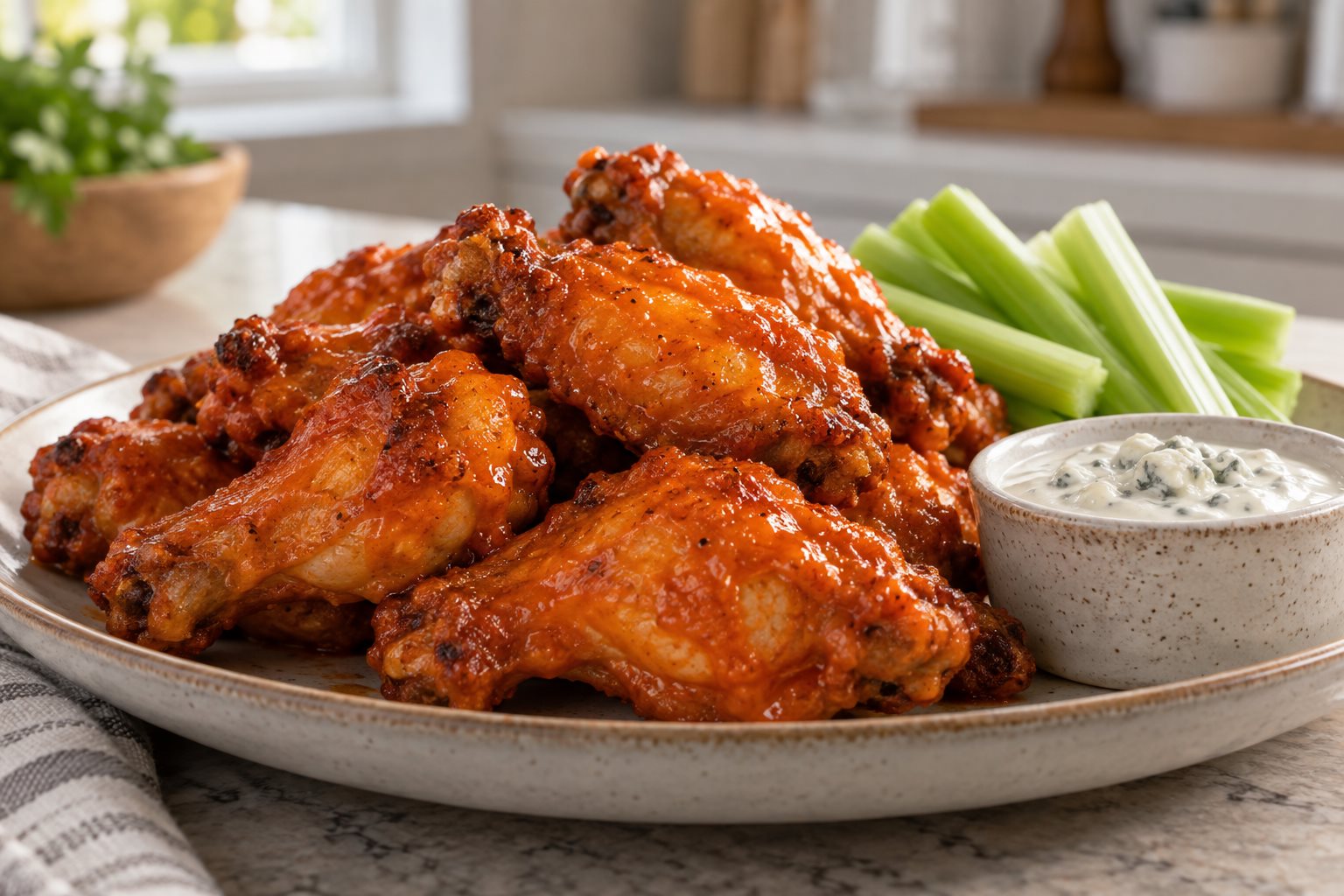
The coating should look wet and glossy on the skin rather than pooled under the wings. That is what a sauce that held together looks like. AI-generated illustration.
The frying is the easy half. The dish is won in a small saucepan, off the heat, whisking cold butter into cayenne sauce one cube at a time.
This one has no printed ancestor and this page will not invent one. The dish is younger than anything in the public domain, so the record is a house and a newspaper file rather than a cookbook chapter. The Anchor Bar on Main Street in Buffalo, run by Frank and Teressa Bellissimo, is where the butter-and-cayenne wing became famous, and the family told the story more than one way. When Calvin Trillin went to Buffalo for The New Yorker in 1980, Frank described a delivery of wings that turned up instead of the backs and necks meant for spaghetti sauce, while their son Dominic described feeding a late Friday-night crowd at the bar. Trillin printed both versions and picked neither, and noted that a long 1969 Courier-Express feature on the bar does not mention wings at all. In 2025 a Buffalo News reporter, Francesca Bond, found five Anchor Bar advertisements on Courier-Express microfiche running from September to November 1963 — fried chicken wings, three of them with a Roquefort garnish — which puts wings on that menu before the year the legend names. In the same years John Young was selling a wing of his own on Jefferson Avenue, left whole and breaded, in a sweeter tomato-based sauce, and he told Trillin that the wings were nothing new and the sauce was the part he had invented. The record is contested, and anyone who hands you one night and one name is repeating a house story.
So the quantities below were worked out for this page, not copied from a document. What is not in doubt is the mechanism. Cayenne pepper sauce is mostly vinegar, water and salt; butter is mostly fat; and the two coat a wing only if they are made into an emulsion first. Melted butter stirred into hot sauce gives a bowl of orange oil and a plate of dry wings twenty seconds later. Cold butter whisked in off the heat gives a sauce that stays on the skin all the way to the table.
Why this version works
Salted and dried before the oil. Surface water boils off before any browning starts, so a wet wing spends its first minutes steaming instead of frying and comes out pale. Salting on a rack half an hour ahead pulls moisture out of the skin and dries what is left.
Fried naked, with no coating at all. The skin is the crust here. Left bare it dehydrates in the oil and sets hard, which is a surface a water-based sauce can wet without destroying. Batter or flour turns to paste the moment the sauce hits it, which is why breaded wings are a different dish and not a better one.
Cold butter, whisked in off the heat. Butter is itself an emulsion, and its milk proteins are what hold the fat in suspended droplets once it goes into the vinegar of the hot sauce. Suspended fat makes the sauce thicker than either liquid alone and makes it cling to wet skin. Boil it and those droplets merge back into a slick that slides straight off.
Celery and blue cheese belong on the plate. They are in the earliest record there is: three of those 1963 advertisements name a Roquefort garnish. They also do a job. Capsaicin binds to fat, so a bite of cold dairy resets the mouth in a way that water cannot, and the celery adds the only cold crunch on the plate.
Ingredient notes
Oil: two quarts of something neutral with a high smoke point — peanut, canola or refined sunflower. Use a pot deep enough that the oil sits no more than halfway up, because wet wings foam hard when they go in.
Wings: buy them whole and split them at the joint yourself into a flat and a drumette. Pre-cut wings sit longer in the case and are often brined, and brined wings carry water into the fryer. Keep the tips for stock.
Butter: unsalted, straight from the fridge, cut into cubes before anything is heated. Cold butter melts slowly enough for the emulsion to form around it. Soft or already-melted butter skips that step and splits.
Hot sauce: a thin Louisiana-style cayenne sauce, meaning cayenne, vinegar and salt and very little else. Thick sauces and chipotle or fruit-based sauces will not emulsify cleanly, and extract-heat sauces bring heat with no flavour behind it. This ingredient also carries most of the salt in the dish, which is why only a teaspoon goes on the wings.
Step by step
Split, salt and dry. Cut each wing at the joint into a flat and a drumette and set the tips aside for stock. Pat every piece dry, season with the salt and pepper, and leave them on a rack for 30 minutes, or uncovered in the fridge for several hours if there is time.
Heat the oil. Bring the oil to 375°F in a heavy pot with at least four inches of clearance above the surface, with a thermometer clipped to the side. The gap between 350°F and 375°F is the gap between greasy and crisp, and guessing it is how wings go wrong.
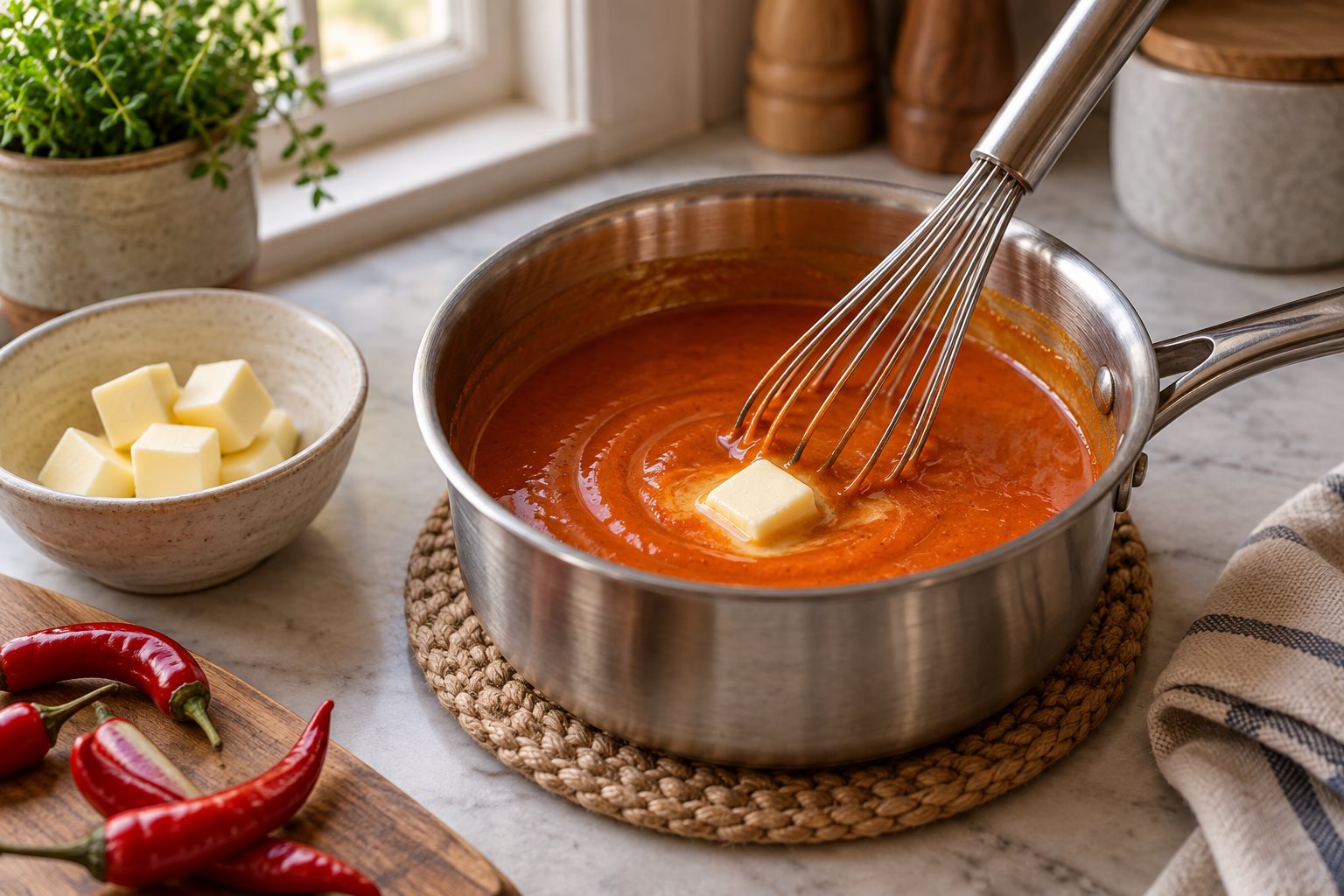
Build the sauce. Warm the cayenne sauce, vinegar and garlic powder in a small saucepan until it just steams, then pull it off the burner. Whisk in the cold butter one cube at a time, letting each disappear before adding the next. The sauce should thicken a little and turn opaque. Hold it warm, never simmering.
Whisk cold butter into the warm sauce off the heat, one cube at a time. AI-generated illustration.
Fry in batches. Lower a third of the wings into the oil and fry 10 to 12 minutes, until the skin is hard and deep gold and the pieces rattle against each other when you shake the pot. Drain on a rack, not on paper, and let the oil climb back to 375°F between batches.
Toss the moment they drain. Tip each batch into a wide bowl, pour over a third of the warm sauce, and toss hard for about 15 seconds so every piece is coated before the skin starts absorbing. Move them to the serving plate and start the next batch.
Send them out. Wings should reach the table within a few minutes of being sauced, with the celery and the cold blue cheese beside them. Anything left standing on the counter is a softer, sadder dish by the time it gets there.
If the sauce breaks into a slick of orange oil over watery hot sauce, it got too hot. Take the pan off the burner, give it a minute to cool, and whisk in one more cube of cold butter — the cold fat usually pulls the emulsion back together. If the wings themselves went soft because they sat in the sauce, that batch is gone; drop the next one back into 375°F oil for 90 seconds and sauce it later.
Storage and make-ahead
Sauced wings keep 3 days refrigerated and never recover in a microwave. Spread them on a rack and give them 10 minutes in a 400°F oven, then toss with a spoonful of fresh sauce, because the first coat will have soaked in.
The sauce keeps a week on its own and sets hard in the fridge, being mostly butter. Warm it slowly and whisk it as it loosens; melting it fast splits it and no amount of stirring brings that back.
What to serve with it
Celery and blue cheese are already on the plate and between them they do most of the cooling. Past that the useful additions are cold and acidic: a thin lager, a vinegar slaw, or carrots pickled and cut to the same length as the celery sticks.
If this is dinner rather than bar food, serve it over plain baked potatoes or plain rice. Anything seasoned ends up arguing with the sauce, and the sauce wins.
From the recipe box / New York
Buffalo Wings
Wings fried naked, no batter anywhere, then tossed in an emulsion of cold butter and cayenne pepper sauce that hangs on the skin instead of running off it.
Prep
20 min
Cook
30 min
Total
50 min
Serves
4
Calories
845 per serving
Ingredients
Scale
Instructions
Split the wings at the joint, dry them, season with the salt and pepper, and rest them on a rack 30 minutes.
Heat 2 quarts of oil to 375°F in a heavy pot, with a thermometer on the side and four inches of clearance above the oil.
Warm the cayenne sauce, vinegar and garlic powder until steaming, take the pan off the heat, and whisk in the cold butter one cube at a time.
Fry the wings in three batches, 10–12 minutes each, until the skin is hard and deep gold. Drain on a rack and bring the oil back to 375°F.
Toss each batch in a third of the warm sauce for 15 seconds, straight off the rack.
Serve within minutes, with the celery sticks and the cold blue cheese dressing.
Nutrition
Fat
71 g (25 g saturated)
Sodium
1680 mg
Protein
44 g
Serving
a quarter of the wings with celery and dressing
Calories
845
Cholesterol
200 mg
Carbohydrates
6 g (3 g sugar, 1 g fiber)
Nutrition is an estimate calculated from the listed ingredients and is provided as
a courtesy, not as dietary advice.
Questions readers ask
Can I fry them ahead?
Fry them through, spread them on a rack, and hold them at room temperature up to an hour, then give them 90 seconds back in 375°F oil and sauce them immediately. What cannot be done ahead is the saucing: wings begin softening within minutes of being coated, which is the whole reason the tossing happens last.
Who invented Buffalo wings?
The record does not settle it. The Anchor Bar in Buffalo is where this sauce became famous, and the city proclaimed a Chicken Wing Day there on July 29, 1977. But the Bellissimo family gave Calvin Trillin two different accounts in 1980, Anchor Bar advertisements for fried chicken wings appear in the Courier-Express in the autumn of 1963, and John Young was selling a different wing on Jefferson Avenue in the same years and said the sauce was his own idea. One night and one name is a story the house tells, not something the documents support.
Can I bake them instead of frying?
Yes, and it is worth doing when two quarts of oil is not happening tonight. Toss the dried wings with a teaspoon of baking powder along with the salt, rack them over a sheet pan, and roast at 450°F for about 45 minutes, turning once. The baking powder raises the pH of the skin so it browns well before the meat dries out. The result is thinner and more brittle than fried skin rather than identical to it, but it takes sauce properly.
How do I make them hotter or milder?
Change the ratio rather than the ingredients. The amounts here are roughly four parts cayenne sauce to three parts butter, which lands in the middle. Equal parts is mild, and cutting the butter back toward half makes it sharp and hot but starts to thin the emulsion. For real heat add cayenne pepper to the butter instead of more hot sauce, which only brings more vinegar and salt.