The regional table / Indiana
Breaded Pork Tenderloin Sandwich
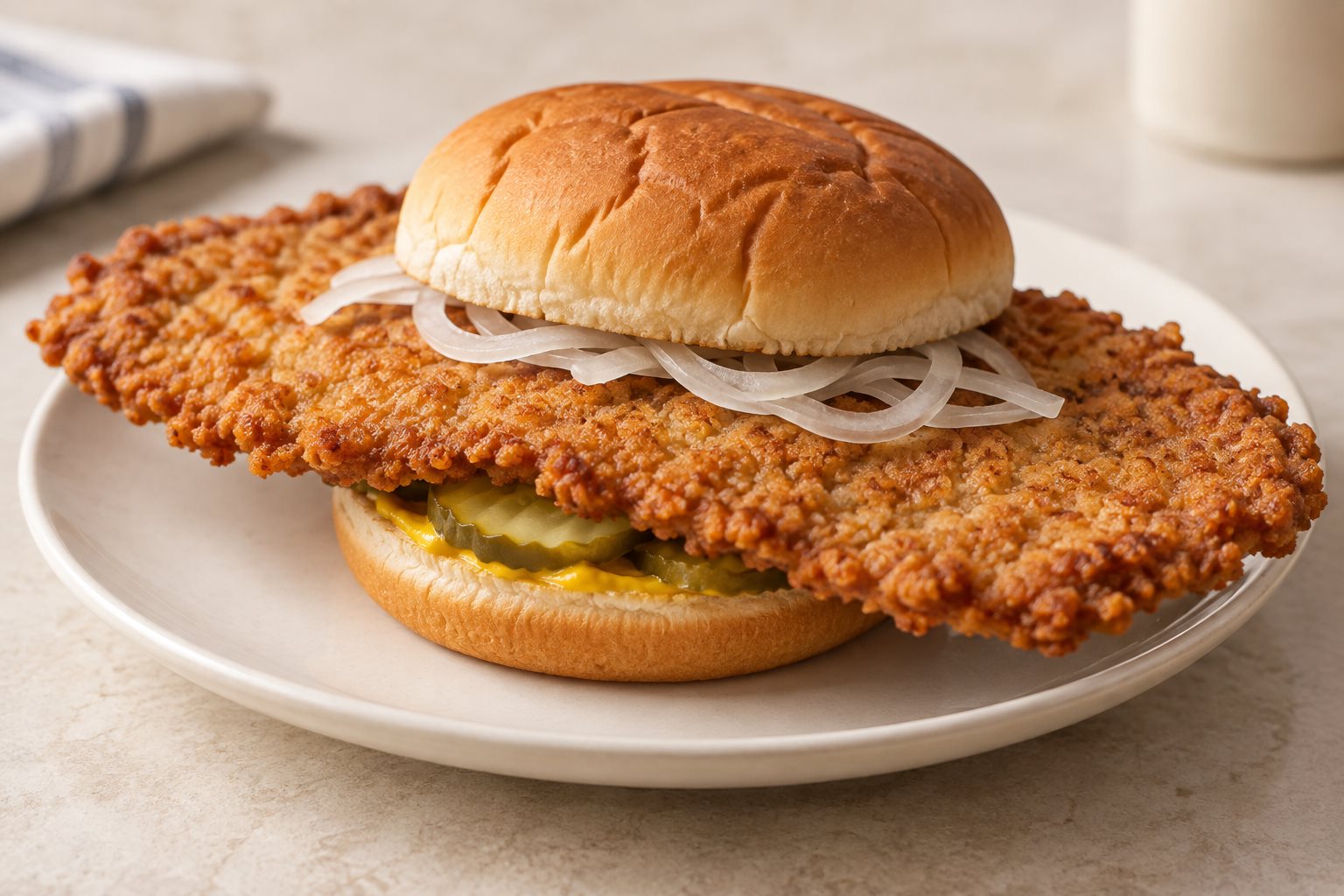
The cut named on the menu is not the cut in the sandwich, and once you know which one is which, everything else about how it is made stops being strange.
Two different pieces of meat are involved and the federal cutting literature keeps them carefully apart. Purdue Extension — Indiana's land-grant university, writing about the state's own animal — publishes AS-671-W, "At-Home Hog Slaughter", by Brian Richert, Matt Claeys and Amanda Mosiman of its Animal Science extension group with Amanda Blair and Christina Bakker of South Dakota State, produced 10 August 2020. When it reaches the point of breaking a side down, it tells you to find the tenderloin and use it as a landmark: "Locate the tenderloin, a small round muscle that sits just under the backbone. At the ham end, make a mark at the edge of the tenderloin." The United States Department of Agriculture says the same thing in Farmers' Bulletin 2138, "Slaughtering, Cutting and Processing Pork on the Farm", in the 1973 revision — cut the thick loin away from the thin bacon strip "at the edge of the tenderloin muscle at the ham end", and then note what comes off the loin itself: "Three kinds of chops are cut from the pork loin — shoulder end chops, center chops, and chops from the ham end." The tenderloin is a small round muscle used to locate a cut. The loin is the large one the chops come out of. A sandwich this size cannot be made of the first and is always made of the second.
The federal label rules keep the distinction in plain sight. 9 CFR 317.344, "Identification of major cuts of meat products", lists the cuts a retailer must carry nutrition information for, and the pork entries read: pork loin chop, pork loin country style ribs, pork loin top loin chop boneless, pork loin rib chop, pork spareribs, pork loin tenderloin, pork loin sirloin roast, pork shoulder blade steak, pork loin top roast boneless. Every one of them but the spareribs and the shoulder begins with the words pork loin, and the tenderloin is one item on that list, not the list itself. What Indiana does to the loin is the opposite of what the older printed sandwich did to the tenderloin. The Jackson Herald of Jefferson, Georgia ran a syndicated sandwich column on 13 May 1926 and reran it on 23 September the same year, and in it: "Pork Tenderloin Sandwiches. — Wipe two large fine-grained pork tenderloins with a cloth dampened in cold water. Sprinkle them with salt and pepper and dredge with flour; lard with thin strips of salt pork and roast, basting often. Remove and chill. Cut into thin slices and place between slices of bread buttered with horseradish butter." Actual tenderloin, larded, roasted, chilled, sliced, served cold, and nothing fried about it. Indiana's sandwich took the name and kept none of the method. The claim usually attached to its invention — a Huntington lunch counter, 1908 — is the house's own and no document behind it could be opened here, because Indiana's newspaper portal at newspapers.library.in.gov answered 403 to every request on 22 September 2026.
Why this version works
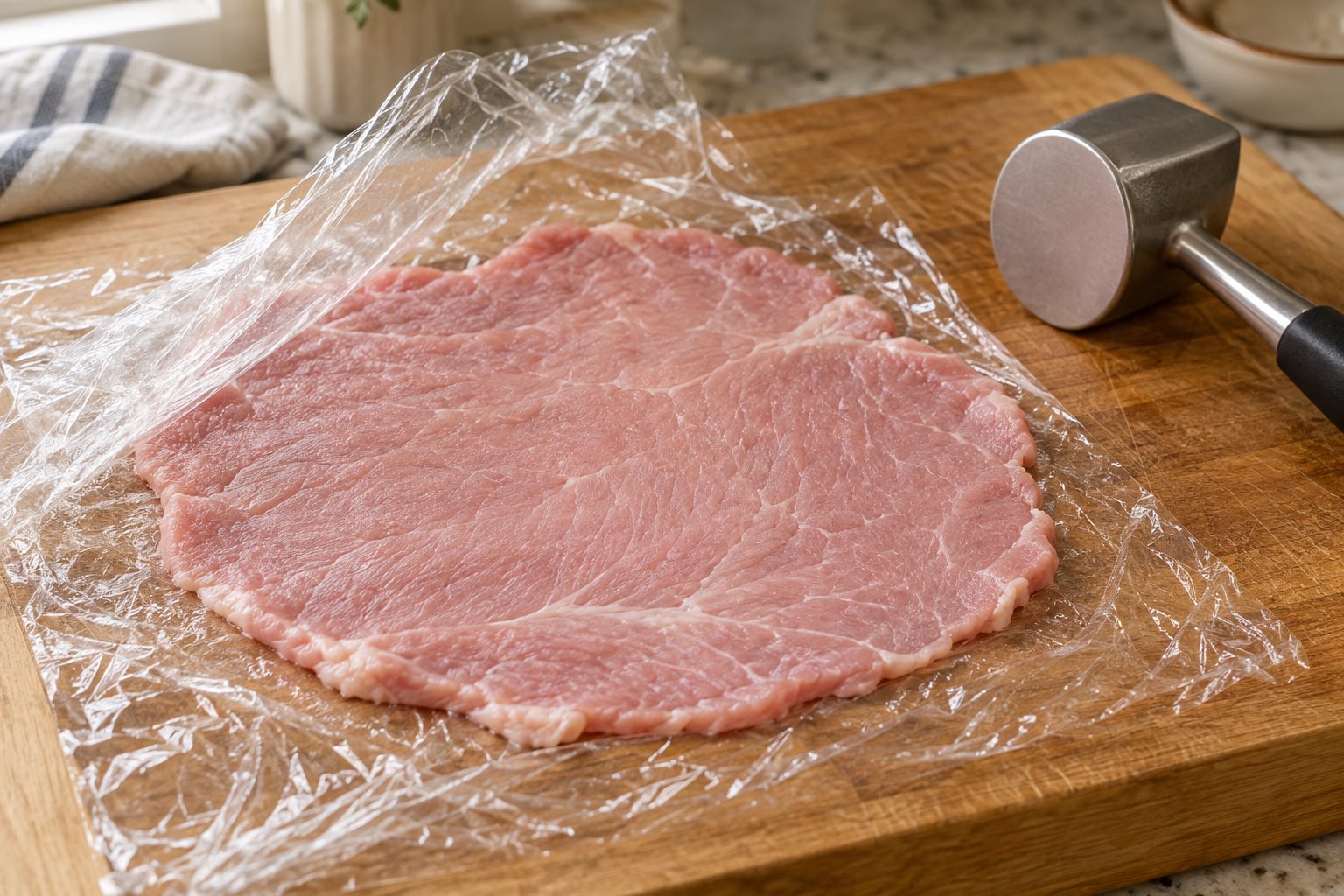
Loin, pounded, not tenderloin, sliced. A whole pork tenderloin weighs about a pound and tapers; flattened, it tears into a ragged strip. A centre-cut loin slice is a single wide-grained muscle with no seams running through it, which is why it will take a beating out to an eighth of an inch and come off the board in one piece. Buy the cut the sandwich is actually made of and the hardest step gets easy.
The federal breading cap is a useful ceiling. 9 CFR 319.880 is one sentence long: "The amount of batter and breading used as a coating for breaded product shall not exceed 30 percent of the weight of the finished breaded product." That is the line between a breaded cutlet and a crouton with a secret. Weigh the cutlet before and after if you like; a properly pressed coating on a thin loin slice lands well under it, and anything that lands over it has too much crumb and not enough pork.
Cracker crumbs rather than fine dry breadcrumbs. Crushed saltines are coarse, salty and already baked dry, so they brown quickly and set into a rigid shell that holds its shape off the meat. Fine crumbs pack tight against the cutlet and go sandy; panko puffs and shatters. The shell is the reason the overhang stays flat instead of drooping.
An eighth of an inch, because the crust has to set before the meat overcooks. Pork loin is lean and goes chalky fast. At an eighth of an inch the cutlet is cooked through in the time the breading takes to colour — two or three minutes — so there is no window in which you are waiting on the inside and ruining the outside.