American cooking Recipes & regional stories

Skillet & Sage

A culinary journey through the fifty states

The regional table / Massachusetts

Boston Cream Pie
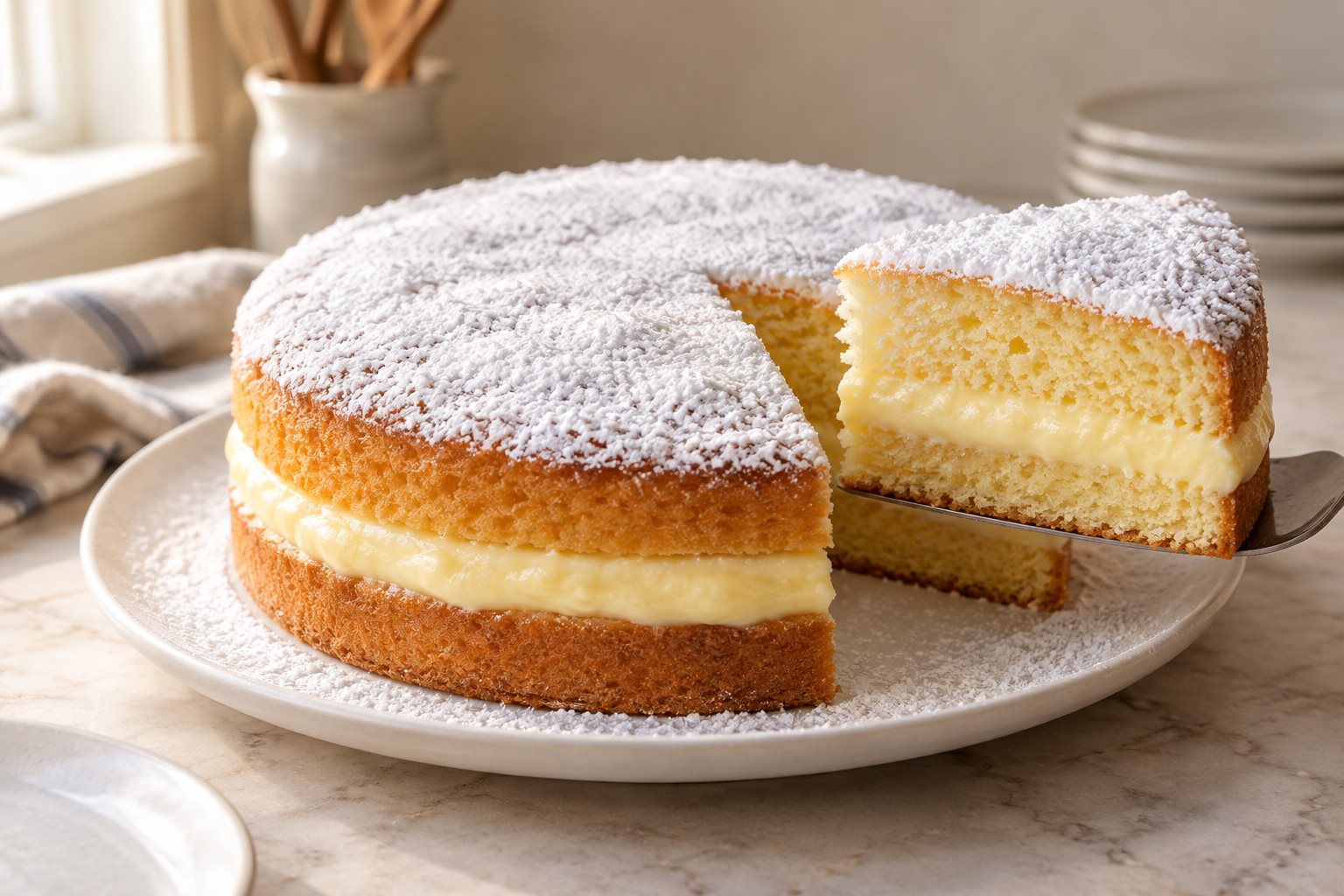
A two-layer yellow cake on a white plate, dusted heavily with powdered sugar, one wedge cut and lifted to show a thick pale band of cream filling between the layers
The filling should stand as its own layer, level and about half an inch thick. If it has run down the side of the cake it was not cooked long enough. AI-generated illustration.

It is a cake. Every book that prints it says so by where it puts it: Fannie Farmer files this in the cake chapter, on page 421, and keeps a completely different Cream Pie of three baked pastry crusts back on page 391.

The document is The Boston Cooking-School Cook Book, Fannie Merritt Farmer, 1896, and what it prints is worth reading slowly. Page 421, in the cake chapter, carries Cream Pie I: half a cup of butter, a cup of sugar, two eggs, half a cup of milk, one and three-quarter cups of flour and two and a half teaspoons of baking powder, mixed as her One Egg Cake, baked in round layer cake pans, with Cream Filling between the layers and the top sprinkled with powdered sugar. Directly under it sits Washington Pie — the same cake, raspberry jam or jelly instead of the cream, powdered sugar again. Overleaf on page 422 is Chocolate Pie, the same cake once more, split and spread between and on top with Chocolate Frosting. So the chocolate-covered version is in the book, under a different name, in a different recipe. There is no glaze on the cream one, and the phrase Boston cream pie does not appear anywhere in the 1896 edition, not in the recipes and not in the index. Mrs Lincoln does not use it either: her Boston Cook Book of 1884 has Sponge Cake for Cream Pies on page 375, baked in round shallow pans, split and filled with a cooked cream, and nothing on top of it at all.

The reason it is called a pie is the pan, and the pan can be chased through the books rather than asserted. Mrs Cornelius, The Young Housekeeper's Friend, Boston, has it first: her 1846 edition has no such recipe, but the revised and enlarged edition of 1859 prints, on page 53 of the cake chapter, Jelly-Cake, or Washington Pie — cup cake batter spread on round shallow tins, three tablespoons to a tin, baked ten or fifteen minutes, jam between the sheets. By 1860 the tin has the name on it: a White Mountain cake recipe in The Southern Field and Fireside that January says to bake in jelly-cake or Washington pie tins, four in number. By 1884 Mrs Lincoln bakes a corn cake in two Washington pie tins and a Harlequin cake in a Washington pie plate, and her cooking-school examination questions ask pupils to state the difference between Washington, jelly-cake, squash and mince pie plates — four distinct rounds of tinware in one Boston kitchen. Farmer herself still uses the word as a pan in 1896: her first strawberry shortcake is baked in buttered Washington pie or round layer cake tins. A recipe syndicated through the Georgia papers in November 1890 gives the instruction in the plainest form anyone has put it — Boston Cream Pie, a plain batter, and then: bake in two large pie tins, split open the cakes with a sharp knife and fill with cream. The name is a pan, the pan outlived the reason, and the Cleveland Courier of 4 October 1929, printing a recipe it credits to the federal Bureau of Home Economics, had already given up and headlined it Boston Cream Pie Is Cake — misleading in its name, for it is not a pie at all. The commonwealth is widely said to have made this the official state dessert by statute; malegislature.gov refused every connection on 22 September 2026 and the law-publishing mirrors answered 403, so this article does not rest on that and neither should you.

Why this version works

The pan is the recipe. A nine-inch pie tin is shallower and wider than a nine-inch cake pan, so the same batter bakes thinner, faster and with a higher proportion of browned surface. That is the texture the old recipes assume: two thin sheets rather than two deep layers, split apart by a band of cream about as thick as either of them. Bake this batter in deep pans and you get a filled layer cake, which is a good thing but is not this.

Butter cake, not sponge, and the books offer you both. Lincoln fills a sponge; Farmer fills a butter cake made as her One Egg Cake. The butter cake is the better host. Sponge is dry enough to drink the filling, and a day later the line between cake and cream has blurred; a butter crumb holds its edge, and the cream stays a layer you can see.

Powdered sugar, because that is what the documents print. Cornelius 1859, the 1871 Georgia printing of Washington Pie with a cream for it, the 1890 syndicated recipe, Lincoln 1884, Farmer 1896 and the 1929 Bureau of Home Economics version all finish with sugar or with nothing. Not one of them pours chocolate over a cream pie. The glaze is a real and now dominant finish and this recipe gives it to you as an option, but it is later than everything above and none of these books will tell you when it arrived.

Fifteen minutes in a double boiler, and flour rather than cornstarch. Farmer's Cream Filling is seven-eighths of a cup of sugar, a third of a cup of flour, an eighth of a teaspoon of salt, two eggs and two cups of scalded milk, cooked fifteen minutes over water. That is long, and the length is the point: flour-thickened custard tastes raw and chalky until the starch is fully cooked out, and a quarter of an hour of gentle heat both cooks it and pasteurises the eggs so the filling sets firm instead of weeping into the crumb.
Ingredient notes

The finish: two tablespoons of confectioners' sugar through a fine sieve, and dust it after the cake is cold or it dissolves into a damp film. For the chocolate version the glaze here is Farmer's own Chocolate Frosting from page 437 — chocolate melted over water, scalded cream, a yolk, a little butter and confectioners' sugar stirred in until it will spread — thinned enough to pour.

Butter and sugar: half a cup of butter to a cup of sugar, exactly Farmer's ratio, and the butter has to be soft enough to take a fingerprint before you start. The salt is mine — her cake has none, because the butter of 1896 was salted and yours is not.

Flour and baking powder: one and three-quarter cups of plain flour and two and a half teaspoons of baking powder. That is a lot of leavening by modern habit and it is correct for a shallow tin, where the batter has to lift fast before the thin layer sets. Measure the powder level; heaped, it leaves a metallic edge.

Milk and eggs for the filling: two cups of whole milk scalded, two eggs, and the flour and sugar mixed dry before anything wet touches them. Mixing dry first is not fussiness — flour tipped into hot milk lumps instantly, and the sugar keeps the grains apart until the eggs can carry them in.

Step by step

  1. Heat the oven and butter the tins. Heat the oven to 350°F. Butter two 9-inch pie tins well, including the sloped sides, and line the bottoms with rounds of parchment. If you have only cake pans, use two 9-inch rounds and expect a deeper, slower cake — add 3 to 5 minutes to the bake.
  2. Make the cake batter. Beat the butter and granulated sugar 3 minutes until pale. Beat in the eggs one at a time. Sift the flour, baking powder and salt together, and add in three parts alternating with the milk and vanilla, beginning and ending with flour. Stop as soon as the last streak goes.
  3. Bake the layers. Divide between the tins and level the tops. Bake 22 to 25 minutes, until the centres spring back and a skewer comes out clean. Cool 10 minutes in the tins, run a knife round the sloped edge, and turn out onto a rack to cool completely.
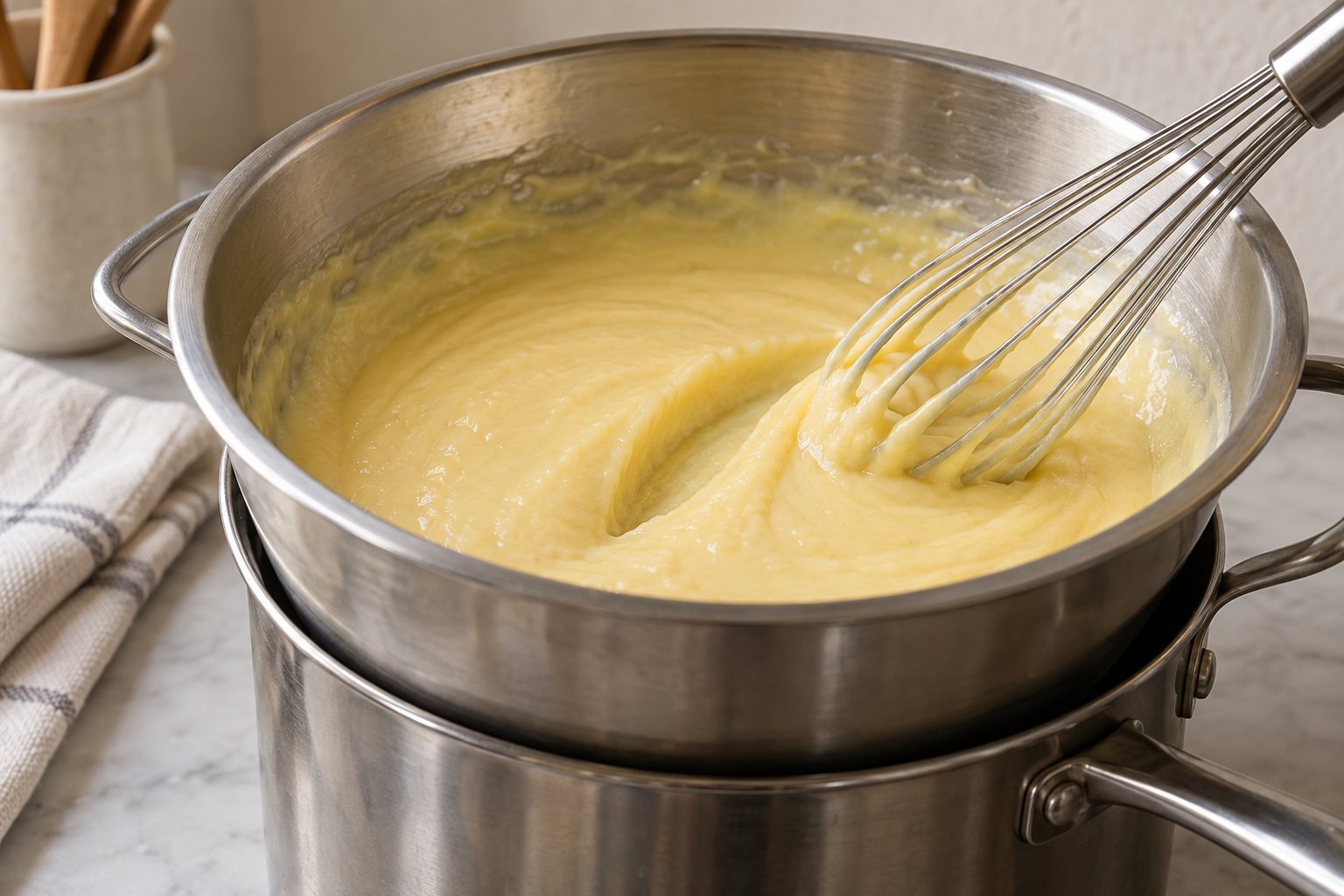
  4. Cook the cream filling. Mix the sugar, flour and salt in the top of a double boiler. Beat the eggs slightly, stir them in, then pour on the scalded milk gradually, whisking. Set over simmering water and cook 15 minutes, stirring constantly until it thickens and then occasionally. It should hold a furrow when you draw the whisk through it.
    A whisk leaving a distinct furrow in thick pale custard over a double boiler
    Cook the cream until a whisk leaves a furrow that holds its shape. AI-generated illustration.
  5. Cool the filling properly. Take it off the heat, stir in the vanilla, and press plastic wrap or buttered paper flat onto the surface so no skin forms. Cool to room temperature and then chill at least 1 hour. Warm filling on cool cake soaks straight in.
  6. Assemble. Set the better-looking layer aside for the top. Put the other on a plate and spread all the filling over it, right out to a quarter-inch from the edge — it will spread the rest of the way under the weight. Lay the second layer on and press it down gently and evenly.
  7. Finish, and choose your century. For the version in the books, chill 30 minutes, then sift confectioners' sugar thickly over the top. For the chocolate finish, melt the chocolate over hot water, stir in the scalded cream, then the confectioners' sugar a little at a time until it pours in a thick ribbon, and spread it over the top while it is still warm enough to level itself. Chill 30 minutes either way before cutting.
If the filling is loose after chilling, it did not cook long enough — flour needs the full fifteen minutes over water and most people pull it at eight. Scrape it back into the double boiler and cook it on, stirring, until it mounds on the spoon; it will thicken again and it will not be harmed. If instead it went grainy or shows threads of cooked egg, the water underneath was boiling rather than simmering. Push it through a fine sieve while warm, whisk hard, and it comes back smooth enough to use. Both faults disappear if the cake is cold and the filling is cold when they meet.

Storage and make-ahead

Refrigerated under a dome, it keeps 3 days, and the second day is arguably better than the first: the filling has had time to set hard and the crumb has softened against it. Take it out 30 minutes before serving, because cold flattens the butter in the cake. If it is dusted with sugar, the sugar will go damp overnight — sift on a fresh layer before it goes to the table.

Do not freeze it assembled. The filling separates on thawing and weeps into the cake. The cake layers themselves freeze well for a month, double-wrapped and unfilled; make the filling fresh on the day, since it needs only fifteen minutes at the stove and an hour in the fridge.

What to serve with it

Coffee, black, and nothing else on the plate. This is a rich, sweet, soft dessert with no acid anywhere in it, so if the table wants something alongside, make it sharp and cold — a small glass of tart cherries in their own juice, or plain raspberries, which is also the direction Farmer's Washington Pie points in.

A two-layer yellow cake on a white plate, dusted heavily with powdered sugar, one wedge cut and lifted to show a thick pale band of cream filling between the layers

From the recipe box / Massachusetts

Boston Cream Pie

A butter cake baked in two pie tins, split by a cooked cream filling, with powdered sugar on top — the way every nineteenth-century book that prints it prints it.

Prep
30 min
Cook
40 min
Total
2 hr 30 min
Serves
8
Calories
465 per serving

Ingredients

Scale

Instructions

  1. Heat the oven to 350°F. Butter two 9-inch pie tins, sides included, and line the bottoms with parchment rounds.
  2. Beat the butter and granulated sugar 3 minutes, beat in the eggs one at a time, then add the sifted flour, baking powder and salt in three parts alternating with the milk and vanilla.
  3. Divide between the tins and bake 22–25 minutes, until the centres spring back. Cool 10 minutes, then turn out onto a rack to cool completely.
  4. Mix the filling sugar, flour and salt in a double boiler, stir in the slightly beaten eggs, pour on the scalded milk gradually, and cook 15 minutes over simmering water until thick.
  5. Stir in the vanilla, press wrap onto the surface, cool to room temperature and chill at least 1 hour.
  6. Spread all the filling over one layer to within ¼ inch of the edge and press the second layer gently on top.
  7. Chill 30 minutes, then sift confectioners' sugar thickly over the top — or pour on the chocolate glaze made from the melted chocolate, scalded cream and confectioners' sugar.

Nutrition

Fat17 g (9 g saturated)
Sodium300 mg
Protein9 g
ServingOne eighth of the cake, dusted with sugar
Calories465
Cholesterol140 mg
Carbohydrates67 g (45 g sugar, 1 g fiber)

Nutrition is an estimate calculated from the listed ingredients and is provided as a courtesy, not as dietary advice.

Questions readers ask

Where is the chocolate?

Not in any nineteenth-century printing anyone can reach. Farmer 1896 finishes her Cream Pie with powdered sugar and puts Chocolate Frosting on a separate recipe two pages later called Chocolate Pie; Lincoln 1884 puts nothing on hers; the syndicated 1890 newspaper version and the 1929 Bureau of Home Economics version both dust with sugar. The glaze is genuine and it is what most people now mean by the name, so it is given here as an option — but the plain one is the older cake and it is the better argument for the recipe.

Can I use a sponge cake instead?

Yes, and you would be following Mrs Lincoln rather than Miss Farmer: her Sponge Cake for Cream Pies, also called Berwick Sponge Cake, is three eggs, a cup and a half of sugar, water, lemon, two cups of pastry flour, cream of tartar and soda, baked in round shallow pans and split. It is lighter and it stales faster, and the filling should go in within a couple of hours of assembling rather than the day before.

Why does my filling taste pasty?

It was undercooked. Flour thickens long before it stops tasting like flour, so the custard looks finished at seven or eight minutes and needs fifteen. Keep the water below the top pan at a bare simmer, stir constantly until it thickens and then every minute or so, and taste it at the end — raw starch is unmistakable once you have met it.

Do I really have to use pie tins?

No, and the cake will be good in two 9-inch round cake pans with a few minutes more in the oven. But the tin is the whole reason for the name, and it changes the proportions: shallower layers, more browned surface, a filling that reads as thick as the cake around it. If you own pie tins, this is the one day a year they make a cake better.