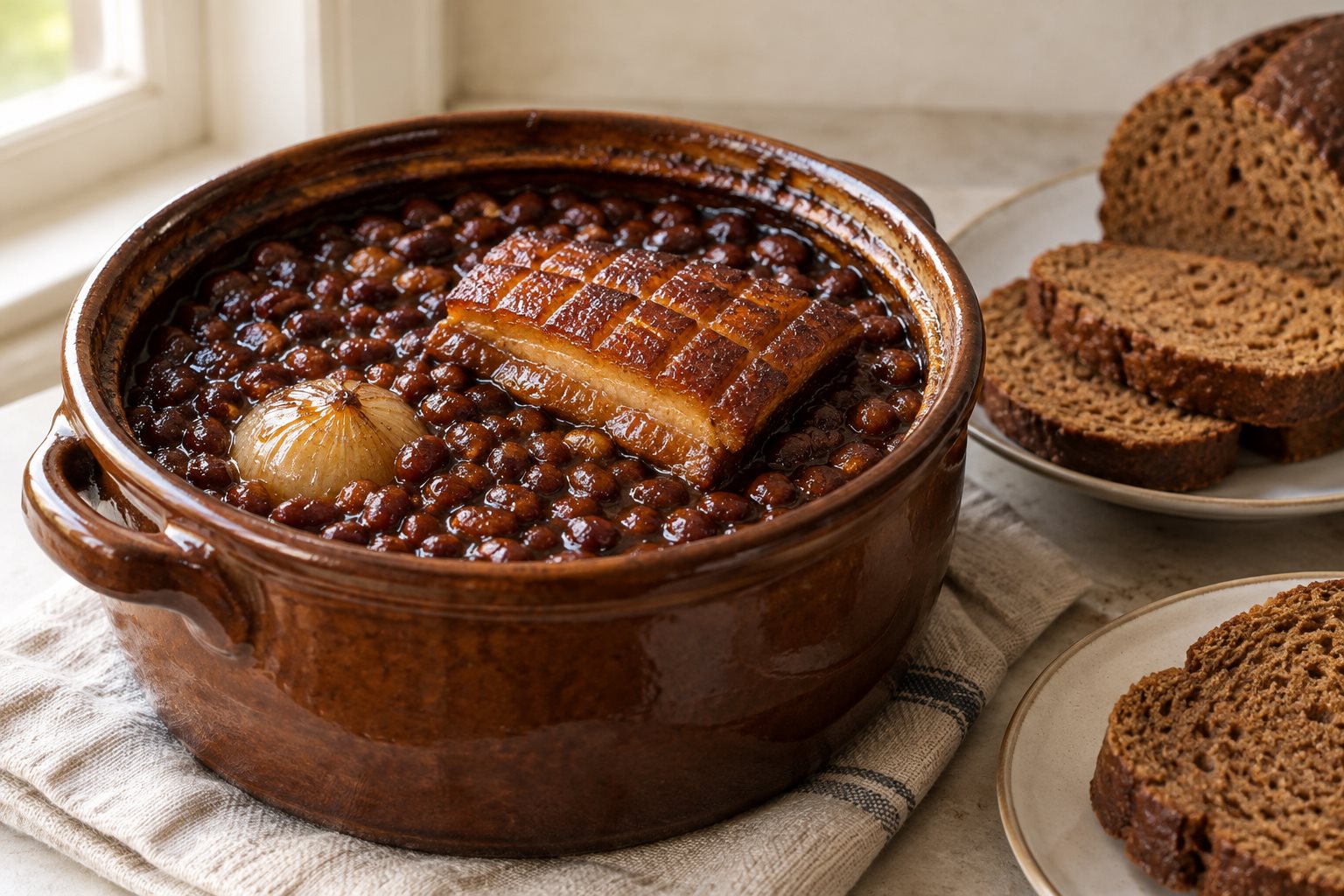
Fannie Farmer tests the parboil by lifting a few beans on the tip of a spoon and blowing on them. If the skins burst, the beans are ready for the pot. It is an odd thing to do and it is the most useful sentence in the recipe.
Three Boston books, sixty years apart, and they do not agree. Lydia Maria Child's The American Frugal Housewife, in the 1838 printing, bakes a quart of beans with a pound of pork — cheeks are best, she says — a little pepper, water just to cover, and three or four hours in the oven. No molasses. No sugar. Nothing sweet at all. Mrs Lincoln's Boston Cook Book of 1884 soaks a quart overnight, simmers them until they can be pierced with a pin, and mixes a quarter cup of molasses with a teaspoon of salt and a teaspoon of mustard. Fannie Merritt Farmer, in The Boston Cooking-School Cook Book of 1896, pages 211 and 212, does something different again: one tablespoon of salt, one tablespoon of molasses and three tablespoons of sugar to the same quart of beans, half a pound of fat salt pork, six or eight hours in a slow oven with the last hour uncovered so the rind browns and crisps. Her own time table for oven dishes gives baked beans as six to eight hours. In the 1900 revision she raised the pork to three-quarters of a pound and left everything else where it was.
The two books also argue about the pot, in print. Lincoln: much of the excellence of baked beans depends upon the bean-pot, which should be earthen, with a narrow mouth and bulging sides, a shape she says is seldom found outside New England and is said to have been modelled after Assyrian pots. Farmer, twelve years later, flatly disagrees — the fine reputation of Boston baked beans has been attributed to that pot, she writes, and equally good beans have often been eaten where a five-pound lard pail was substituted for the broken bean pot. Her book uses the same lard pail as a mould for Boston brown bread, so she is not being rude about it. As for the Saturday night the dish is famous for, the evidence is in the newspaper rather than the cookbook. A Boston Herald piece reprinted in Georgia papers in December 1880 and again in December 1881 reports that custom prescribed Saturday night or Sunday morning as the correct time to eat them, that few of the hundreds of bakers in the city failed to put one to five barrels of beans to soak on Friday night, and that for five cents a baker would take in a household's own filled pot and bake it in his brick oven. It puts the city's consumption at around two hundred barrels a week. Alice Morse Earle's The Sabbath in Puritan New England, 1891, supplies the reason the bake had to be done by Saturday sundown: in ministers' households, from sunset on Saturday until Sunday night no food was prepared and no cooking utensils were washed. Earle never once mentions beans.
Why this version works
The pork is scored, buried, and left rind up. Farmer scalds the rind, cuts a quarter-inch slice off to line the bottom of the pot, then scores the remaining block through the rind every half inch, an inch deep, and buries it in the beans with only the rind showing. The buried fat renders into the pot for six hours; the exposed rind is what crisps when the lid comes off. Scoring gives the fat a way out and gives you squares that pull apart at the table.
A slow oven, and the water never drops below the beans. Lincoln is explicit — keep them covered with water until the last hour, then lift the pork to the surface and let it crisp. Farmer just says add water as needed. Skins that surface into dry air go leathery and stay that way, and no amount of later liquid fixes them. At 300°F a pound of beans wants five to six hours, which is Farmer's six-to-eight in a hotter, less controllable oven.
Less sweetening than most modern recipes, more than the books. Scaled to a pound of dry beans, Lincoln's quarter cup works out near two tablespoons of molasses, Farmer's to about half that plus a little under two of sugar, and Child's to nothing whatever. Four tablespoons of molasses and two of brown sugar, as here, is sweeter than any of the three and still well short of a supermarket can. If you want to cook the 1838 version, leave both out and add pepper; it is a good dish and a completely different one.
The beans are boiled soft before anything sweet or salty goes near them. Child, Lincoln and Farmer all parboil first, and they are right for a reason the USDA put in writing in 1900. Farmers' Bulletin 121, Beans, Peas, and Other Legumes as Food, reports that legumin forms insoluble compounds with the lime and magnesia salts in hard water, so that parts of the bean stay hard no matter how long they are cooked. By USDA's own composition figures molasses carries about 205 milligrams of calcium per 100 grams. The bulletin does not test molasses itself, so that connection is not proven there — but the three Boston books all have the beans soft before the sweetening is mixed, and it is a cheap habit to keep.
Ingredient notes
Beans: a pound of navy beans, which the United States Standards for Beans — the federal grading standard, sourced to 34 FR 7863 of 17 May 1969 — files under the class Pea Beans, defined as the type grown in the Great Lakes region, known also as Navy Beans. Pea bean is what all three Boston books call them. Farmers' Bulletin 121 says the small white bean is used for baking chiefly because its skin is thin and tender. Buy from somewhere with turnover: beans several years old may never soften. Farmer and Lincoln both name yellow-eye beans as good baked.
Water: the 1900 bulletin is firm that hard water is unsuitable for cooking any dried legume and that rain water is the best there is. Its advice where the tap is hard: boil the water and pour it off the sediment before using it, for soaking as well as cooking. Baking soda does fix the hardness, it says, but the flavor is apt to be injured. Filtered water is the modern answer to the same problem.
Molasses: unsulphured, not blackstrap, which is bitter over six hours. It is worth saying where it came from. Weeden's Economic and Social History of New England, 1890, working from colonial records, traces the circuit plainly: the lowest grade of New England cod, the refuse fish, was shipped to the West Indies and eaten by enslaved people on the sugar plantations; molasses came back; Boston had a still working by 1714 and eight distilleries on Price's plan of the town; and the trade in enslaved people on the African coast absorbed the rum. Rhode Island's 1764 remonstrance, which he quotes, counts 14,000 hogsheads of molasses a year into that colony, thirty distilleries, and American rum driving French brandy off the African coast, with Massachusetts importing within a thousand hogsheads of as much.
Salt pork: half a pound, unsmoked, rind on, which is Farmer's 1896 quantity; her 1900 revision calls for three-quarters. Child allows a pound to the quart and says pieces alternately fat and lean are most suitable, the cheeks best. Bacon is the wrong thing here — there is no smoke anywhere in these books — but if it is all you have, blanch it two minutes in water first and expect a different dish.
Step by step
Soak overnight. Pick the beans over for stones and split ones, cover them by three inches with cold soft water, and leave them 8 to 12 hours. Farmers' Bulletin 121 puts the usual soak at not less than eight hours and says the long soak is to be preferred to a short stand in hot water.
Parboil below the boil. Drain, cover with fresh water by two inches, and bring up slowly, keeping the pot just under a boil for 30 to 45 minutes. Test the way Farmer does: lift a few beans on a spoon and blow across them, and when the skins burst they are done. Drain and discard that water; do not use it in the pot.
Prepare the pork and load the pot. Pour boiling water over the pork and scrape the rind. Cut a quarter-inch slice from the block and lay it in the bottom of a 3-quart bean pot or 5-quart Dutch oven. Score the remaining block through the rind every half inch and an inch deep. Heat the oven to 300°F. Tip in the beans with the onion, and bury the pork among them with the rind level with the surface.
Mix the seasoning and cover with boiling water. Stir the molasses, brown sugar, salt, mustard and pepper into 1 cup of boiling water until the molasses has gone, and pour it over the beans. Add enough more boiling water to cover them by half an inch.
Bake covered for five hours. Lid on, into the oven. Look at it every ninety minutes and pour in boiling water whenever the level drops to the beans — count on two or three cups over the whole bake. The beans should never be seen dry.
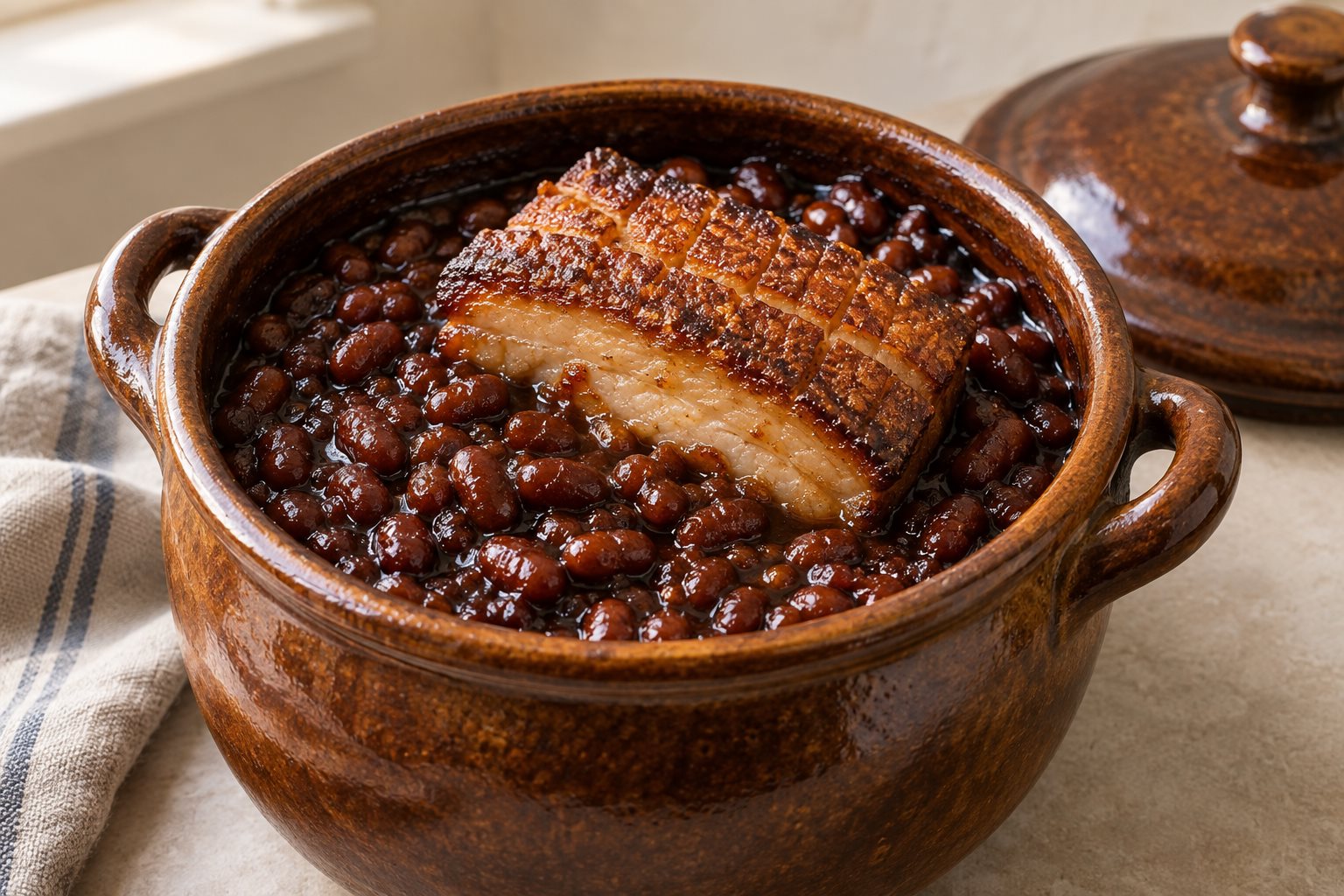
Uncover for the last hour. Take the lid off, lift the pork so the rind sits proud of the surface, and bake 60 minutes more, until the rind is brown and crisp and the liquid has drawn down to a syrup around the beans. Taste for salt, which depends entirely on the pork. Rest 20 minutes before serving.
Expose the pork rind for the final uncovered hour so it can brown above the beans. AI-generated illustration.
If the beans are still chalky after six hours, they were old or the water was hard, and more time on its own will not fix either. Add a cup of boiling water, cover, and give them another hour; if they still resist, stir a quarter teaspoon of baking soda into the next cup of water you add. That is the remedy the 1900 bulletin gives for hard water, with its own warning attached — the beans soften and the flavor is apt to be injured. The other failure is a pot gone dry, which shows up as wrinkled, leathery skins on top. Those beans do not come back; push them under, top up with boiling water, and finish the bake for the sake of the ones below.
Storage and make-ahead
Baked beans keep 5 days refrigerated and are better on the second day than the first. Reheat them covered in a 325°F oven for 30 minutes with a splash of water stirred through, or in a saucepan over low heat. They freeze well for 3 months, which the milk-based dishes of this coast do not.
Farmer prints the leftover dish too. Her Baked Bean Soup takes 3 cups of cold baked beans, 3 pints of water, 2 slices of onion and 2 stalks of celery, simmered half an hour and rubbed through a sieve, then a cup and a half of stewed and strained tomatoes and a tablespoon of chili sauce, bound with a tablespoon each of butter and flour cooked together.
What to serve with it
Steamed brown bread, which shared the oven with the beans by Child's own instructions: white bread and pies were not to go in until the brown bread and beans had been in half an hour. Farmer's Boston brown bread is a cup each of rye meal, granulated corn meal and Graham flour with half a cup of molasses and sour milk, steamed three and a half hours in a buttered mould — a five-pound lard pail, she says, answers the purpose.
Everything else should be sharp and cold against six hours of pork fat and molasses: cabbage slaw with cider vinegar, bread-and-butter pickles, or pickled beets.
From the recipe box / Massachusetts
Boston Baked Beans
Pea beans boiled soft before anything sweet touches them, a scored block of salt pork buried rind up, and six hours in a slow oven with the lid off for the last one.
Prep
20 min
Cook
6 hr 30 min
Total
6 hr 50 min
Serves
8
Calories
450 per serving
Ingredients
Scale
Instructions
Soak the picked-over beans in cold soft water to cover by 3 inches for 8–12 hours.
Drain, cover with fresh water by 2 inches, and hold just under a boil 30–45 minutes, until the skins burst when you blow on a few on a spoon. Drain and discard that water.
Scald and scrape the pork rind, cut a ¼-inch slice for the bottom of a 3-quart bean pot, and score the rest through the rind every ½ inch. Heat the oven to 300°F.
Tip in the beans and the whole onion and bury the pork among them, rind level with the surface.
Stir the molasses, brown sugar, salt, mustard and pepper into 1 cup boiling water, pour it over, and add boiling water to cover the beans by ½ inch.
Bake covered 5 hours, adding boiling water whenever the level drops to the beans.
Uncover, lift the pork rind proud of the surface, and bake 1 hour more until the rind is crisp and the liquid is syrupy. Season and rest 20 minutes.
Nutrition
Fat
23 g (8 g saturated)
Sodium
890 mg
Protein
15 g
Serving
About 1 cup
Calories
450
Cholesterol
20 mg
Carbohydrates
45 g (12 g sugar, 8 g fiber)
Nutrition is an estimate calculated from the listed ingredients and is provided as
a courtesy, not as dietary advice.
Questions readers ask
Do I need a bean pot?
The two women who ran the Boston Cooking School disagreed about this in print. Lincoln, 1884: much of the excellence of baked beans depends upon the pot, earthen, narrow-mouthed, with bulging sides. Farmer, 1896: equally good beans have often been eaten out of a five-pound lard pail standing in for a broken bean pot. A heavy 5-quart Dutch oven with a tight lid works, though the wide mouth evaporates faster, so check the water more often.
Can I do the all-night bake?
Yes, and it is the older way: the 1900 bulletin describes pork and beans baked all night in the New England brick oven as a legume properly prepared, and the Boston bakers of 1880 filled their ovens overnight. Use 250°F for 9 to 10 hours, with the water topped up before you go to bed, and give it the uncovered hour in the morning. A brick oven falling gradually from bread heat is what the method was built around; a modern oven holding one low temperature is close enough.
Do I have to soak them overnight?
Farmers' Bulletin 121 of 1900 notes that some cooks skip it, covering the beans with hot water for a short stand instead, and says the overnight soak is to be preferred — not less than eight hours. Both Boston books soak overnight. The parboil that follows is not optional in any of them, soak or no soak.
Where is the tomato or the ketchup?
Not in any of the three books. Child has no sweetening of any kind in her beans, Lincoln has molasses and mustard, Farmer has molasses, sugar and optional mustard, and none of them has tomato within reach of the pot. Farmer does use stewed tomatoes and chili sauce — but in the soup she makes from the leftovers the next day.