American cooking Recipes & regional stories

Skillet & Sage

A culinary journey through the fifty states

The regional table / Idaho

Basque Chorizo with Beans
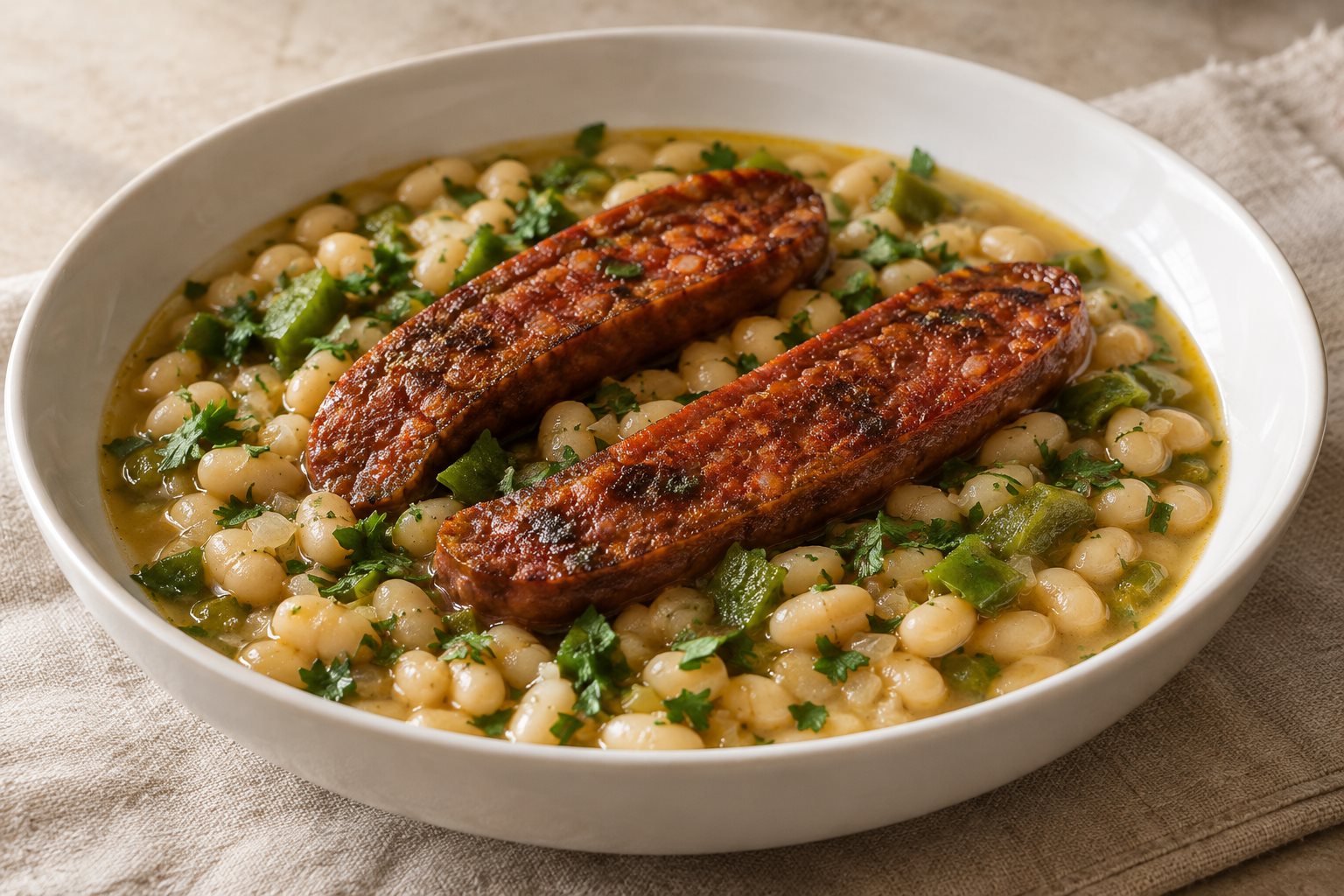
A shallow white bowl of pale beans in a thin golden broth with two split chorizos browned side up laid across them
The chorizos go in whole and come out split. Everything orange in the bowl came out of them while the beans cooked. AI-generated illustration.

The 1905 Boise city directory names a street called Spanish Town, lists a man named Uberuaga keeping furnished rooms on West Idaho, and contains the word Basque exactly zero times.

Boise is a Basque city that took a long time to be called one in print. Polk's Boise City Directory for 1905 is a plain commercial document — streets, names, trades — and it is more useful about this than any later account. Its list of streets and avenues includes an entry between Sixth Street and State Street that reads "SPANISH TOWN, south from 101 W Main." Under Furnished Rooms, among the Larsens and the Palatines and the Cosmopolitans, is "Uberuaga Joseph, 706½ W Idaho", and in the alphabetical pages he appears again as a keeper of furnished rooms. Search the whole volume for the word Basque and you get nothing. The trade is recorded, the street is recorded, the surname is recorded; the people are filed as Spanish or not filed at all.

By the time the Federal Writers' Project published Idaho: A Guide in Word and Picture in 1937, the omission had been corrected loudly: the guide calls the Basques of Boise "the largest, and by far the most significant, colony in Idaho", puts about 7,000 in the state and 1,500 in Boise itself, notes that "On Grove Street is their DeLamar Hotel, a hostelry popular with the colony", and describes the midsummer festival as a genuine Romeria "with Basque food, costumes, dances, and music". It never says what the food was. The word chorizo does not appear in that book once. For that you have to go to the houses themselves, and the Basque Museum and Cultural Center in Boise keeps the record of the one that is still standing: the Cyrus Jacobs house at 607 Grove Street, which the museum says "began being used as a Basque boardinghouse in 1910 and functioned in that capacity until 1969", first rented by the Galdos, Bicandi and Uberuaga families and finally bought by the Uberuagas in 1928 for two thousand dollars. No Boise Basque recipe from that period is reachable in any open archive, and none is invented here; the quantities below were worked out for this page.

Why this version works

White beans, not red. Alubias blancas or plain small white beans make a thinner, paler, more savoury broth than red beans do, and they let the sausage be the loudest thing in the bowl. Red beans fight it. This is the difference between a pot where the beans are the dish and a pot where the chorizo is.

The chorizos go in whole. Slicing sausage into a bean pot at the start gives you sixty cut faces leaking fat and paprika into the liquid, and by the end the coins are grey and spent. Left whole, a chorizo gives the pot its colour slowly through the casing and keeps most of its own texture. You take it out at the end still intact, and it still tastes of itself.

Split and seared at the end. Lift the poached sausages out, halve them the long way, and put the cut faces down in a dry hot pan for ninety seconds. The fat that is left inside renders against the metal, the cut face caramelises, and you get a browned, slightly bitter edge that two hours of simmering can never produce. This is a cook's decision, not an inherited rule, and it is worth making.

Nothing sour until the beans are soft. Acid keeps bean skins tough. Peppers, tomato, wine or vinegar all go in after the beans give way, off the heat, which is late enough to season and too late to set the skins.
Ingredient notes

Fat: two tablespoons of olive oil and nothing else. There is no bacon, no hock and no salt pork here — the sausage supplies all the meat and all the colour, and the point of this pot is that you can see exactly what it supplied.

Beans: a pound of dried small white beans — alubias, cannellini or Great Northern — soaked overnight and cooked in their soaking water. Do not tip that water away; it is half the broth.

Chorizo: six whole Spanish-style chorizos, the semi-cured or fresh kind rather than the hard salami-like sticks, about a pound and a quarter in total. They must be firm enough to lift out of the pot in one piece after an hour. If your shop sells only the hard dry kind, use four of those and add them in the last thirty minutes.

Aromatics: two onions, a whole head of garlic split across the equator, two bay leaves and a green pepper. The pepper goes in at the end with the parsley, raw and chopped, which keeps some bite in a bowl that is otherwise entirely soft.

Step by step

  1. Soak the beans overnight. Cover the beans with 3 inches of cold water and leave them 8 to 12 hours. Keep the water.
  2. Soften the onion. Warm the olive oil in a wide heavy pot over medium and cook the onions 10 minutes until soft and just golden. Lay the split head of garlic in cut side down for 2 minutes.
  3. Start the beans. Add the beans with their soaking water, topped up to cover by 2 inches, and the bay. Bring to a bare simmer and cook 45 minutes with the lid ajar.
  4. Poach the chorizos in the pot. Lower the whole chorizos into the beans, prick none of them, and cook 1 hour more at the same bare shiver, topping up with hot water if the level drops below the beans. The broth will turn a clear gold-orange as the fat comes out.
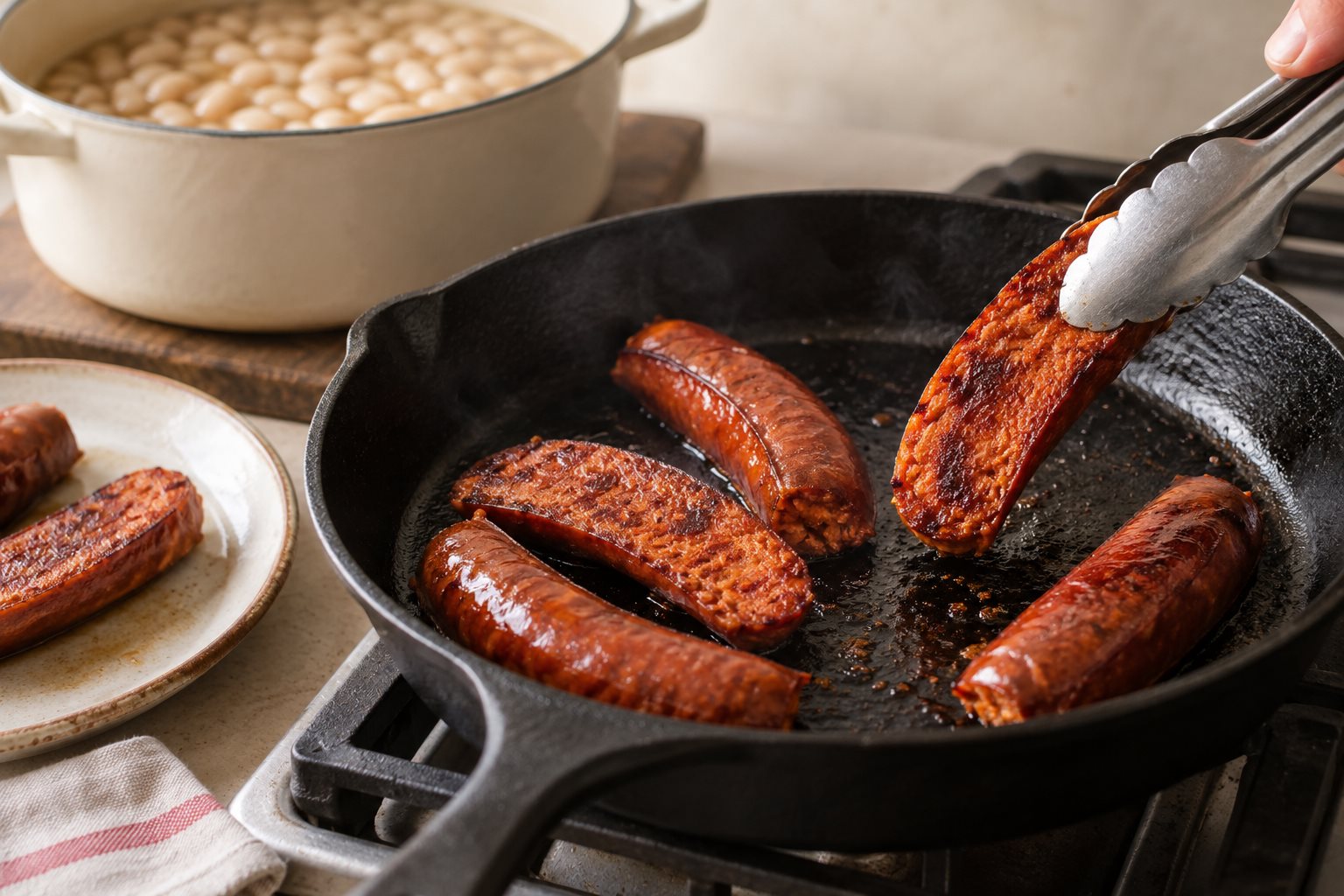
  5. Lift, split and sear. Take the sausages out with tongs and halve them lengthways. Put a dry skillet over high heat and lay the cut faces down for 90 seconds, until browned and blistered. Set them aside.
    Tongs lifting a split chorizo to show its browned cut face over a skillet.
    Split the poached chorizos lengthwise and sear their cut faces briefly before serving. AI-generated illustration.
  6. Season the pot last. Add the salt, the chopped green pepper and the sherry vinegar to the beans off the heat, squeeze the soft garlic out of its skins back in, and taste. Rest 10 minutes, then ladle into bowls and lay the seared chorizo halves on top with the parsley.
If the broth is watery, lift out a ladleful of beans, crush them against a bowl with a fork and stir them back in — starch is the only thickener this pot should ever see. If the beans are still hard after two hours they were old stock and nothing will rescue them faster than more time. If the sausages fell apart when you lifted them, they were fresh rather than cured: fish out the pieces, brown them in the skillet anyway, and call it a different dinner.

Storage and make-ahead

Four days in the fridge, and better on the second once the fat has set on top and been stirred back through. Keep the seared chorizo separate and re-crisp it in a dry pan when you reheat, or it goes soft in the broth.

The beans freeze for three months. The sausage does not freeze well once it has been split and seared, so freeze the pot and buy fresh chorizo for the top.

What to serve with it

Bread, torn rather than cut, and enough of it to finish the broth. This was boarding-house food and boarding-house food came with a loaf on the table.

A hard cider or a rough red, and something raw and sharp afterwards — plain sliced onion in vinegar, or an escarole salad.

A shallow white bowl of pale beans in a thin golden broth with two split chorizos browned side up laid across them

From the recipe box / Idaho

Basque Chorizo with Beans

White beans cooked slowly with onion and garlic while whole chorizos poach in the pot, then come out to be split and crisped and laid back on top.

Prep
20 min
Cook
2 hr
Total
2 hr 20 min
Serves
6
Calories
542 per serving

Ingredients

Scale

Instructions

  1. Soak the beans overnight in 3 inches of cold water and keep the water.
  2. Cook the onions in olive oil 10 minutes, then lay the split garlic head cut side down for 2 minutes.
  3. Add the beans with their soaking water topped up to cover by 2 inches, and the bay. Simmer 45 minutes with the lid ajar.
  4. Lower in the whole chorizos and cook 1 hour more at a bare shiver, topping up with hot water as needed.
  5. Lift out the sausages, halve them lengthways, and sear the cut faces 90 seconds in a dry hot skillet.
  6. Off the heat stir the salt, green pepper, vinegar and squeezed garlic into the beans, rest 10 minutes, and lay the chorizo on top with parsley.

Nutrition

Fat26 g (9 g saturated)
Sodium920 mg
Protein27 g
Servingabout 1½ cups with one chorizo
Calories542
Cholesterol48 mg
Carbohydrates50 g (5 g sugar, 12 g fiber)

Nutrition is an estimate calculated from the listed ingredients and is provided as a courtesy, not as dietary advice.

Questions readers ask

Which chorizo should I buy?

A semi-cured Spanish-style link, firm enough to lift whole out of a simmering pot after an hour. Mexican fresh chorizo is a different sausage, loose and raw, and it will disintegrate; the very hard dry sticks are fine but add them only for the last half hour or they turn leathery. If you can find a maker who cures their own, buy theirs.

When does chorizo reach the Idaho newspapers?

Astonishingly late, and not from Boise. In the Pocatello dailies, which run unbroken from the 1940s, the word appears four times before 1970 and one of those is optical-character noise. The earliest genuine one is a syndicated cookery column of 12 January 1956 headed "FOREIGN DISHES are delightfully different", which introduces its readers to "Lentejas Guisadas Con Chorizo, meaning lentils cooked with sausages". Boise had been making chorizo in boarding-house kitchens for half a century by then, and the state's own press was explaining the word as a foreign novelty. Boise has no daily newspaper in any open archive, so that gap cannot be closed from here.

Is this the same as the Nevada Basque bean pot?

No, and the difference is deliberate. The Nevada dish on this site is a red-bean pot built on rendered chorizo fat and a ham hock, from sheep-camp households in the Great Basin. This is a white-bean pot from a city, where the sausage is poached whole and finished separately. Both are Basque and both are American, and neither is more authentic than the other. The Boise documents are about houses rather than about pots, and the cooking here is an honest reconstruction rather than a transcription.

How well documented is the Boise boarding house?

Better than most. The Basque Museum and Cultural Center holds the Cyrus Jacobs/Uberuaga house at 607 Grove Street and publishes its own chronology: a boardinghouse from 1910 to 1969, rented first by the Galdos, Bicandi and Uberuaga families, bought by the Uberuagas in 1928 for $2,000. Jose Uberuaga had come from the Basque Country to Boise in 1907 at twenty; Hermenegilda Bernedo arrived in March 1913 and married him that July; they took over the Grove Street lease in 1917, and after Jose died in 1954 Hermenegilda ran the house until her own death in 1969. The museum quotes John and Mark Bieter's An Enduring Legacy on what such a house was for: "For young Basque immigrants a long way from home, the boarding houses became the village church, the town tavern, the bank and health dispensary."