American cooking Recipes & regional stories

Skillet & Sage

A culinary journey through the fifty states

The regional table / Montana

Bison Stew
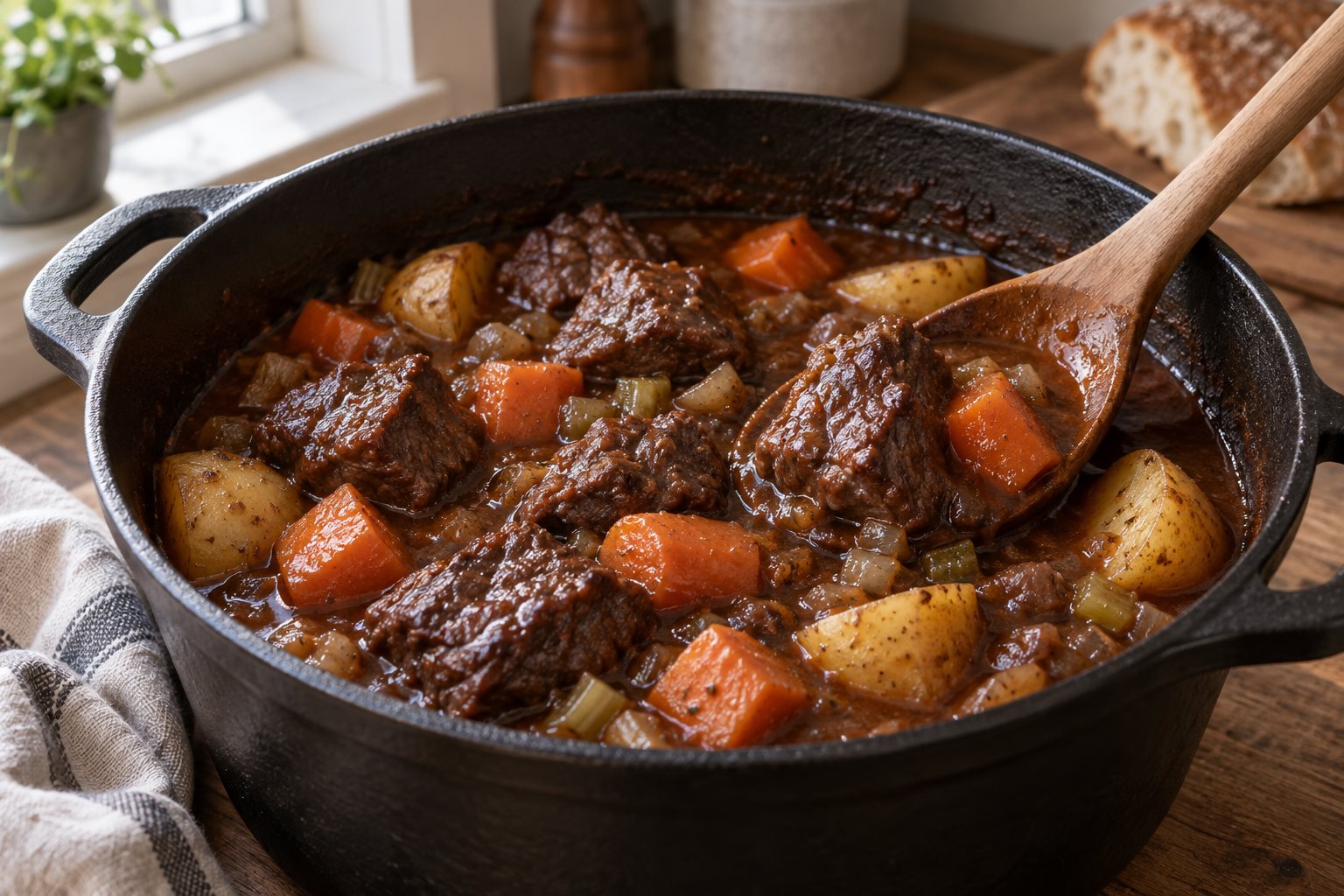
A dark stew of bison chunks, carrots and potatoes in a cast iron Dutch oven, thick gravy clinging to a wooden spoon
Bison chuck goes from tough to tender and then straight to dry. The window is real but it is not narrow. AI-generated illustration.

Bison is a farmed animal with a federal grade standard and a voluntary inspection service, and it is worth knowing exactly how it got to be one.

The destruction of the herds is not folklore, it is a federal publication. William T. Hornaday's The Extermination of the American Bison appeared in the Report of the National Museum for 1887, printed by the Government in 1889, and it is free to read. Its account of Montana is exact: "The hunting season which began in October, 1882, and ended in February, 1883, finished the annihilation of the great northern herd, and left but a few small bands of stragglers, numbering only a very few thousand individuals all told." A Minneapolis robe buyer, J. N. Davis, wrote to Hornaday on 27 September 1887 with the trade's side of it — about two hundred thousand hides and robes bought and shipped in 1882, forty thousand in 1883, and then one car load, which "was the last shipment ever made". That is the span of a single human career, start to finish.

What came next is worse to read and is also on the federal record. In the first three months of 1886 Hornaday, then chief taxidermist of the National Museum, found by correspondence that the actual number of wild bison remaining in the whole United States "was probably less than three hundred", and that his own museum, with one mounted female skin and a few dilapidated pieces, could not show a single presentable male. So the Secretary of the Smithsonian, Spencer F. Baird, sent a collecting party into the field, resolved "to collect at all hazards, in case buffalo could be found, between eighty and one hundred specimens of various kinds" — twenty to thirty skins, as many skeletons, at least fifty skulls. The leads came from an Army surgeon writing from Huntley, Montana; two of the three were wrong, and the party went to the Big Dry country out of Fort Keogh with War Department transport and escort. The national museum shot the survivors so that there would be bison to look at afterwards. None of that is a reason not to cook bison, and it is a reason not to cook it sentimentally. The animal on sale today is farmed: 9 CFR part 352 lists bison among "exotic animals" alongside reindeer, elk, deer, antelope, water buffalo and yak, with inspection voluntary and paid for by the applicant rather than mandatory as it is for cattle, and the same section says flatly that "Bison includes catalo or cattalo" — the direct bison-and-cattle cross. On the grading side, 7 CFR 54.1 defines the animals the Agricultural Marketing Service grades as "Bison, cattle, goats, sheep, swine, or other species identified by the Administrator". It is livestock, with paperwork.

Why this version works

The vegetables go in late. Potatoes and carrots take forty-five minutes. Put them in at the start and they disintegrate into the gravy, which thickens it and costs you everything that was good about having them there. Add them for the last stretch and they arrive whole.

A bare shiver, never a boil. Collagen turns to gelatin from about 160°F, and it will do that whether the pot is simmering or boiling. Boiling only squeezes the muscle fibres harder and faster, which on a lean meat is the difference between tender and stringy. A 325°F oven holds the pot at the right lazy blip without watching.

Time, not temperature, is the lever. Bison chuck is tough for the same reason beef chuck is, and it gives in the same way: two and a half to three hours. Do not shorten the braise by raising the heat. If the meat is still tight at two hours, it needs another forty minutes, not a hotter oven.

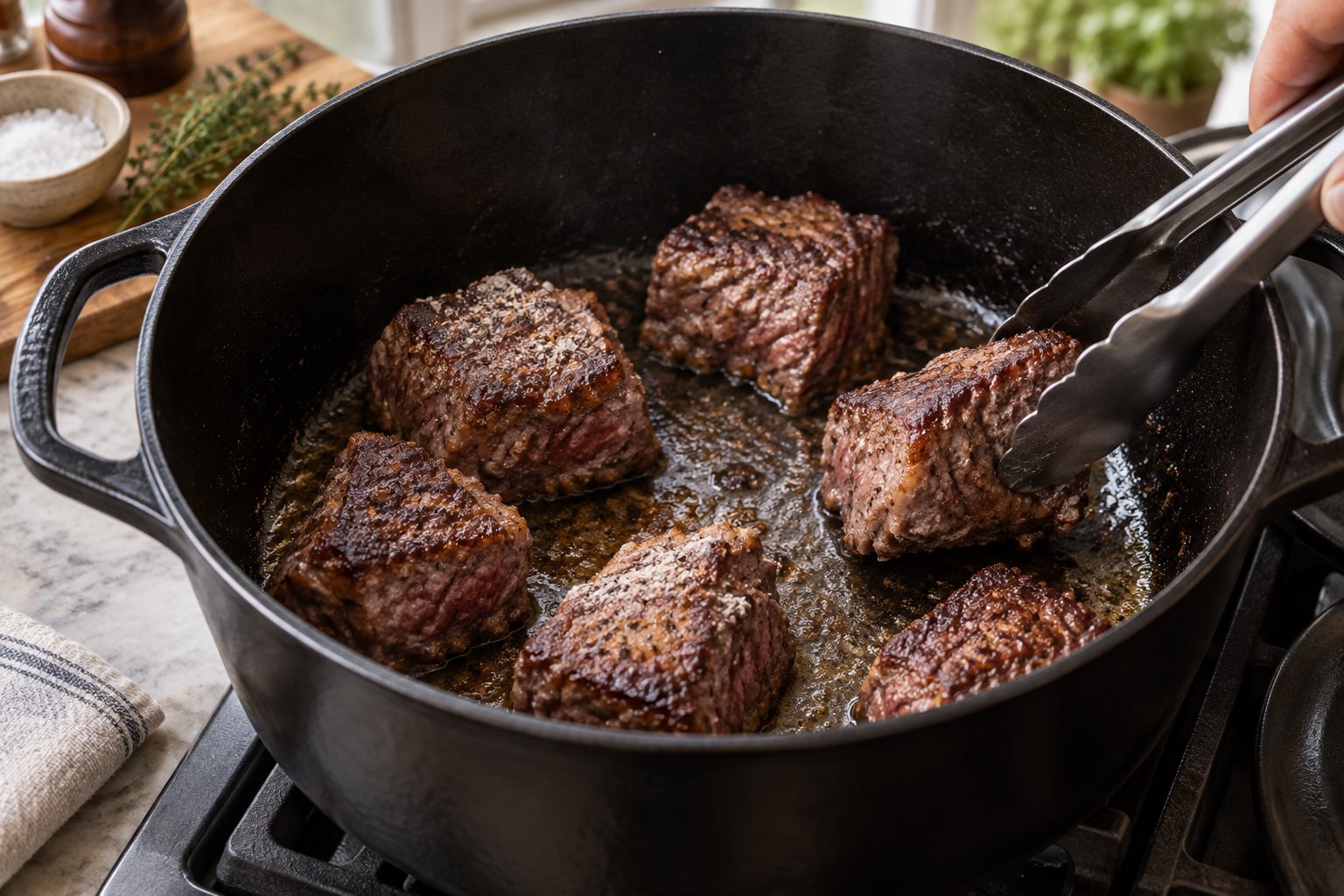
Brown it in borrowed fat, and gently. Bison chuck carries much less intramuscular fat than beef chuck, so a ripping-hot dry pan scorches the surface before it browns it. Use three tablespoons of oil or a couple of rashers of bacon, keep the heat at a confident medium-high, and take the time to do it in three batches.
Ingredient notes

Fat: three tablespoons of a neutral oil, or two rashers of bacon cut small and rendered first. The animal is not going to supply it. This is the single adjustment that matters most when you move from beef to bison.

Bison: two and a half pounds of chuck or shoulder, in two-inch chunks. Ask for stew meat and you will get chuck. Do not buy the expensive lean cuts for this — sirloin and tenderloin have no connective tissue to convert and will simply go grey and tight. If bison is not to be had, beef chuck works with the same method and about twenty minutes less.

Wine and stock: a cup of dry red and three cups of beef stock. The wine is for acid and depth rather than for wine flavour; reduce it hard against the browned bits before the stock goes in.

Root vegetables: a pound and a half of waxy potatoes and three large carrots, cut big. Big pieces survive the last three quarters of an hour; small ones melt.

Step by step

  1. Season and dredge. Pat the bison dry, season with the salt and pepper, and toss with the flour until lightly coated. Heat the oven to 325°F.
  2. Brown in batches. Heat the oil in a heavy Dutch oven over medium-high. Brown the meat in 3 batches, about 5 minutes a batch, turning once or twice. Crowd it and it steams. Move each batch to a plate.
    Bison chunks browning in a spaced batch in a Dutch oven
    Brown in small batches with space between the pieces so the meat sears. AI-generated illustration.
  3. Build the base. Lower the heat, add the onion, carrot and celery with a pinch of salt and cook 8 minutes until softened. Stir in the garlic and tomato paste and cook 2 minutes more, until the paste darkens.
  4. Deglaze. Pour in the wine, scrape the pan clean and let it reduce by half. Return the meat and its juices, add the stock, bay and thyme, and bring to a bare simmer.
  5. Braise. Cover and put it in the oven for 2 hours. Check once at the hour mark that it is blipping rather than bubbling; drop the oven 25 degrees if it is.
  6. Add the roots. Stir in the potatoes and the big carrot pieces, cover, and give it 45 minutes to an hour more, until the meat pulls apart under a spoon and the potatoes are tender.
  7. Settle it. Skim what little fat has risen, taste hard for salt, and let it sit off the heat 15 minutes before serving. Overnight in the fridge improves it more than almost anything you could add.
If the meat is tough at the end of the braise it is undercooked, not overcooked — put the lid back on and give it another 30 to 40 minutes. If it has gone dry and stringy, the pot was boiling rather than shivering; the gravy will still carry it, so shred the meat into the liquid and serve it over something absorbent. If the gravy is thin, lift the meat and vegetables out and reduce the liquid hard for ten minutes rather than adding more flour.

Storage and make-ahead

Five days in the fridge and better on the second. Reheat gently on the stove with a splash of stock; a rolling reheat undoes the braise.

It freezes for three months, though the potatoes come back grainy — leave them out if you are freezing it and boil fresh ones when you reheat.

What to serve with it

Bread that can mop, or buttered egg noodles. The gravy is the point and it should not be left in the bowl.

Something bitter and green alongside — chicory with a sharp dressing, or plain braised cabbage. The stew is deep and sweet and wants an argument.

A dark stew of bison chunks, carrots and potatoes in a cast iron Dutch oven, thick gravy clinging to a wooden spoon

From the recipe box / Montana

Bison Stew

Bison chuck browned in fat it does not supply itself, then braised low and slow with onion, root vegetables and red wine until the collagen gives way and the meat stays short of dry.

Prep
25 min
Cook
3 hr
Total
3 hr 25 min
Serves
6
Calories
520 per serving

Ingredients

Scale

Instructions

  1. Season the bison with the salt and pepper and toss with the flour. Heat the oven to 325°F.
  2. Brown the meat in the oil in 3 batches in a heavy Dutch oven, about 5 minutes each, and set it aside.
  3. Soften the onion, celery and the diced carrot 8 minutes, then cook the garlic and tomato paste 2 minutes more.
  4. Add the wine and reduce by half, return the meat, add the stock, bay and thyme and bring to a bare simmer.
  5. Cover and braise 2 hours at 325°F, checking that it is blipping rather than boiling.
  6. Add the potatoes and the big carrot chunks and braise 45 minutes to 1 hour more, until the meat pulls apart.
  7. Skim, season, and rest 15 minutes before serving.

Nutrition

Fat22 g (6 g saturated)
Sodium890 mg
Protein42 g
Servingabout 1½ cups
Calories520
Cholesterol105 mg
Carbohydrates38 g (7 g sugar, 5 g fiber)

Nutrition is an estimate calculated from the listed ingredients and is provided as a courtesy, not as dietary advice.

Questions readers ask

Is bison wild game?

Not in law and not usually in fact. Under 9 CFR part 352 bison is an exotic animal whose inspection is voluntary and paid for by the applicant, and the regulation's own definition adds that bison "includes catalo or cattalo", meaning hybrids of bison and cattle. Under 7 CFR 54.1 it is one of the animals the Agricultural Marketing Service grades, listed in the same breath as cattle, goats, sheep and swine. Nearly all of it is ranched.

Can I use beef instead?

Yes, and the method barely changes. Use beef chuck, keep the same temperature, and start checking twenty minutes earlier. The gravy will be a little richer because the meat brings more of its own fat to it.

Why does Montana own this dish?

Because Montana is where the northern herd ended. Hornaday's federal report dates the finish to the hunting season of October 1882 to February 1883, and three years later the Smithsonian sent a party into the Big Dry country with Army escort to collect up to a hundred of the last ones for the National Museum. The state's own Writers' Project book of 1943, Copper Camp, still records buffalo and bear meat being served in season on the free-lunch counters of Butte's saloons, with the fresh hide hung outside as the advertisement.

Does bison cook differently from beef?

Only in one respect that matters, and it matters a lot: there is less fat in and around the muscle. So add fat for the browning, keep the braise at a shiver rather than a simmer, and do not try to rush it with a hotter oven. The collagen schedule is the same as beef, which is why the time is the same too.