The regional table / Kansas
Bierock
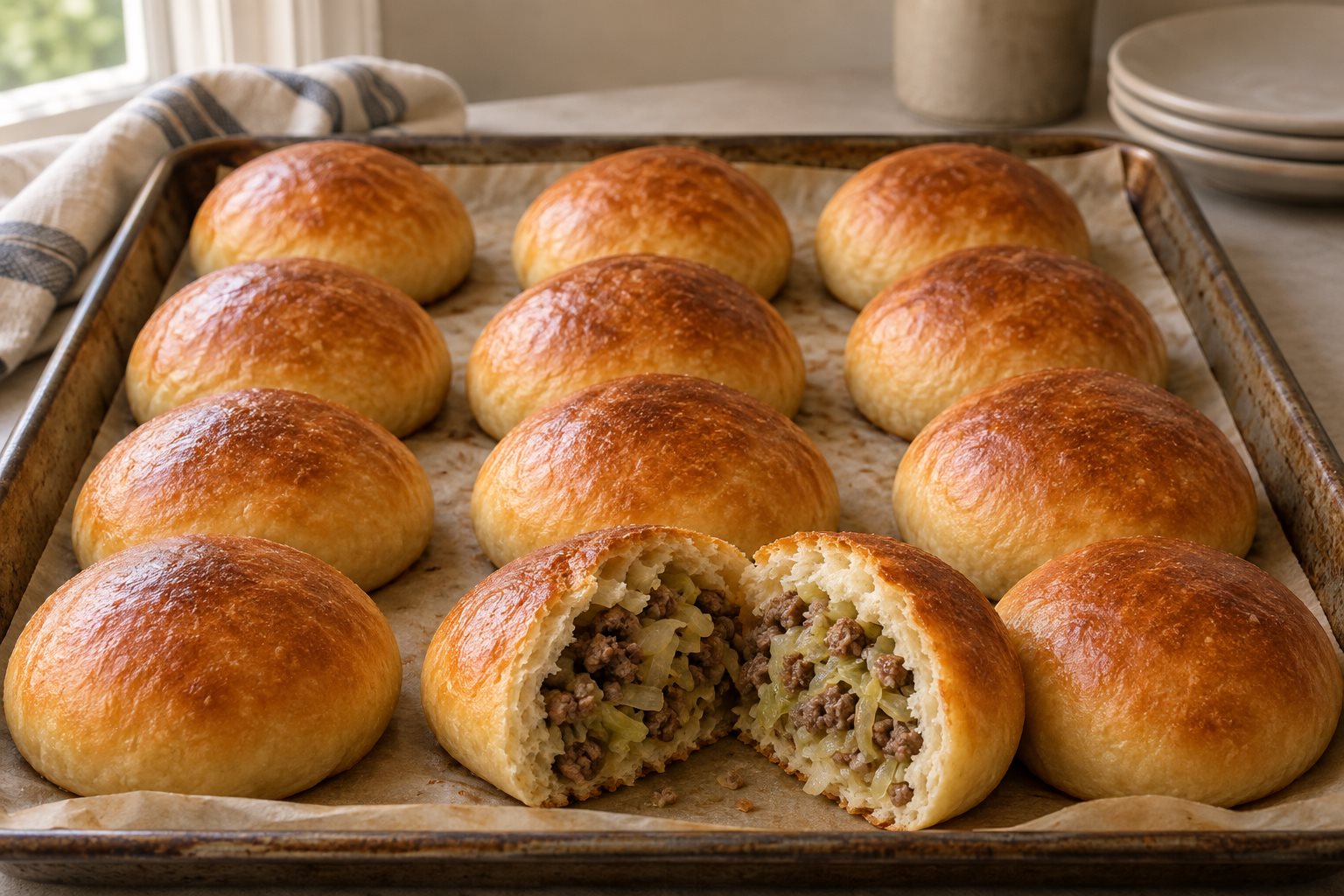
Everything that can go wrong with this bun goes wrong in the frying pan, half an hour before the dough is touched.
The document under this bun is not a cookbook. It is "German-Russian Settlements in Ellis County, Kansas", written by the Rev. Francis S. Laing for the Kansas State Historical Society and printed in its Collections, volume XI, in 1910 — forty pages, long out of copyright, and readable in full on the Internet Archive. Laing starts with Catharine II's summary invitation of 4 December 1762 and the detailed manifest of 22 July 1763, which guaranteed incoming colonists the free exercise of religion, thirty years free of taxes and exemption from military duty. Some 8,000 families, about 25,000 persons, came out of Hessia, Saxony, Alsatia, Baden, Wuerttemberg, Bavaria, Tyrol, Switzerland and the Palatinate; 104 colonies were founded on the Volga, 59 on the meadow side and 45 on the mountain side. The Ellis County families came from a named handful of them — Herzog, Obermonjour, Katharinenstadt, Pfeifer, Schoenchen, Liebenthal — and what moved them is dated to the day: "the military law of January 13, 1874", which subjected the colonists to service after a century of exemption. Laing also settles the wheat. "Some few of the settlers brought with them seed wheat (e. g., the Walter family in 1876 brought ten pounds of Turkish or spring wheat)", he writes, and then, flatly: "Experience has taught that winter wheat must be preferred." That is the flour this dough is made of.
What Laing does not contain is the word bierock. He gives a list of the Russian words his neighbours had taken into their German — ambar for a granary, arbus for a watermelon, galosch, kaback, kaftan, kalatsch for white bread, polschupka, prostoi — and no filled bun is among them. Neither is it in Kansas: A Guide to the Sunflower State, the Federal Writers' Project volume of 1939, which describes Victoria as a German-Russian community built to resemble a native Russian village, with sharply peaked roofs flush to the street and heavy solid-wood shutters, puts roughly 50,000 German-Russians in Russell, Ellis, Trego and Rush counties, and names not one thing they ate. Nebraska's newspaper archive, which is open, returns zero pages for bierock and zero for krautburger. Kansas's own run would settle the date and it cannot be reached: the Historical Society's digitised pages sit behind a commercial portal that answers a script with 401, Chronicling America blocks scripts, and — despite what I was told before starting — Kansas operates no open newspaper instance of its own. So there is no inventor here, no year and no first bierock, and this article invents none. The people are documented; the quantities below were worked out for this page.
Why this version works
Cabbage goes in shredded and cooked hard. Thin shreds collapse to about a third of their volume and brown a little at the edges, which is where the sweetness comes from. Chunks stay crunchy, hold their water and push the dough apart as they shrink in the oven.
The filling is cooked until the pan is dry. Cabbage is about ninety per cent water and it gives all of it up in the pan. Cook the filling until the bottom of the skillet stops sizzling and starts to squeak, then cool it. A wet filling steams the crumb from the inside, blows the seam open and leaves a grey soggy ring around a hole.
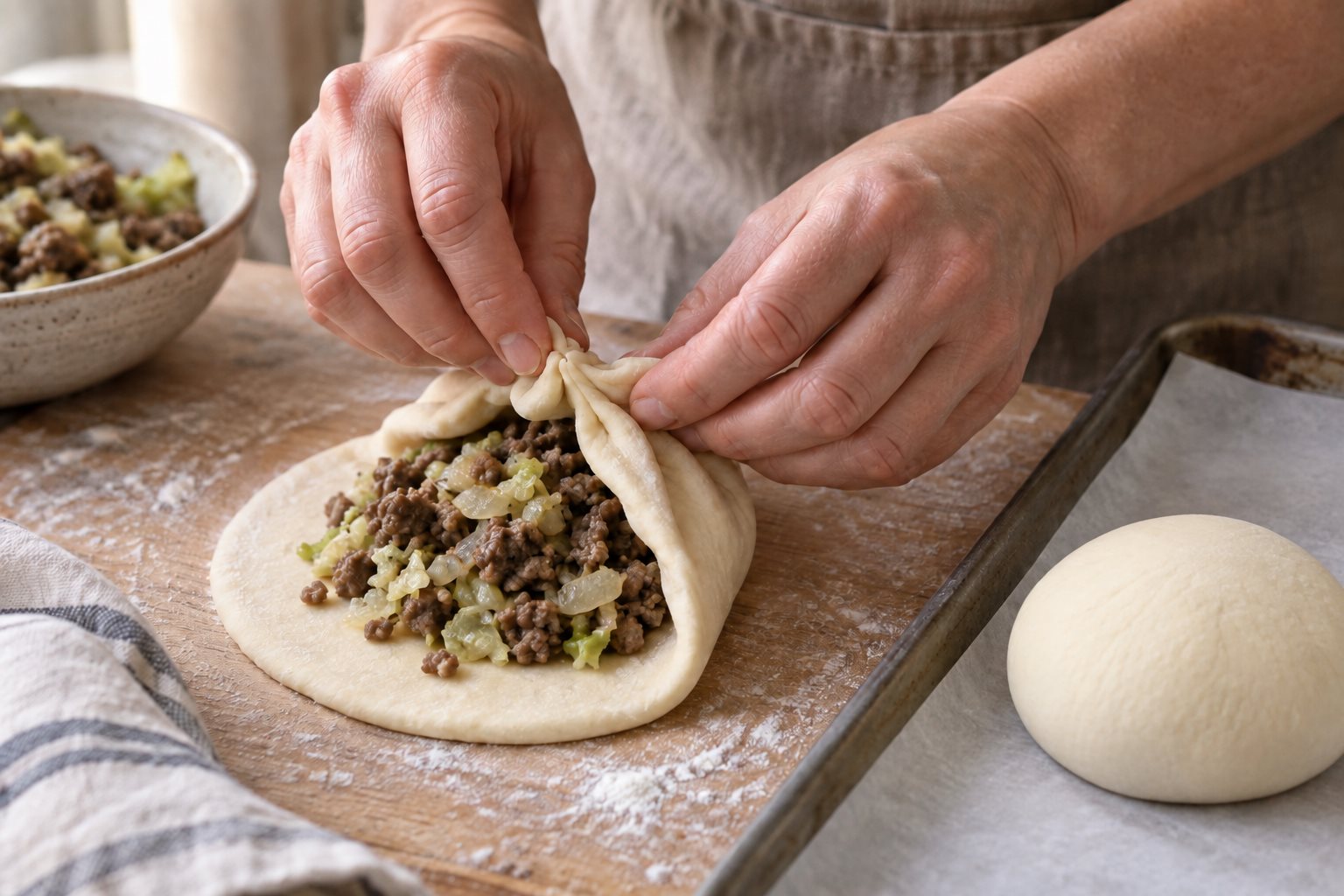
Seam side down, and no egg wash on the seam. Gather the dough into a purse, pinch it properly and set it pinch down on the sheet. The bun's own weight holds the seal shut while the oven sets it. Egg wash on the seam is glue that melts before it grips.
The dough is enriched, not a lean bread dough. Milk, butter, an egg and a spoon of sugar give a crumb that stays soft when the bun is cold, which is what this bun is for. Hard winter wheat flour has the gluten to carry all that fat and still seal; a soft flour tears at the seam.