American cooking Recipes & regional stories

Skillet & Sage

A culinary journey through the fifty states

The regional table / New York

Beef on Weck
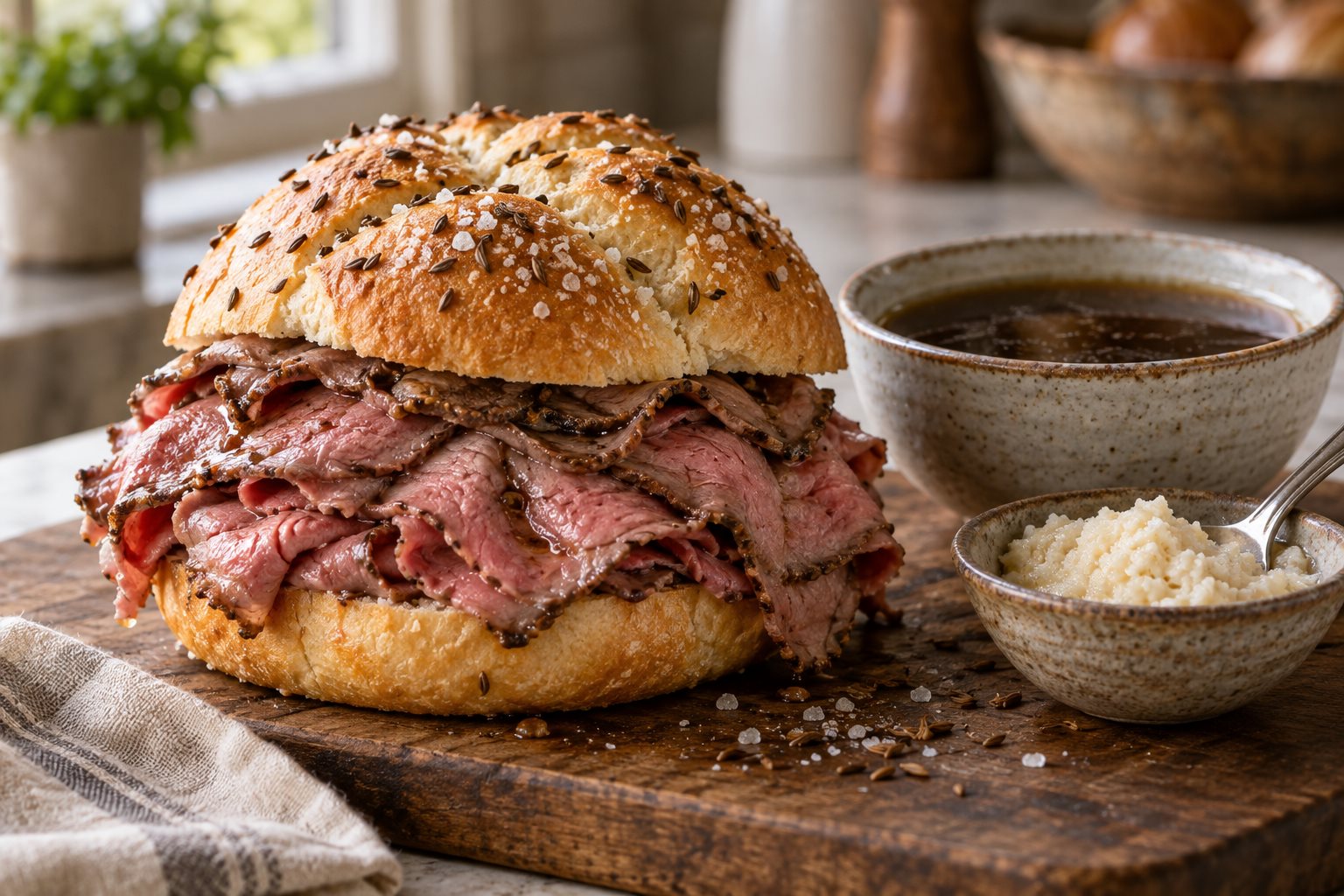
A cut hard roll crusted with coarse salt and caraway seeds, heaped with thin slices of rare roast beef, a cup of jus and a spoon of horseradish beside it
The top of the roll should be wet and darkened where it was dipped, while the salt crust above it stays dry and visible. Both at once is the whole sandwich. AI-generated illustration.

Everything in this sandwich exists to carry salt, caraway and horseradish to a piece of beef that has almost no fat and no seasoning of its own.

The document trail here is the roll, not the sandwich, and it runs in that order. New York State Historic Newspapers, the state's own digitised run of its papers, has the word kimmelwecks in The Buffalo News of 30 June 1904, where a man is described as a maker of them, and again in the Buffalo Evening News of 24 October 1910. The sandwich comes much later in the same archive: nothing at all before the Island Dispatch of Grand Island advertised Hot Roast Beef On Kummelweck on 17 October 1957, followed by the Medina Daily Journal of 13 August 1959, whose stand offered roast beef always well done and beef on kummelweck as two different orders. The short form everybody now uses is later still — the earliest the archive will give is a restaurant advertisement in the Lake Shore News and Times of 11 July 1963, running beef on weck after the pizza and the spaghetti, and by 23 March 1975 the Courier Express was calling it Buffalo's own. The bakery advertisements sit in between: fresh kimmelweck rolls sold by the dozen in papers as far from the city as Wellsville and Westfield on 19 April 1961. No inventor and no founding year appear anywhere in that record, so this page names neither. What the record does show is a roll that was ordinary in Buffalo half a century before the sandwich had a printed name.

The name is German and it is two plain words. An 1874 printing of Adler's Dictionary of the German and English Languages gives Kümmel as cumin and caraway-seed, and lists Kümmelbrod as bread with caraway seeds in it. Emil Braun's The Baker's Book, a New York trade manual of 1902, glosses the other half all through its lists of European bakery work — Brotwecken a bread roll, Patent Wecken a patent roll, Kaffeehaus Wecken a coffeehouse roll — and describes the hard salted roll itself in Bohemian bakeries, washed and well sprinkled with salt, some also sprinkled with caraway seed. A caraway roll, then, made by the trade that half of Buffalo came from: H. Perry Smith's History of the City of Buffalo and Erie County of 1884 says there are few Northern cities where the German element forms a larger proportion of the population, and counts the parents of the city's public school children in 1880 at 9,088 German against 4,612 American. The beef is settled by USDA's Institutional Meat Purchase Specifications, which puts the top round under item numbers 168 and 169 and names the muscles in it, the semimembranosus foremost. It is a lean, close-grained, nearly fatless piece of meat, which dictates the rest: roast it low, stop it rare, and shave it thin, because there is nothing in it to forgive a cook who does otherwise. No document prints quantities for this sandwich, so the ones below were worked out for this page.

Why this version works

Shaved thin, across the grain. A lean close-grained muscle eats tough in any slice thick enough to hold its shape. Cut against the grain and thin enough to drape, the same beef goes tender because no single fibre is long enough to fight. This is why the dish belongs to slicers and carving knives rather than to a plate of roast beef.

The roll carries the seasoning. Salt and caraway go on the outside of the roll, not into the beef, so they land on the tongue first and undiluted. That is the order the archive shows too: the salted caraway roll was a Buffalo staple long before anyone put roast beef in it, and Braun's trade book describes exactly that finish on a hard roll in 1902.

Jus on the crown, not on the plate. Dipping only the top of the roll wets one face and leaves the cut faces and the bottom dry, so the sandwich holds together to the last bite while still tasting of the roast. Ladling jus over the whole thing gives you a bowl of bread in ten minutes, which is a different and much worse dish.

Top round, roasted low and pulled rare. IMPS item 169 is the semimembranosus with the muscles around it and almost no intramuscular fat. Fat is what lets a roast sit at a higher temperature without seizing, and this cut has none, so a 250°F oven and a thermometer are not fussiness. Pulled at 125°F it stays red and slices cleanly; ten degrees further and the same roast turns grey and fibrous.
Ingredient notes

Beef: a whole top round roast, three pounds, tied if it is loose. Ask for top or inside round rather than bottom or eye of round — the federal specification separates them for a reason, and the bottom round is a stringier muscle that will not shave the same way. Trim the surface fat to a bare film; it renders to nothing at this temperature anyway.

Rolls: hard rolls with a thin crisp crust and an open, dry crumb. Kaiser rolls are the closest thing sold everywhere. Soft supermarket buns collapse the moment the crown is dipped, and an enriched brioche bun fights the salt. The topping goes on rolls you bought, which is what most Buffalo kitchens do at home.

Horseradish: prepared horseradish in vinegar, drained of its liquid, or a fresh root grated at the last minute if you can get one. Creamed horseradish sauce turns the sandwich into something milder and more genteel than it should be. Its heat is volatile and fades within a day of opening, so buy a small jar.

Caraway and salt: whole caraway seed, not ground, and pretzel salt or the coarsest flaked salt you can find. Fine salt dissolves into the crust and disappears; the point of the topping is that you can see the grains and taste them separately. Kosher salt crushed lightly between the fingers is a workable substitute.

Step by step

  1. Salt the beef a day ahead. Pat the roast dry, rub it all over with the kosher salt and the pepper, and leave it uncovered on a rack in the fridge for 12 to 24 hours. The salt draws moisture out and takes it back in seasoned, and the dry surface browns instead of steaming.
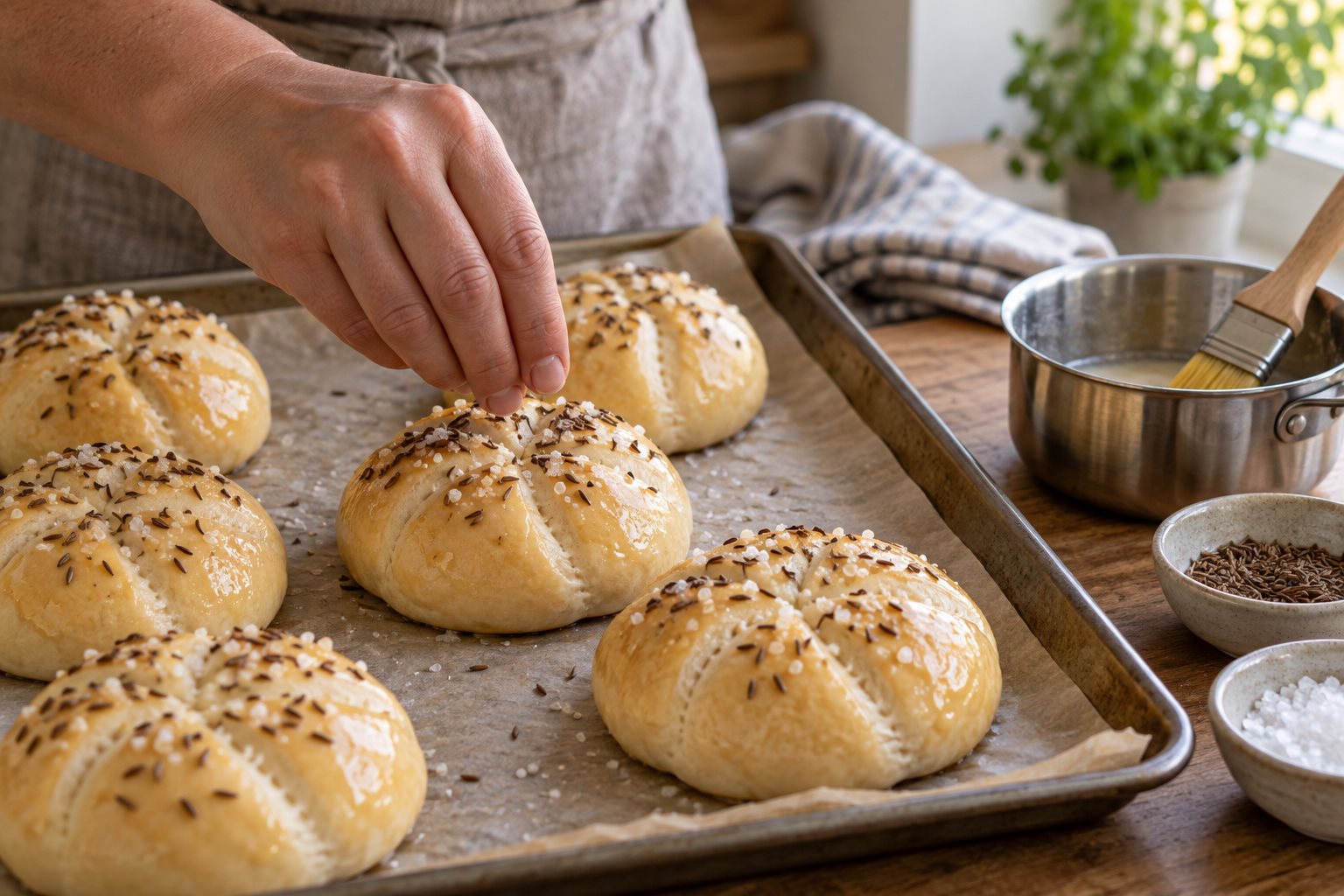
  2. Top the rolls. Whisk the cornstarch into the cold water in a small pan, bring it to a boil and cook 30 seconds until it is a clear, thin paste. Cool it, brush it over the top of each roll, and press on the caraway and the coarse salt. Bake at 400°F for 5 minutes to set the glaze, then leave the rolls on a rack.
    Caraway seeds and coarse salt added to glazed kaiser rolls
    Press caraway and coarse salt into the glaze before briefly baking the rolls. AI-generated illustration.
  3. Roast low. Heat the oven to 250°F. Rub the roast with the oil, set it on a rack over a shallow pan, and roast until a thermometer in the centre reads 125°F, about 1 hour 45 minutes for a three-pound roast. Start checking at 80 minutes; the difference between rare and ruined is about fifteen minutes.
  4. Rest it properly. Move the roast to a board and leave it 30 minutes, loosely tented. This is not optional with a lean cut: carved hot, it bleeds its juice onto the board and the slices dry out while you are still building the first sandwich.
  5. Build the jus. Set the roasting pan over medium heat, pour in the stock, and scrape up everything stuck to the bottom. Simmer 5 minutes, season with the remaining salt if it needs it, and add any juice that collected under the resting roast. Do not thicken it. Keep it at a bare simmer.
  6. Shave and dip. Slice the beef as thin as your knife allows, across the grain, and pile it loosely rather than stacking it flat. Cut a roll open, dip its top crust briefly in the hot jus — a second, no more — spread horseradish on the bottom half, heap on the beef, and close it. Serve the rest of the jus alongside.
If the roast came out past rare and looks grey at the edge, slice it thinner than you planned and dip each slice in the hot jus for a second or two before it goes on the roll — the beef reabsorbs enough to stop being sawdust. If the salt and caraway slid off the rolls in the oven, the cornstarch wash was too thin or went on hot; cook the next batch a little longer until it coats a spoon, let it cool, and press the seeds in rather than scattering them.

Storage and make-ahead

Keep the beef whole and unsliced, wrapped tight, for 4 days refrigerated, and slice it as you eat it. Sliced beef dries out overnight no matter how well it is wrapped, and this cut has no fat to protect it.

The jus keeps 5 days and freezes well. Topped rolls go stale fast because the glaze holds damp against the crust, so top only the rolls you are about to use and keep the rest plain.

What to serve with it

A cold lager and a dill pickle, which is what the counters serve it with, and a German potato salad dressed in vinegar rather than mayonnaise if you want a plate rather than a sandwich.

Anything sweet on the side argues with the horseradish. Keep the whole table salty and sour and the sandwich stays the loudest thing on it.

A cut hard roll crusted with coarse salt and caraway seeds, heaped with thin slices of rare roast beef, a cup of jus and a spoon of horseradish beside it

From the recipe box / New York

Beef on Weck

Top round roasted rare and shaved thin onto a hard roll baked under coarse salt and caraway, the crown dipped in the roast's own jus, horseradish underneath.

Prep
25 min
Cook
2 hr
Total
3 hr
Serves
6
Calories
455 per serving

Ingredients

Scale

Instructions

  1. Rub the roast with the kosher salt and pepper and leave it uncovered on a rack in the fridge 12–24 hours.
  2. Boil the cornstarch with the water 30 seconds, cool it, brush it on the rolls, press on the caraway and coarse salt, and bake at 400°F for 5 minutes.
  3. Rub the roast with the oil and roast at 250°F on a rack to 125°F in the centre, about 1 hour 45 minutes.
  4. Rest the roast 30 minutes on a board, loosely tented.
  5. Deglaze the roasting pan with the stock, simmer 5 minutes with the resting juices, and hold it hot without thickening it.
  6. Shave the beef thin across the grain, dip each roll crown in the jus for a second, spread horseradish on the bottom, pile on the beef and serve with the jus alongside.

Nutrition

Fat11 g (4 g saturated)
Sodium1290 mg
Protein48 g
Serving1 sandwich with jus and horseradish
Calories455
Cholesterol115 mg
Carbohydrates35 g (3 g sugar, 2 g fiber)

Nutrition is an estimate calculated from the listed ingredients and is provided as a courtesy, not as dietary advice.

Questions readers ask

Can I use a different cut?

Eye of round works and is cheaper, though it is finer-grained and wants slicing even thinner. Bottom round does not; it is a separate item in USDA's specification, stringier and better braised. Anything fatty and marbled misses the point — this sandwich was built around a lean roast that had to be shaved to be edible, and a rib roast in it just tastes expensive.

Do I have to bake the rolls myself?

No, and most people do not. Buy hard rolls and put the topping on them: the cornstarch wash and the salt and caraway are the whole difference between a kaiser roll and a kummelweck. If you do bake your own, glaze and top them for the last five minutes rather than before they go in, because the salt draws water and softens a crust that is still setting.

How rare is rare, and is that safe?

Pulled at 125°F and rested, the centre lands near 130°F and the beef is red through. That is the traditional doneness and it is the cook's decision to make: the federal rule governing commercially cooked roast beef, 9 CFR 318.17, sets a lethality performance standard for processors and names no temperature at all. If you would rather go further, stop at 135°F, accept pink rather than red, and slice thinner still.

Who invented beef on weck, and when?

Nothing reachable answers that. The state's newspaper archive has the roll in Buffalo print by 1904 and no sandwich under any spelling until the Island Dispatch advertisement of 17 October 1957, with the short form beef on weck no earlier than 11 July 1963. Taverns and families tell origin stories that go back much further, and none of them is in the record searched here, so this page repeats none of them. The roll, at least, is older than the sandwich by half a century.