American cooking Recipes & regional stories

Skillet & Sage

A culinary journey through the fifty states

The regional table / Maryland

Baltimore Pit Beef, Charred Outside and Rare Through the Middle
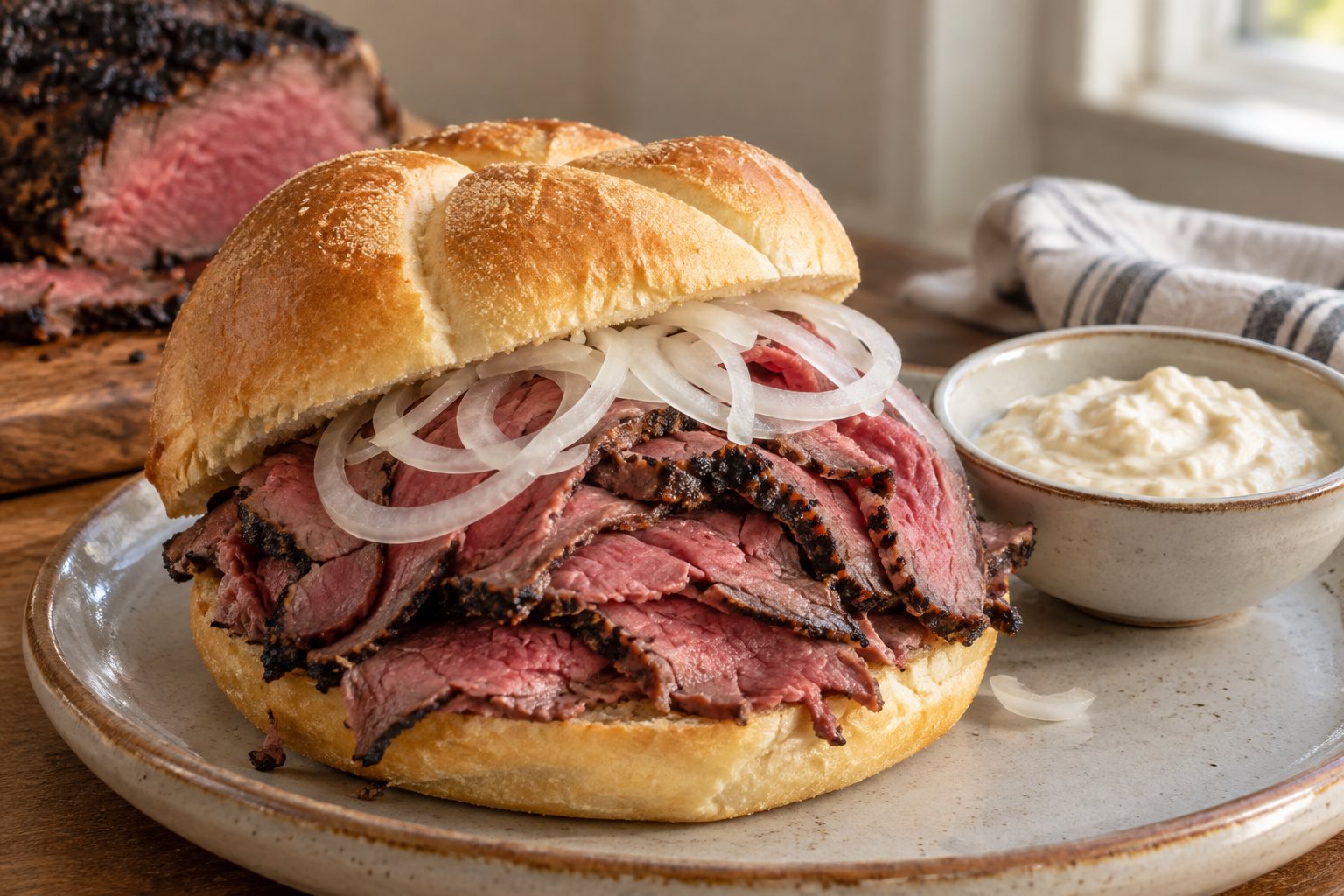
A kaiser roll heaped with thin shavings of rare beef edged in black char, raw white onion rings on top and a bowl of pale horseradish sauce beside it
Every shaving should have a black edge and a red middle. If the slices are pink all the way to the rim, the fire was too far away. AI-generated illustration.

This is a sandwich built on a contradiction: a piece of beef cooked past black on the outside and barely cooked at all half an inch in.

Start with what it is not, because the argument is settled in federal regulation rather than in opinion. The standard of identity for barbecued meats at 9 CFR 319.80 says a product labelled beef barbecue must be cooked by the direct action of dry heat resulting from the burning of hard wood or the hot coals therefrom, for a sufficient period to assume the usual characteristics of a barbecued article, which it defines as the formation of a brown crust on the surface and the rendering of surface fat. Read that list and notice what is missing: no hours, no temperature, no low and slow anywhere in it. A bed of lump hardwood charcoal is the rule's own fire, and a pit beef round wears the rule's own crust. What disqualifies it is the last sentence of the section, which caps the weight of barbecued meat at 70 percent of the weight of the fresh uncooked meat. USDA's own table of cooking yields for meat and poultry puts broiled top round at 72 percent of its raw weight, and that is beef taken further than this. Pit beef is not barbecue because it refuses to lose enough of itself — it is over the line by a couple of points, and pulled rare it is well over.

Who started it is a different matter, and here the page has to stop short. The cut is documented: USDA's Institutional Meat Purchase Specifications put the top round at item 168 untrimmed and item 169 trimmed, five muscles with the semimembranosus foremost, sold in blocks of fourteen pounds and up, and item 169A strips the cap and the soft side off to leave one long grain to cut across. Almost no fat runs through any of it, which is the whole reason for the hot fire: a cut this lean held for hours dries out, while a cut this lean seared hard and stopped early does not. The stands on Pulaski Highway are the usual origin story and nothing reachable tests it. Maryland has no open state newspaper portal, and of the three Maryland instances in the Advantage Preservation community network, one holds two pages of the Baltimore Sun, both from 1972, and the Montgomery County run has no dated printing of the phrase at all. What the archives do give is the Eastern Shore. The Queen Anne's Record-Observer of 6 October 1966 carries a display advertisement headed covered pit beef barbecue, selling half a pound of pit barbecued beef with fried soft-shell clams and cole slaw for two dollars at the county 4-H park; a fortnight later, on 20 October, the paper's 4-H column uses Pit Beef Barbecue as a set phrase and promises that the pit will be opened at 1:00. The Democratic Messenger of Snow Hill, on 12 May 1971, photographs a Methodist church class splitting wood for theirs. The advertisement calls the method an old Indian recipe; nothing supports that and this page makes no such claim. Community fundraisers on the Shore are what the record holds, the Baltimore stands are a claim it cannot reach, and no document anywhere prints quantities, so the ones below were worked out for this page.

Why this version works

Char is seasoning, not a mistake. The outside is meant to go past brown to black in patches. That burnt layer is the only strong flavour the sandwich has of its own, and shaving spreads it through the pile — a quarter-inch of near-carbon distributed across twenty paper-thin slices reads as smoke and bitterness in the right proportion rather than as a burnt edge.

A hot fire, because the cut has no fat to spare. The specification describes a nearly fatless block of muscle. Held at a smoker's temperature for hours it simply dries, because there is no intramuscular fat and very little collagen to melt into anything. Seared hard and pulled at 125°F it stays red, and every minute it spends over the coals is a minute spent building crust rather than drying the middle.

Shaved across the grain, as thin as you can manage. A close-grained lean muscle eats tough in any slice thick enough to stand up by itself. Cut against the grain and thin enough to drape, no single fibre is long enough to fight back. This is why the stands shave to order: a cut face left standing greys and dries within minutes, so the roast is kept whole and opened one sandwich at a time.

The sauce is cold and late because the heat is volatile. The University of Illinois extension bulletin on Illinois horseradish puts it exactly: the root holds highly volatile oils released by enzyme activity when the cells are crushed, and horseradish loses its pungency rapidly after grinding if exposed to air. Its own heading is keep it cold to keep it hot. So the sauce is mixed within half an hour of eating, never warmed, and never made the day before.
Ingredient notes

Beef: a three-pound piece of top round, tied. Ask for top or inside round and not bottom or eye — the federal specification separates them because they are different muscles, and the bottom round is stringier under a fast fire. If the butcher offers a cap-off piece, take it: that is item 169A, and it gives you one long grain to cut across instead of three.

Charcoal: lump hardwood, a full chimney and then some, burned down to a bed that is glowing and not flaming. This is the one ingredient that cannot be substituted. Briquettes will cook the meat but give a duller crust, and a gas grill will not char the surface before the middle overshoots.

Horseradish: a fresh root, peeled and grated, is worth the trouble and a small jar of prepared horseradish drained of its vinegar is the practical answer. The Illinois bulletin puts the timing plainly: vinegar stops the enzymatic action and stabilises the degree of hotness, so add it at once for a mild sauce or wait three minutes for it as hot as it goes. An old open jar has already lost what you are buying it for.

Rolls and onion: plain kaiser rolls, firm enough to take the sauce, and a white onion sliced as thin as the beef. The onion goes on raw and unseasoned. Soft buns collapse, and a sweet onion turns the sandwich into something mild that the horseradish then has to fight.

Step by step

  1. Rub the roast a day ahead. Mix the salt, pepper, paprika, garlic powder, onion powder and oregano and rub it over every face of the tied roast. Leave it uncovered on a rack in the fridge 12 to 24 hours, then take it out an hour before it cooks.
  2. Build a two-zone fire. Light a full chimney of lump charcoal and tip it over two thirds of the grill, leaving a third bare. Wait until the coals are grey and glowing with no flame, and set the cooking grate about 4 inches above them.
  3. Char the outside. Lay the roast directly over the coals and turn it every 3 to 4 minutes, using tongs and not a fork, for 20 to 25 minutes, until every face is dark brown going to black in patches. Flare-ups are fine; a fire that is licking the whole roast is not, so move it aside for a minute when that happens.
  4. Finish over the bare side. Slide the roast to the empty third of the grill, put the lid on with the vents open, and cook until the centre reads 125°F, another 20 to 30 minutes depending on the shape of the piece. Start checking at 15. Rare is 125°F and there is no recovering from 145°F.
  5. Make the sauce while the beef rests. Rest the roast on a board 15 minutes. Grate the horseradish into a cold bowl, leave it three minutes, then stir in the vinegar. Fold that into the mayonnaise and sour cream with the salt and lemon juice, and keep it in the fridge until the sandwiches are built.
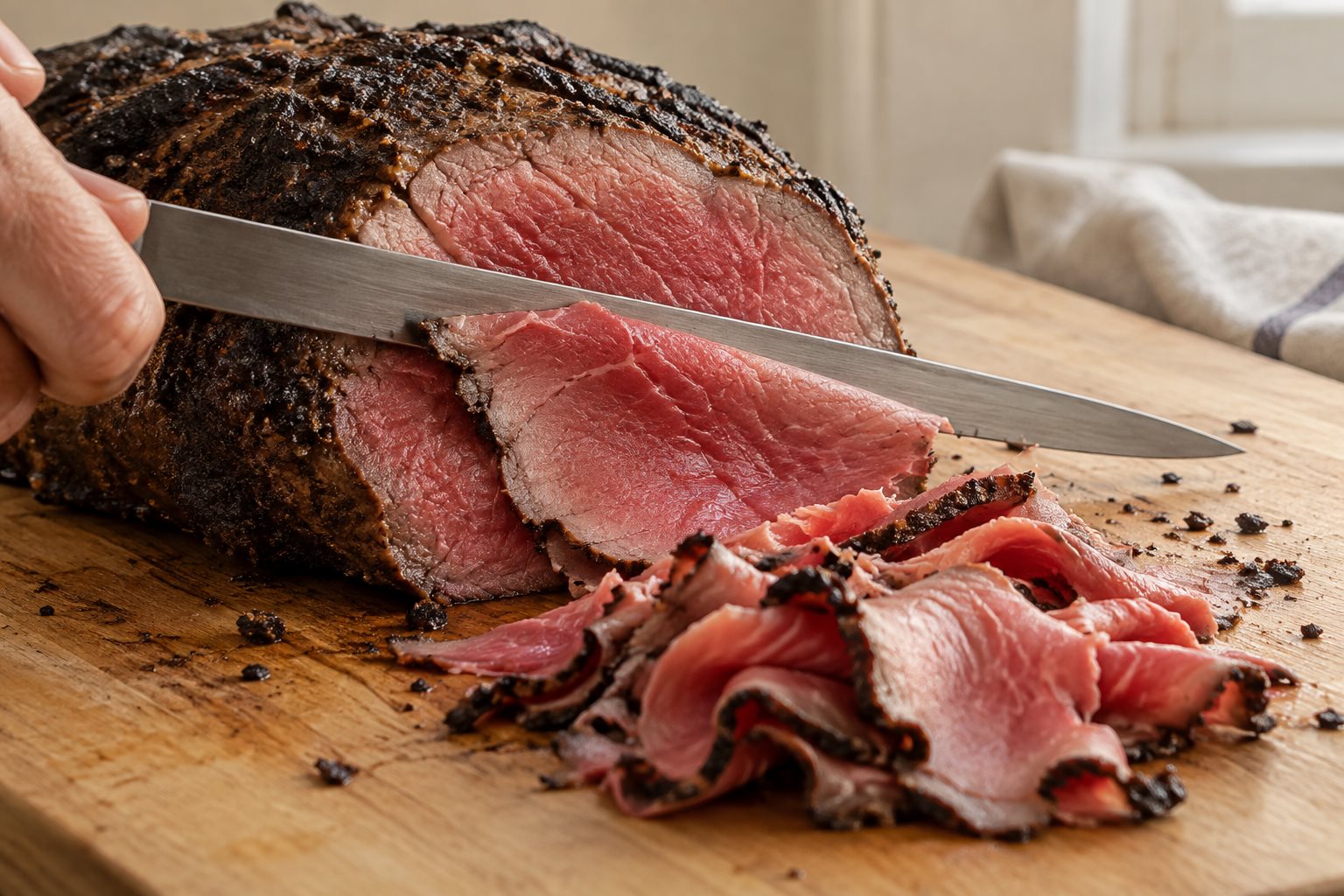
  6. Shave and build. Slice across the grain with a long thin knife, as close to paper as your hand allows, cutting only what you are about to serve. Pile the shavings high on a split kaiser roll, lay on raw onion, and spoon the sauce over the top.
    A knife shaving thin slices across a rare roast with a charred crust
    Shave the rested roast across the grain as thinly as possible, cutting only what you will serve. AI-generated illustration.
If the crust went black before the centre came up, the coals were too close or too deep — move the roast to the bare side, cover the grill and let it coast, and shave the bitterest quarter-inch off the ends before serving. If the middle came out grey rather than red, it went past 135°F and no amount of sauce will put the colour back; shave it half as thick as you meant to, pile it twice as high, and be generous with the horseradish, which is the sandwich you now have.

Storage and make-ahead

Keep the roast whole and unsliced, wrapped, 3 days in the fridge. Cold, firm and uncut it shaves thinner than it ever did warm, so leftovers are better eaten as more sandwiches than reheated as roast beef. Warming it through cooks it a second time and takes it out of rare for good.

The sauce keeps a week refrigerated in a tight jar but is at its hottest within the hour it was mixed and noticeably milder by the second day. Make what you will use and grate more when you want more.

What to serve with it

Nothing that needs a fork. A pile of dill pickles, plain salted crisps or a vinegar slaw with no sugar in it, and something cold and unambitious to drink. The sandwich is salt, char and horseradish in a row, and any side with sweetness in it blunts all three at once.

A kaiser roll heaped with thin shavings of rare beef edged in black char, raw white onion rings on top and a bowl of pale horseradish sauce beside it

From the recipe box / Maryland

Baltimore Pit Beef, Charred Outside and Rare Through the Middle

A top round rubbed with salt and paprika, burned black over open charcoal in under an hour, shaved paper-thin and piled on a kaiser roll with raw onion and a cold horseradish sauce.

Prep
20 min
Cook
50 min
Total
1 hr 30 min
Serves
8
Calories
520 per serving

Ingredients

Scale

Instructions

  1. Rub the tied roast all over with the salt, pepper, paprika, garlic powder, onion powder and oregano, and leave it uncovered on a rack in the fridge 12–24 hours.
  2. Light a full chimney of lump charcoal, tip it over two thirds of the grill, and set the grate 4 inches above the coals once they are grey and glowing.
  3. Cook the roast directly over the coals 20–25 minutes, turning every 3–4 minutes, until every face is dark brown going to black in patches.
  4. Move it to the bare side, cover with the vents open, and cook to 125°F in the centre, another 20–30 minutes.
  5. Rest the beef 15 minutes. Grate the horseradish, wait 3 minutes, stir in the vinegar, and fold it into the mayonnaise, sour cream, lemon juice and salt. Keep cold.
  6. Shave the beef across the grain as thin as you can, pile it onto the split rolls, and top with raw onion and the sauce.

Nutrition

Fat22 g (6 g saturated)
Sodium720 mg
Protein39 g
Serving1 sandwich
Calories520
Cholesterol95 mg
Carbohydrates34 g (3 g sugar, 2 g fiber)

Nutrition is an estimate calculated from the listed ingredients and is provided as a courtesy, not as dietary advice.

Questions readers ask

Is beef pulled at 125°F safe?

This is whole-muscle beef, where contamination sits on the surface rather than through the meat, and the surface here spends twenty minutes in direct contact with hot coals. USDA's own guidance for whole cuts is 145°F with a rest, so if that is the line you cook to, cook to it and expect a pink rather than a red sandwich. Grinding or tenderising the meat changes the answer completely and this method should not be used on either.

Can I make pit beef in the oven?

You can roast a top round in an oven and shave it thin, and it will make a decent sandwich, but it is a different dish. The crust is the point here, and the federal barbecue standard names the one thing an oven cannot supply: the direct action of dry heat from burning hardwood or its coals. If the grill is not an option, roast at 250°F to 125°F, then blast the outside under a broiler for five minutes a side and accept a browner, milder crust.

Why is my horseradish sauce not hot?

Three likely reasons, all about timing. The jar was old, and prepared horseradish darkens and fades on the shelf. The vinegar went in too early, which stops the enzyme before it has made much of anything — the extension bulletin's trick is to wait three minutes. Or the sauce was warmed. The enzyme that makes the heat is a protein and is inactivated by heating at around 60°C, and what it produces is volatile and leaves, which is why this sauce is never cooked and never made ahead.

Can I use bottom round or eye of round instead?

They are cheaper and they are not the same. The purchase specification separates the top round at items 168 and 169 from the bottom round at item 170 because they are different muscles: the bottom is coarser and stringier, and eye of round is a tight cylinder that goes dry the moment it passes rare. If you only have bottom round, cook it the same way, stop it at 120°F and shave it thinner still.