The regional table / California
Cioppino
The oldest printed cioppino was written down by the chef of the Hotel St. Francis in 1918, and the oldest after that, from a reader in Petaluma, has no shellfish in it at all.
The word is older than any of its stories and it is in print in San Francisco in 1896. On 3 October that year the San Francisco Call ran its weekly sporting column, and in a paragraph on a party of anglers taken out of the wharf on a charter boat it reports that "The party caught rock and blue cod under the Alcatraz forts, just enough for a tasty 'chippino.'" The quotation marks are the newspaper's, the spelling is phonetic, and nothing is explained: a chippino is simply what you make at the end of a day's fishing out of what you caught. That is nineteen years before the modern spelling reaches a California page. In the California Digital Newspaper Collection the spelling "cioppino" first appears on 24 November 1915, the day before Thanksgiving, in a Los Angeles restaurant advertising column where a house on Hill Street near Fourth sets a cioppino of rock bass, "Italian Style", on its bill of fare between cold lobster with mayonnaise and sweetbread patties. The same archive shows how late the word went general. Searched across the whole run, "cioppino" returns one page in the 1910s, one in the 1920s, eighty-two in the 1930s and three hundred and twenty-five in the 1940s. As late as 28 December 1938 a syndicated column reaching Georgia had to gloss it for readers when Joe DiMaggio, asked about his family's restaurant, answered that "my special Joe Dimaggio Cioppino (Seafood Stew) is so good I'm losing money on it. I eat too much of it myself."
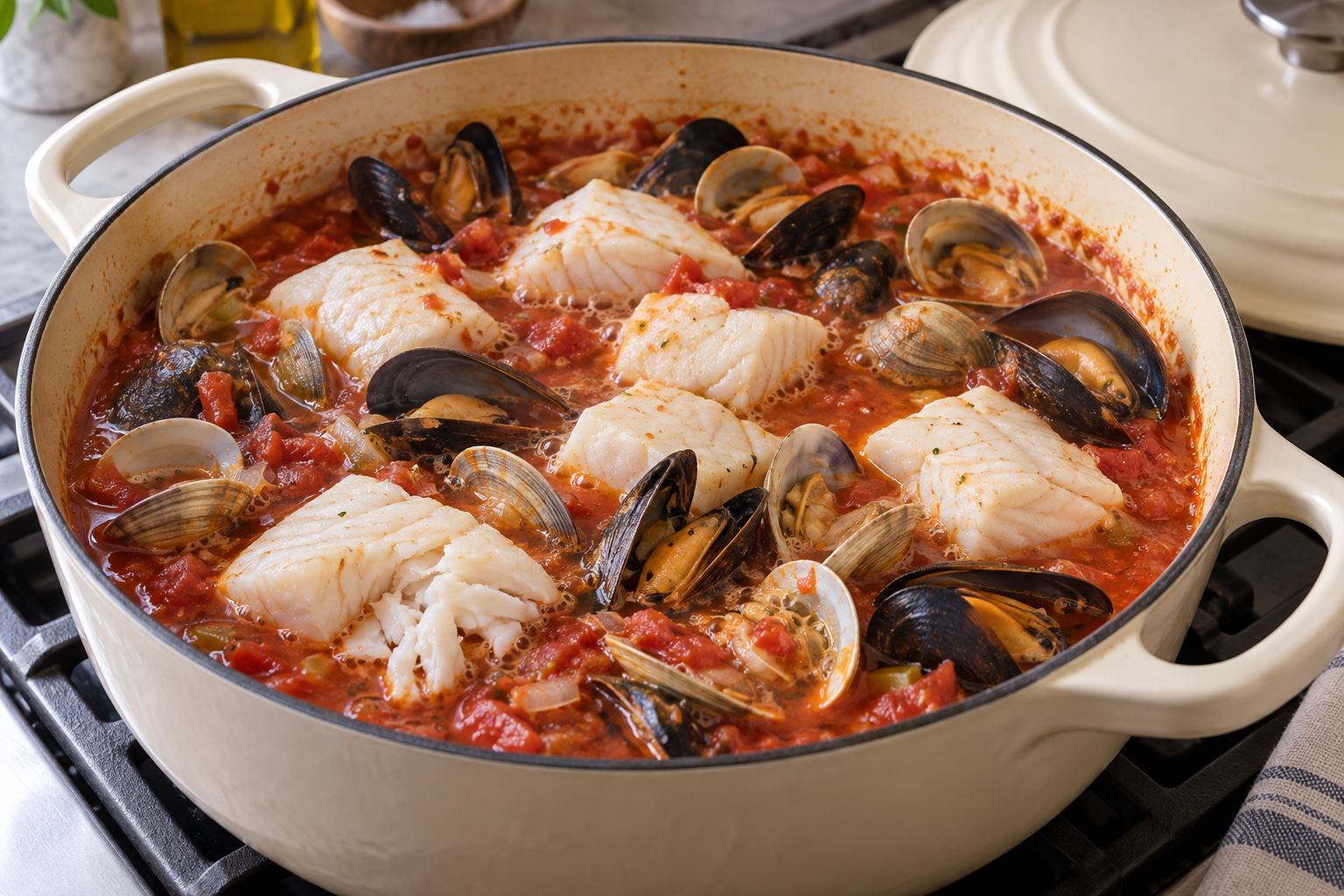
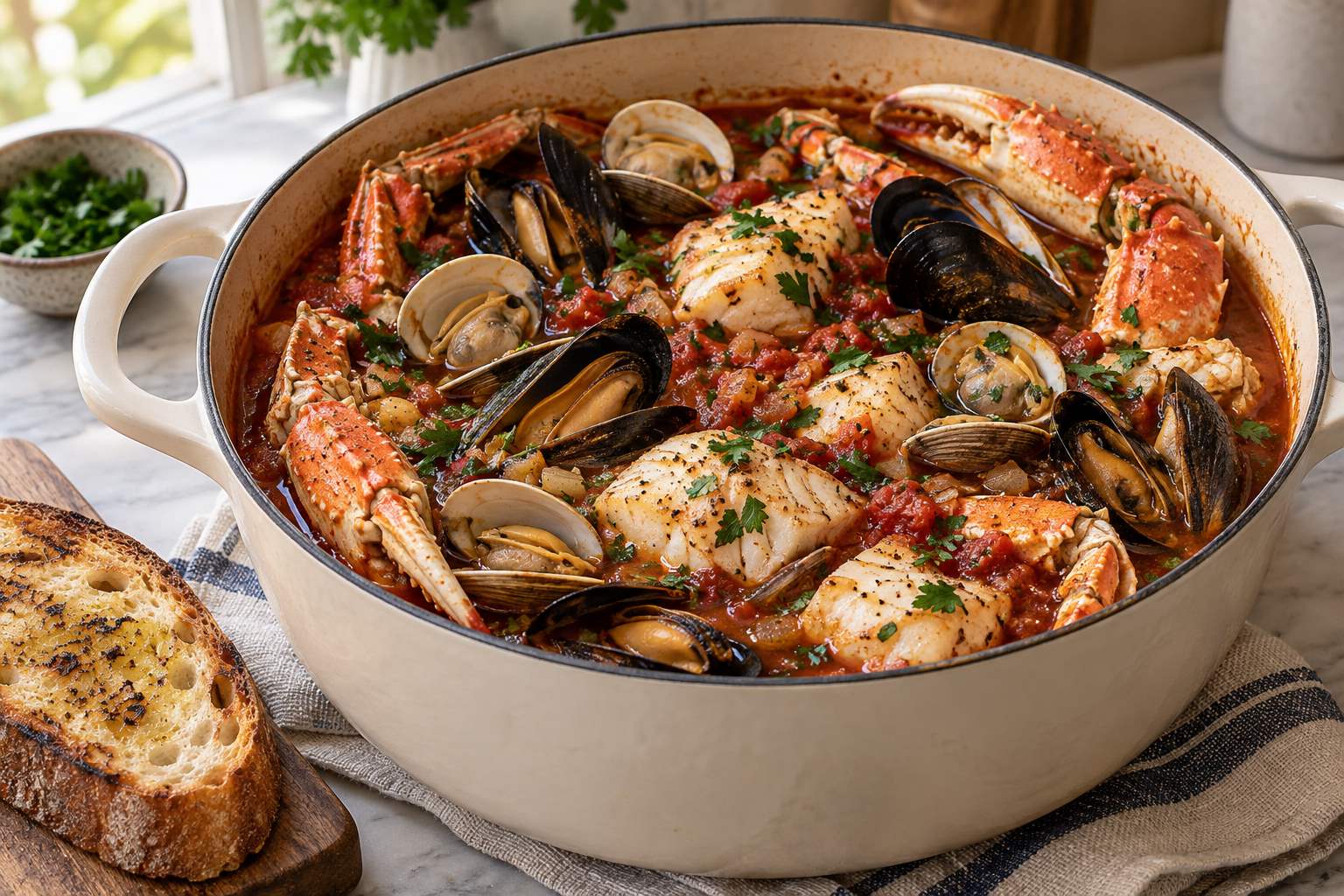
Two printed recipes survive from before the public-domain line, and both are from the Call. The first is Victor Hirtzler's, maître de cuisine of the Hotel St. Francis, printed in his newspaper column on Monday 25 February 1918 under the heading CIOPINO ALLA GENOVESE — Genoese, which is where the city's Italian fishermen came from. It runs: "Slice an onion very fine and fry in olive oil with one clove of garlic, a small carrot, a little celery and parsley, all chopped very fine, together with one well washed and boned anchovy, melted in hot olive oil and broken with a fork. After these ingredients have been fried add one-half glass of claret, about two pounds of black rock codfish, cut in portions, and some soft shell crabs." Dried mushrooms follow, then "a few ripe tomatoes chopped or one teaspoon of conserva (Italian tomato preserve)", water, "salt, pepper and a little allspice", and twenty minutes of boiling; and Hirtzler ends by saying that when black rock cod is not to be had almost any other fish will do the same. The second is three years later, on 9 April 1921, when the Call paid a dollar each for three readers' recipes and the first was "Cioppino (Italian Fish Stew)" from a reader on Sunnyslope Avenue in Petaluma, whose surname the scan does not render. Hers is the plainer and the more startling: two pounds of a solid, firm fish — "barracuda, striped bass or a large sole" — onion browned in olive oil, garlic and parsley added off the fire, then the fish in inch-thick slices with four large sliced tomatoes or a can of sauce, salt and pepper, and one instruction that is the whole technique: "Do not stir fish while cooking." No crab. No clams. No wine. Against the newspapers, the cookery books of the period are silent: Hirtzler's own Hotel St. Francis Cook Book of 1919, which prints a Bouillabaisse Marseillaise and uses the word crab a hundred and sixty-four times, does not contain cioppino under any spelling, and nor do A California Cook Book of 1916, the Landmarks Club Cook Book of 1903, Bertha L. Turner's Federation Cook Book of 1910 or the California Street M.E. Church Cook Book of 1911. The dish belonged to men who were not writing books. The federal fisheries survey found them where they lived: Goode's Fisheries and Fishery Industries of the United States reports that "The fishermen of San Francisco all live near the end of Vallejo street, about the Vallejo street wharf. The most of them are Italians, with some Slavonians, Greeks, Portuguese, and Spaniards", that the quarter had been theirs "since about 1850", that most could not read, and that those without families boarded at the Fisherman's Home or the Dalmazia Chop House for twenty-five cents a meal. The same survey names the crab — Cancer magister, "the common crab", seined off the sandy beaches south of the Golden Gate and sold three or four for twenty-five cents. This is their stew, and what follows is a pot built for a kitchen out of the 1918 and the 1921 recipes; the quantities are this page's own.
Why this version works
Do not salt until the shells have opened. USDA's composition tables explain why this pot salts itself. Raw clams carry 601 milligrams of sodium per hundred grams and blue mussels 286, against 74 for Pacific rockfish — so the liquor that runs out of a kilo of shellfish is a brine, and it is going into your broth. Season the base lightly, let the clams and mussels open, then taste and correct. Salted to perfection before the shellfish go in, the finished stew is reliably too salty to eat.
The anchovy disappears and does the work. Hirtzler is specific: "one well washed and boned anchovy, melted in hot olive oil and broken with a fork". Melted is the right word. An anchovy fillet put into warm oil collapses into it in a minute or two, and what it leaves behind is salt and savour with no fish flavour that anyone can name. Leave it out and the broth needs more salt to taste of the same amount, which is the usual sign that something was carrying more than its weight.
The fish goes in last and is not stirred. The Petaluma recipe of 1921 gives the instruction flat — "Do not stir fish while cooking" — and the numbers say why it matters. Pacific rockfish is 79 percent water and 1.34 grams of fat per hundred, so the pieces hold together by structure alone, and a spoon dragged through a simmering pot turns them into cloudy shreds. Lay the fish on top of the liquid, put the lid on, and let steam and heat do it. Six or seven minutes is the whole of it.
The base is built before any shell comes near it. Both period recipes open the same way and in the same order: onion sliced very fine into olive oil, then garlic and parsley, then the liquid. Hirtzler adds a small carrot and a little celery, chopped as fine as the onion, and that is not a garnish — it is the sweetness that stops a tomato broth tasting raw and tinny. Give it a full ten minutes of quiet frying before anything wet arrives. Everything after this step happens fast, so this is the only part of the dish where time is yours to spend.