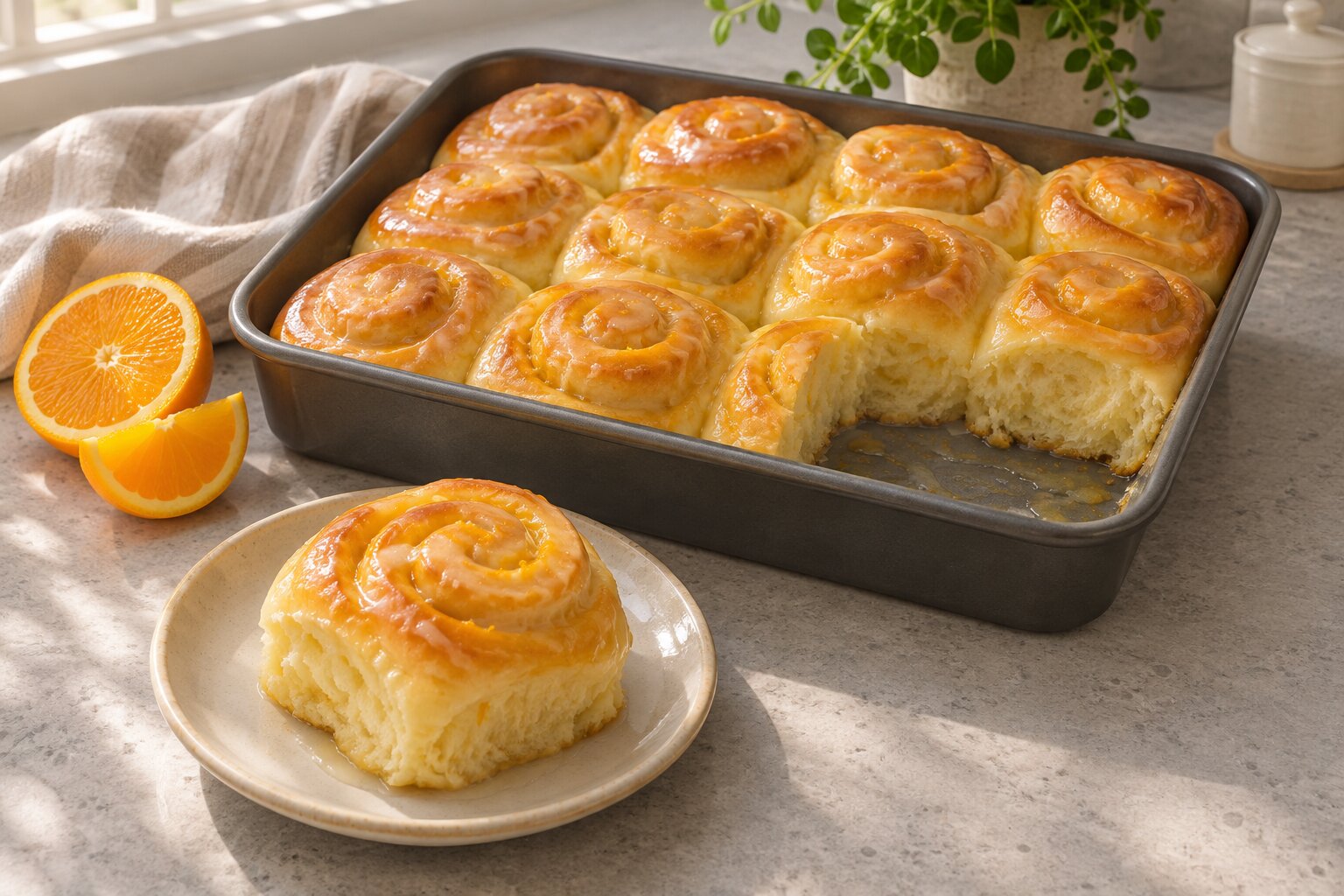
These Alabama orange rolls pull apart like soft dinner rolls, but each spiral holds butter, sugar and orange zest. Roll the dough from a long edge, let the buns puff up in the pan, then spoon a thin orange glaze over the warm tops.
At All Steak in Cullman, Alabama, orange rolls are a house specialty. The restaurant’s account records its move to Cullman in 1938 and describes how customers can take the rolls home baked or unbaked. The Alabama Tourism Department featured All Steak’s orange rolls in its 2016 guide, 100 Dishes to Eat in Alabama.
This home version makes a dozen spirals in one pan. It is inspired by the Cullman rolls, not a claim to reproduce the restaurant’s formula. Zest goes in the filling, where its aroma survives baking; juice goes in the glaze, where you can taste its acidity.
Why this version works
Soft dough An egg, milk and a little butter give the dough a soft, fine crumb. Weigh the flour so a densely scooped cup does not push the dough too dry.
Orange oils Rubbing zest into the sugar spreads its oils through the filling, so the citrus does not collect in a few stray shreds.
A clean seam A thin coating of softened butter helps the sugar stick. Leaving a clean strip along the final edge makes it easier to seal the log.
A thin glaze A loose glaze flows into the spirals. Letting the buns stand for five minutes first keeps the glaze from running straight down to the pan.
Ingredient notes
Butter Use softened butter for the filling so it spreads without pulling the dough. The butter for the dough is melted and cooled.
Oranges Use two medium navel oranges for the zest and juice. Zest the orange-colored skin before juicing and avoid the bitter white pith.
Powdered sugar Sift lumpy powdered sugar before stirring in juice. Reserve a little juice so you can adjust the glaze a teaspoon at a time.
Flour and yeast Use all-purpose flour and instant yeast. If the milk is hot to the touch, let it cool before mixing; comfortably warm is enough.
Step by step
Mix and knead the dough Whisk the flour, 2 tablespoons granulated sugar, instant yeast and salt. Stir in the warm milk, egg and 3 tablespoons melted, cooled butter. Once no dry flour remains, knead on a lightly floured surface for 8 to 10 minutes, or use a dough hook on low for 6 to 8 minutes. Aim for a smooth, elastic dough that feels tacky but lifts cleanly from the worktop.
Let the dough rise Cover the bowl and leave it at room temperature until the dough has roughly doubled, about 60 to 90 minutes. While it rises, zest the oranges. Rub the zest into the ⅓ cup granulated sugar until fragrant and slightly damp. Line a 9-by-13-inch (23-by-33-cm) metal baking pan with parchment.
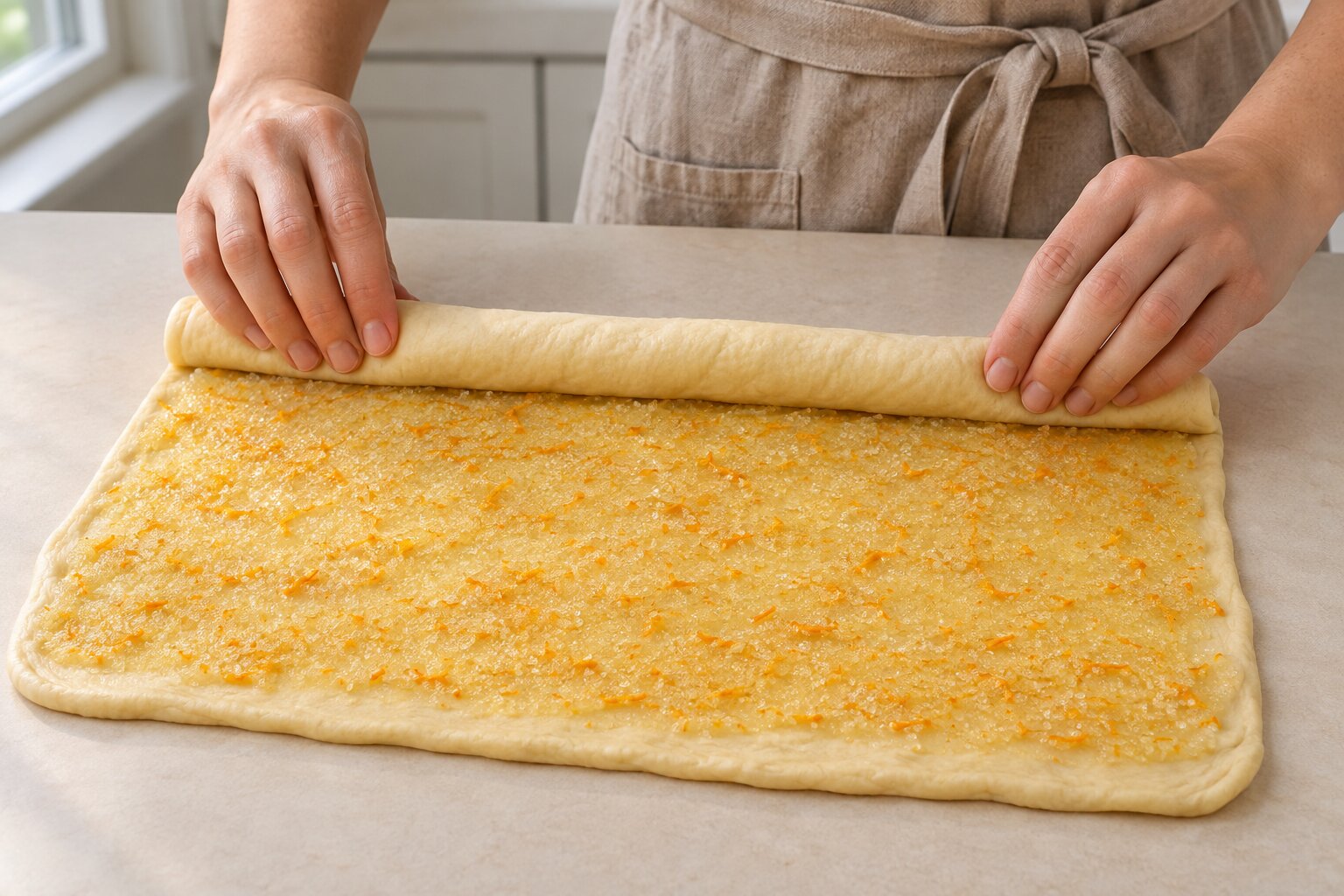
Fill and roll from a long edge Roll the dough to roughly 15 by 10 inches (38 by 25 cm), with one long edge facing you. Spread the 3 tablespoons softened butter evenly over the rectangle, leaving a ½-inch (1-cm) strip bare along the near long edge. Scatter the orange sugar over the butter. Roll from the opposite long edge toward the bare strip, keeping the cylinder snug but not stretching the dough. Pinch the seam and set the log seam-side down.
Roll the long edge evenly across the filling toward the bare strip of dough.
Cut the rolls and proof in the pan Cut the log into 12 nearly equal pieces with a sharp serrated knife. Arrange in the pan in three rows of four, spirals facing up. Cover and let rise for about 35 to 55 minutes, until puffy and nearly touching. Heat the oven to 350°F (175°C) near the end of the rise.
Bake until lightly golden Bake on the middle rack for about 22 to 27 minutes. The edges should be light gold and a center roll should spring back; an instant-read thermometer inserted into its dough should register about 190°F (88°C). If the tops color before the center is done, lay a piece of foil loosely over the pan. Let stand for 5 minutes.
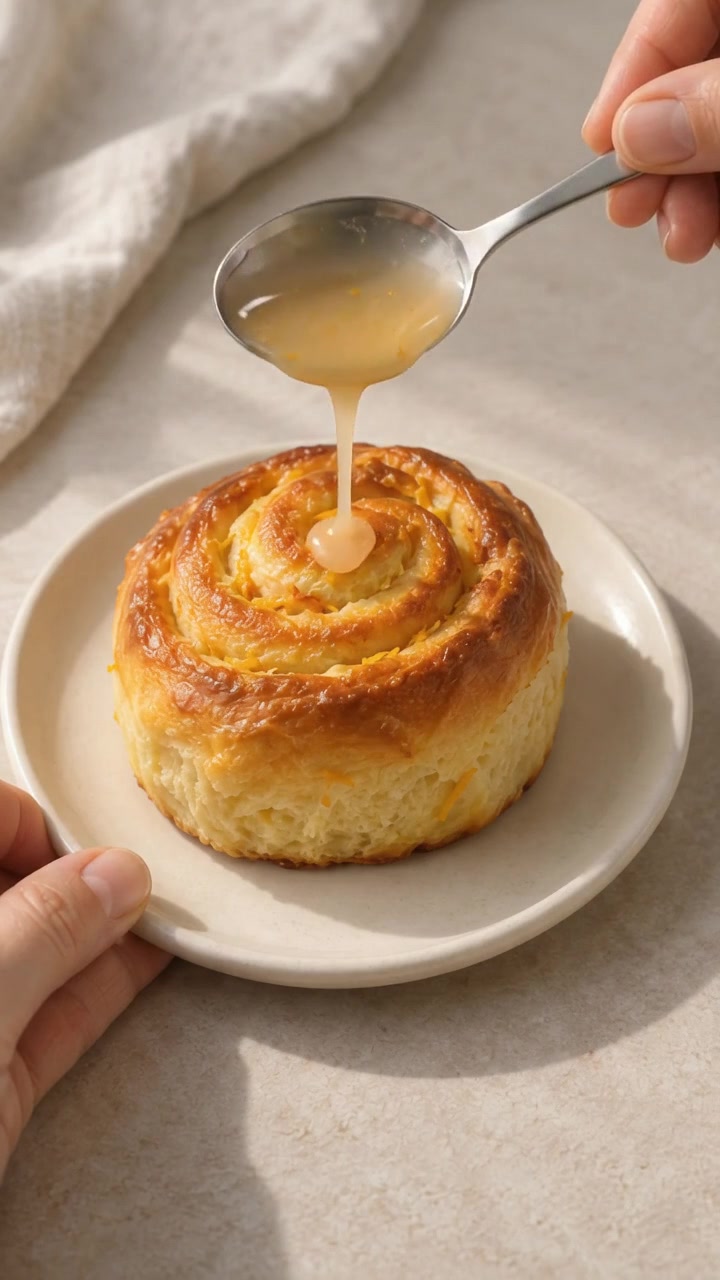
Glaze the warm rolls Stir 2 tablespoons of orange juice into the powdered sugar. Add more juice a teaspoon at a time, up to 1 tablespoon more, until it falls from the spoon in a thin ribbon. Spoon it over each warm roll, then let the glaze settle for a few minutes before pulling the rolls apart.
9sWatch the technique
The glaze should fall from the spoon in a thin ribbon. Spoon it over the warm rolls and let it settle.
Play with sound to hear the mixing.
If the dough smears rather than holding shape after several minutes of kneading, let it rest for 5 minutes before adding flour. Dust the worktop an extra teaspoon at a time if needed. If the glaze runs like juice, whisk in a spoonful of powdered sugar; if it falls in clumps, add a few drops of juice.
Storage and make-ahead
Cool before covering and store airtight at room temperature for up to 2 days. To serve one warm, give it 10 to 15 seconds in the microwave; the glaze will soften again.
What to serve with it
Serve warm after dinner with black coffee, or put the pan out at brunch with eggs and fruit.
From the recipe box / Alabama
Alabama Orange Rolls
Soft, pull-apart yeast rolls with an orange-zest filling and a thin orange glaze.
Prep
30 min
Cook
27 min
Total
3 hr 10 min
Serves
12
Calories
240 per serving
Ingredients
Scale
Instructions
Whisk the flour, 2 tablespoons granulated sugar, instant yeast and salt. Stir in the warm milk, egg and 3 tablespoons melted, cooled butter. Once no dry flour remains, knead on a lightly floured surface for 8 to 10 minutes, or use a dough hook on low for 6 to 8 minutes. Aim for a smooth, elastic dough that feels tacky but lifts cleanly from the worktop.
Cover the bowl and leave it at room temperature until the dough has roughly doubled, about 60 to 90 minutes. While it rises, zest the oranges. Rub the zest into the ⅓ cup granulated sugar until fragrant and slightly damp. Line a 9-by-13-inch (23-by-33-cm) metal baking pan with parchment.
Roll the dough to roughly 15 by 10 inches (38 by 25 cm), with one long edge facing you. Spread the 3 tablespoons softened butter evenly over the rectangle, leaving a ½-inch (1-cm) strip bare along the near long edge. Scatter the orange sugar over the butter. Roll from the opposite long edge toward the bare strip, keeping the cylinder snug but not stretching the dough. Pinch the seam and set the log seam-side down.
Cut the log into 12 nearly equal pieces with a sharp serrated knife. Arrange in the pan in three rows of four, spirals facing up. Cover and let rise for about 35 to 55 minutes, until puffy and nearly touching. Heat the oven to 350°F (175°C) near the end of the rise.
Bake on the middle rack for about 22 to 27 minutes. The edges should be light gold and a center roll should spring back; an instant-read thermometer inserted into its dough should register about 190°F (88°C). If the tops color before the center is done, lay a piece of foil loosely over the pan. Let stand for 5 minutes.
Stir 2 tablespoons of orange juice into the powdered sugar. Add more juice a teaspoon at a time, up to 1 tablespoon more, until it falls from the spoon in a thin ribbon. Spoon it over each warm roll, then let the glaze settle for a few minutes before pulling the rolls apart.
Nutrition
Fat
7 g
Sodium
150 mg
Protein
4 g
Serving
1 orange roll, estimated
Calories
240
Carbohydrates
42 g
Nutrition is an estimate calculated from the listed ingredients and is provided as
a courtesy, not as dietary advice.
Questions readers ask
Can I skip the glaze?
Yes. The rolls still have an orange filling, but the glaze adds juice and keeps the citrus flavor brighter.
Why roll from the long edge?
It gives you a longer, narrower cylinder with enough length for twelve rolls. Rolling from a short edge makes fewer, thicker spirals.
Can I make the dough in a mixer?
Yes. Use a dough hook on low and stop when the dough stretches smoothly and clears most of the bowl. You do not need to wait for a completely dry bowl.
How do I know the rolls are done proofing?
The portions look rounded and nearly meet in the pan. A light touch on the side of one leaves an impression that eases back slowly.
The orange restaurant dip of central Arkansas: mild green chiles, cumin and a pound of American cheese taken to a pour that holds all night over a low flame.
Sharp cheddar ground smooth with garlic, dry mustard, cayenne and flat beer, then left overnight so the heat comes up — the snappy cheese of the road houses on the Kentucky River.