The regional table / Missouri
St. Louis Toasted Ravioli
Two restaurants a few blocks apart on the Hill each say the accident happened in their kitchen, and neither has ever produced a piece of paper.
The neighborhood is documented even where the dish is not. The Missouri Historical Review, in its issue of October 1987, reviewed Gary Ross Mormino's Immigrants on the Hill: Italian-Americans in St. Louis, 1882-1982, and the review sets out the ground plainly: Italians from Lombardy and Sicily settled the Hill, "or, formerly, Dago Hill," in the late nineteenth century, and "they immigrated to work in the area's clay mines and brick factories." The reviewer notes what makes the place unusual — while St. Louis's other Italian quarter, Little Italy, came apart under urban renewal and suburbanization, the Hill's isolation kept it concentrated, homogeneous and in place. That is the fifty-odd blocks this dish comes from. The dish itself is younger than the public domain and has no old cookbook behind it, so the quantities below are this site's own, worked out for this page.
Two houses claim it, and the honest thing is to lay both claims out rather than pick. Charlie Gitto's On The Hill says on its own site that "the story of Charlie Gitto's Toasted Ravioli dates back to the 1940s when an unnamed chef at Angelo's on the Hill (as legend has it) accidentally dropped a ravioli in hot oil instead of water." Mama Campisi's, which its own history page describes as once known as Oldani's, told it differently: in a version captured by the Internet Archive in May 2006, "in the early 1940s, a chef by the name of Fritz accidently dropped an order of ravioli into hot oil instead of hot water," and "Mickey Garagiola, older brother of Major League Baseball Hall-of-Famer Joe Garagiola, was actually at the bar during the mishap and was the first to taste the accidental treat." Asked whether it really started there, that page has Mickey answering, "I'll bet my house on it." Neither claim is datable from a document. What is datable is the spread: the earliest printed appearance I could reach is not in Missouri at all but in an Athens, Georgia drive-in advertisement in The Red and Black of 15 February 1962, where the Shrimp Boat-Campus Hideaway lists "TOASTED RAVIOLI (With Italian Sauce and Cole Slaw)" at $1.10, and by 20 July 1983 the Forsyth County News was passing on Jane and Michael Stern's coast-to-coast eating trip with the line, "But for the unusual try the 'toasted ravioli' at Lou Boccardi's in St. Louis."
Why this version works
350°F, and no hotter. A raw pasta shell needs two to three minutes to blister and set. At 375°F the crumb is mahogany before the pasta has lost its chalkiness; at 325°F the breading drinks oil while it waits. Fry in batches of six or eight so the oil does not fall below 340°F.
A fine dry crumb, not panko. The St. Louis coat is sandy and smooth and sits tight against the pasta, which is what lets the crimped edge still read through it. Panko builds a spiky open crust that holds three times the oil, sheds in the basket and leaves the ravioli greasy and bald in patches.
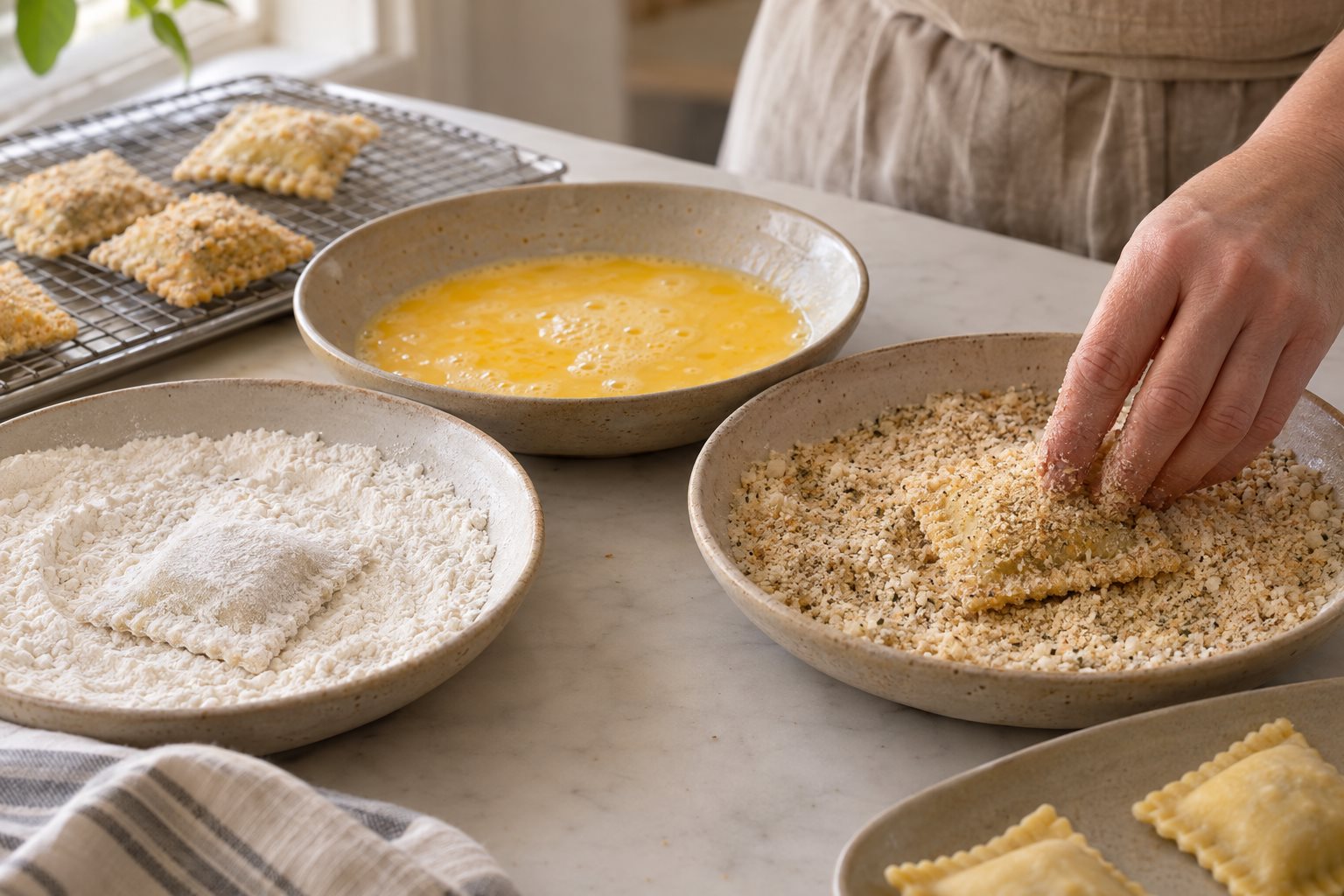
They never see boiling water. This is the one rule. The filling is already cooked and the pasta is thin enough to cook through in the time the crust takes, so the ravioli go into the egg wash thawed and dry and into the oil breaded and raw. Boil them first and the shell swells, the seam softens and the whole thing splits in the fryer, dumping cheese into the oil.
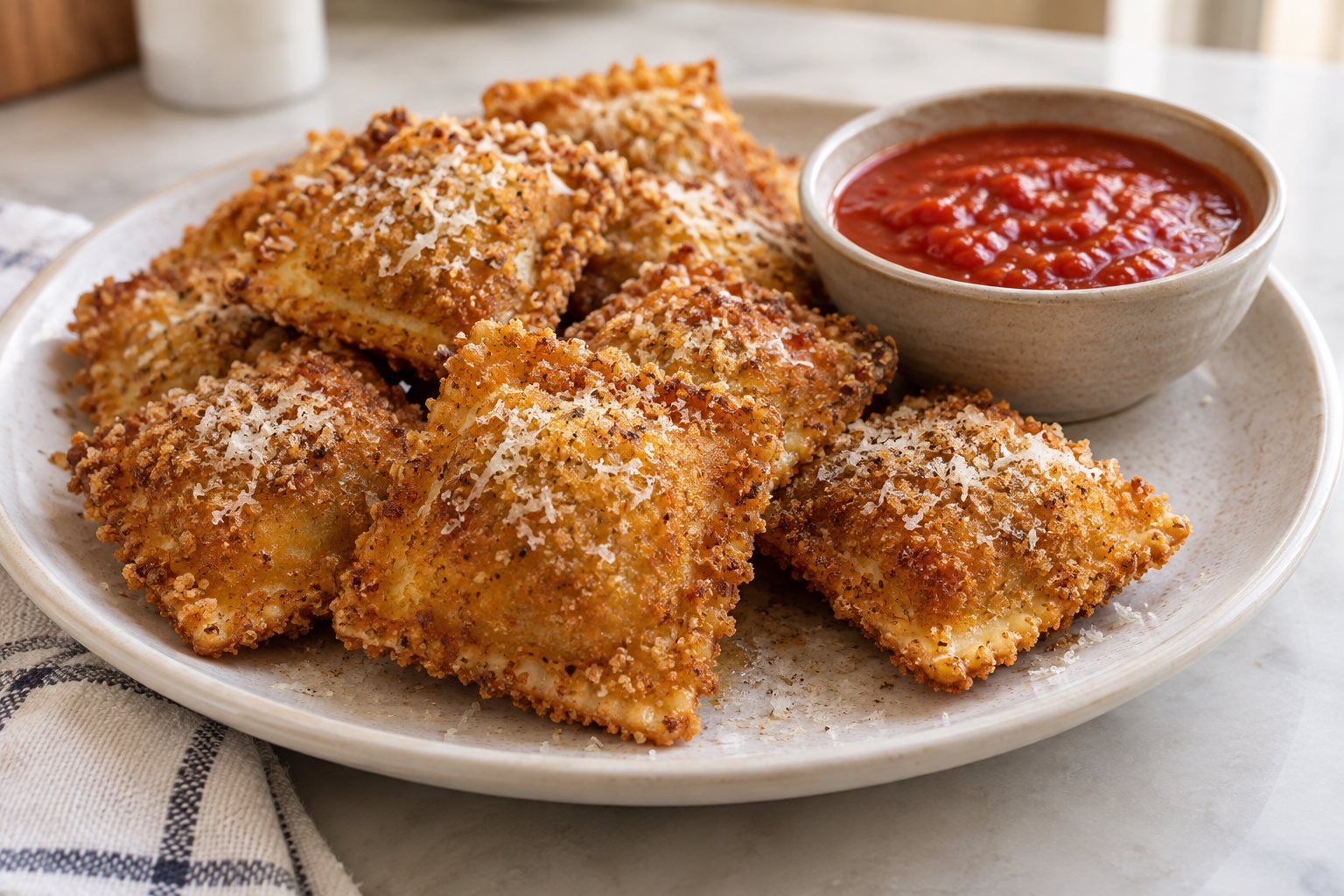
Cheese and salt on the way out. Grated Parmesan thrown on within ten seconds of the basket lifting sticks to the film of hot oil and stays there. The same cheese on a rested ravioli falls straight onto the plate. Keep the sauce in a bowl alongside for the same reason the Athens menu of 1962 served its sauce with the order rather than under it: poured over, the crust is soft before it reaches the table.