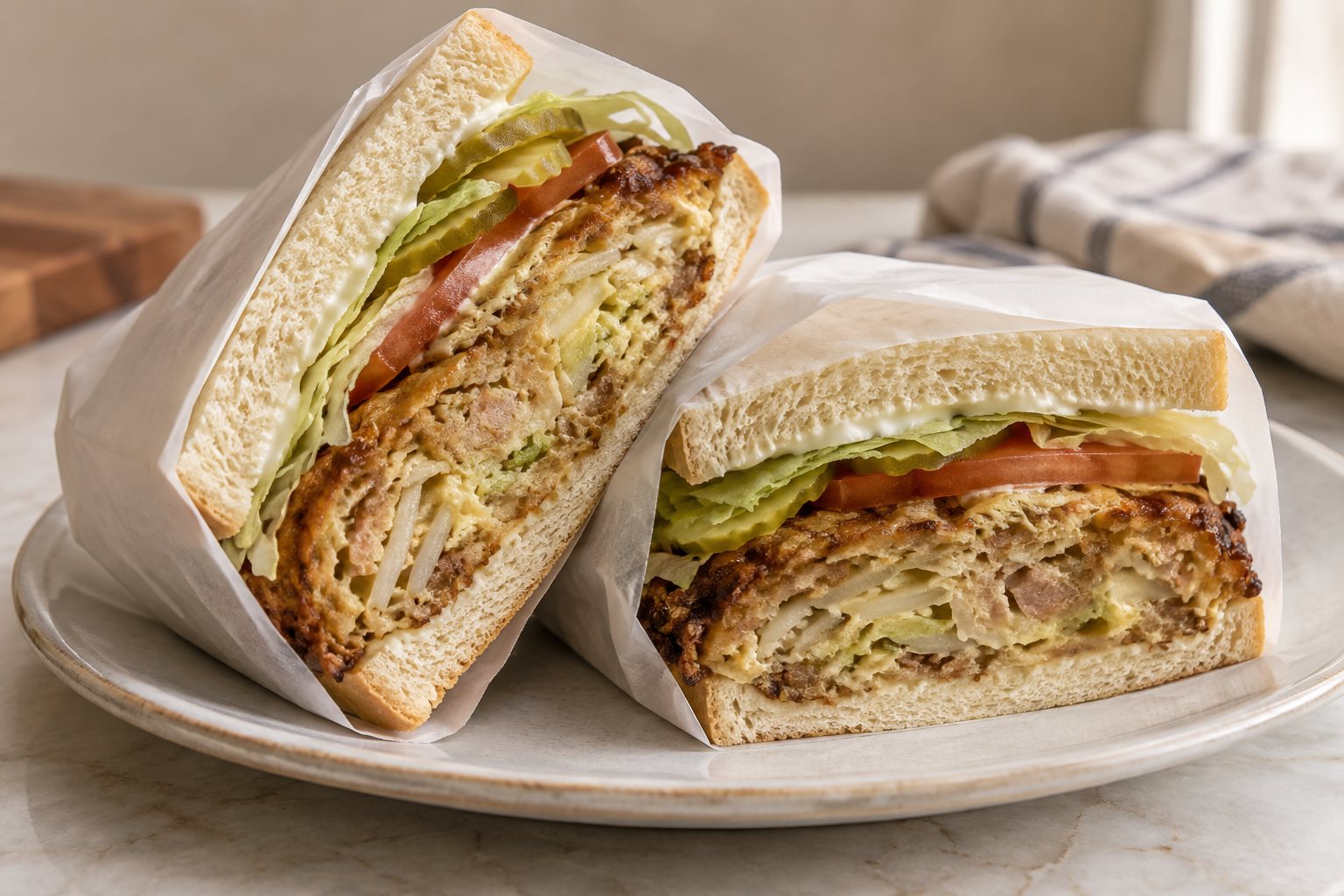
Hot patty, cold bread, and the sandwich cut and wrapped straight away. The lacy brown edge is the point of frying it in a pool of oil. AI-generated illustration.
It is an omelette on white bread with mayonnaise, it is sold out of neighborhood Chinese-American takeouts across St. Louis, and it is named after a city three hundred miles north in another state.
Start with what is documented, because the sandwich itself is not. St. Louis had a Chinese quarter, and the State Historical Society of Missouri holds the photographs of its end: James Orville Spreen, who spent the 1950s and 1960s photographing what urban renewal was pulling down, shot "the last days of Hop Alley" between 1963 and 1965, and the Society's catalogue records what the pictures show — a neighborhood running between Walnut and Chestnut Streets from Seventh to Tenth, grown from a community of around 250 Chinese immigrants who came to St. Louis in 1869, condemned from 1958 onward and demolished for urban renewal and for Busch Memorial Stadium, which opened in 1966. Spreen lived from 1897 to 1991 and gave his well-labeled collection to the Society in 1984. The sandwich does not come from those blocks; it comes from the corner takeouts that sell chop suey and fried rice out of storefronts all over north and south St. Louis, which is a different chapter of the same immigrant story. It is younger than the public domain and no printed recipe underwrites it, so the quantities below are this site's own, worked out for this page.
The patty is egg foo young, and that much the federal government will define for you. USDA's Food Standards and Labeling Policy Book, the Food Safety and Inspection Service's standing rulebook for what a label may say, sets the composition: "EGG FOO YOUNG WITH MEAT: The product must contain at least 12 percent meat," and "EGG FOO YOUNG WITH POULTRY: The product must contain at least 3 percent poultry meat." It has been sold in patties for as long as it has been on American menus in this form — a restaurant advertisement in a Georgia paper of 19 July 1957 lists "EGG FOO YUNG (Chinese Omelet) Three Patties per Order." The name on the bread is the part nobody can explain, and the archives make it stranger rather than clearer. The phrase turns up in print long before St. Louis and nowhere near it: The Omaha Guide of 19 January 1935 carries an advertisement on page 8 for the American Weiner Shop at 2509 North 24th Street, Omaha, offering "ST. PAUL SANDWICH 15c" between a five-cent hamburger sandwich and a thirty-five-cent double-deck club house sandwich of breast of chicken, and the same ad ran again the following week. A wiener shop is not a Chinese kitchen and I cannot show that the 1935 sandwich was this sandwich; what the page proves is that the name was already on a lunch counter board in another state in 1935. Searching the open newspaper archives for egg foo young in either spelling turns it up on American menus through the 1950s and 1960s and never once between two slices of bread.
Why this version works
The gravy stays in a cup. Brown sauce over egg foo young is right on a plate and wrong on bread: it soaks through the bottom slice before the sandwich reaches the table. If you want it, take it alongside and dip. The mayonnaise on both slices is doing the same job with none of the damage — it is a fat barrier, and it is what keeps the bread dry.
Hot patty, cold everything else. The contrast is the dish: an egg patty straight out of the oil against cold bread, cold mayonnaise, cold pickle and cold tomato. Warm the bread or the tomato and the sandwich goes flat and slightly sweet. Assemble on the counter with the bread already laid out, so the patty goes on within seconds of leaving the pan.
The patty has to be built to hold. A restaurant egg foo young sits in a bowl under gravy and can afford to be loose. This one has to survive being lifted, sauced, sandwiched and cut in half. A teaspoon of cornstarch slaked into the eggs and vegetables that are dry rather than damp is the whole of the engineering, and it is the difference between a sandwich and a plate of scrambled egg.
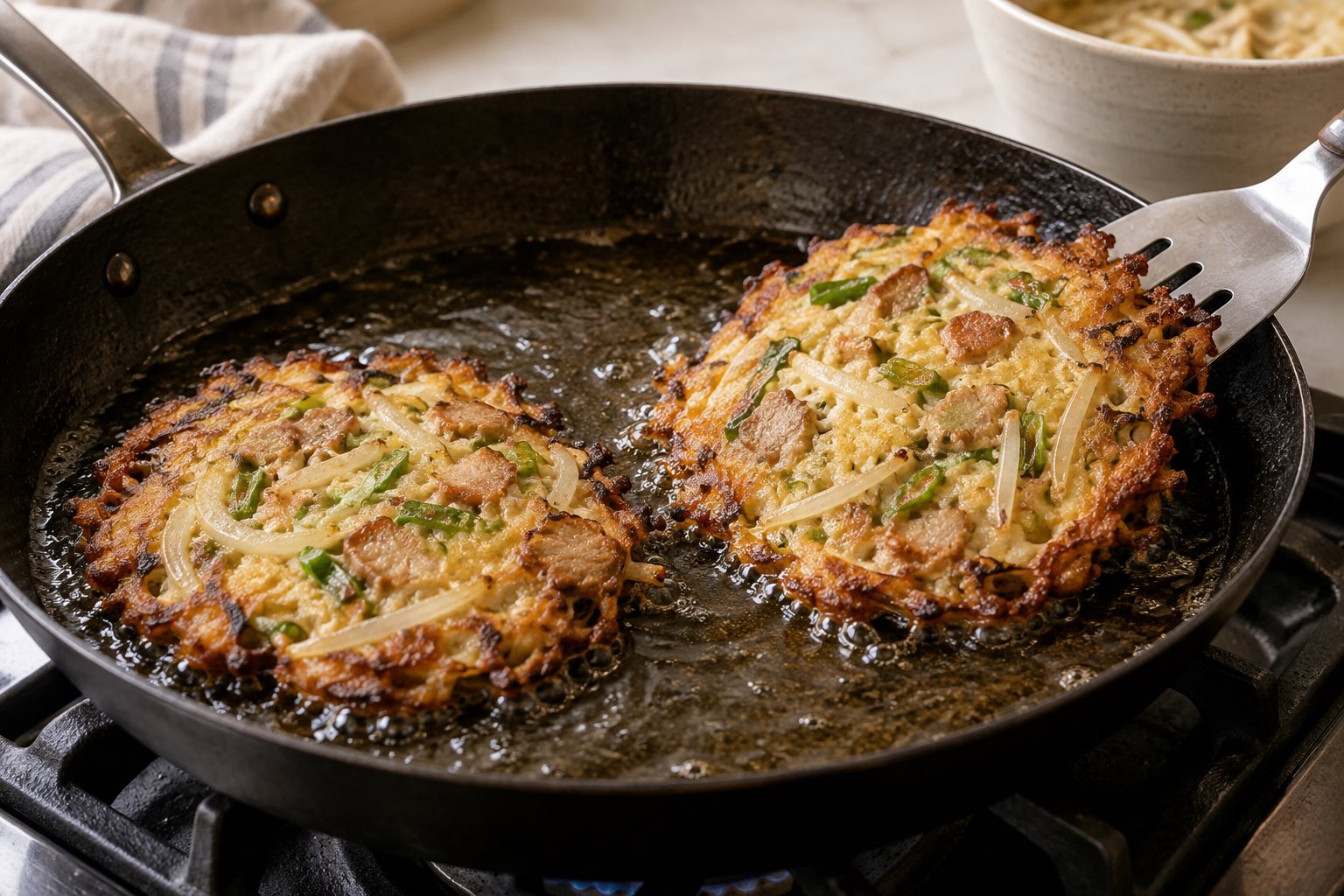
Fry it in a pool of oil, not a film. A quarter inch of hot oil is what makes the edge lace and brown and go crisp while the middle is still soft. The mixture is ladled into the oil and holds its round shape by itself; a dry nonstick pan gives you a pale flat omelette with none of the texture the sandwich is built on.
Ingredient notes
Eggs: Six large eggs make four generous patties. Beat them only until the yolks and whites come together; overbeaten eggs trap air, puff in the oil and then collapse into something flat and rubbery.
The meat: Four ounces of chopped cooked roast pork is the St. Louis default, with shrimp and chicken the usual alternatives and a plain vegetable version on every board. Anything cooked and cold works; the point is a little of it distributed through the egg, which is roughly what the federal standard describes when it puts the floor at 12 percent meat.
Bean sprouts: Two cups, and they must be dry. Rinse them, spin or towel them properly and leave them spread out for ten minutes. Sprouts straight from the tub carry enough water to loosen the mixture and spit in the oil. Canned sprouts are limp but they drain honestly and will do.
Bread and garnish: Plain soft white sandwich bread, untoasted — this is not the place for sourdough, and toasting turns eating it into a sawing exercise. Mayonnaise on both slices, dill pickle chips, a thin slice of tomato and a leaf of iceberg. That is the standard build and it is standard for good reasons.
Step by step
Dry the vegetables. Rinse the bean sprouts and dry them thoroughly. Slice the onion and celery thinly and the scallions on an angle. Spread everything on a towel while you get the rest ready.
Mix the patty. Slake the cornstarch in the soy sauce, beat in the eggs with the white pepper and salt, then fold in the sprouts, onion, celery, scallions and chopped pork. It should look like vegetables barely held together by egg, not like an omelette with things in it.
Lay out the bread. Spread mayonnaise on eight slices of bread, right to the crusts. Set out pickle chips, tomato and lettuce. Do this before you turn on the heat; the patties will not wait.
Fry the patties. Heat ¼ inch of oil in a skillet over medium-high until a drop of the mixture sizzles at once. Ladle in about a cup of mixture per patty, two at a time, and let them sit undisturbed 2 to 3 minutes, until the edges are lacy and deep brown. Flip and give them 2 minutes more.
Let the patties fry undisturbed until the edges become lacy and deep brown. AI-generated illustration.
Drain briefly. Lift onto a rack for no more than 15 seconds — long enough to shed loose oil, short enough that the patty is still hot when it lands on the bread.
Build and wrap. Patty on the bottom slice, pickle chips on top of it, then tomato and lettuce, then the second slice. Press once, cut corner to corner, and wrap in paper. Serve the brown sauce alongside if you are making it.
If the patties fell apart in the oil, the mixture was wet or the pan was not hot enough — drain the mixture through a sieve for a minute, add the second teaspoon of cornstarch, and wait for the oil to shimmer before the next ladle. If they came out greasy and pale, the oil dropped below frying temperature when the second patty went in; fry one at a time and let the heat come back. A patty that browned hard outside and stayed raw inside was too thick: spread the next one wider with the back of the ladle rather than cooking it longer.
Storage and make-ahead
The patties keep 2 days refrigerated and reheat properly only in a dry skillet or a 400°F oven for 6 minutes, which brings the edge back. Build the sandwich after reheating, never before — a made-up sandwich in the fridge is a soggy one within an hour.
The mixture itself does not keep. Cornstarch and salt draw water out of the sprouts, and an hour in the bowl leaves you with a puddle. Mix it and fry it.
What to serve with it
What the takeouts sell alongside: fried rice, an egg roll, and something cold and sweet to drink. At home, the useful addition is a small bowl of the brown sauce for dipping and a second pile of pickles. Anything rich on the side competes with the sandwich, which is already eggs, mayonnaise and fried oil in one hand.
From the recipe box / Missouri
The St. Paul Sandwich
An egg foo young patty fried lacy at the edges and laid hot on cold white bread with mayonnaise, pickle, tomato and lettuce — the St. Louis takeout sandwich named after a city in Minnesota.
Prep
15 min
Cook
10 min
Total
25 min
Serves
4
Calories
540 per serving
Ingredients
Scale
Instructions
Rinse and dry the bean sprouts; slice the onion, celery and scallions and spread them out to dry.
Slake the cornstarch in the soy sauce, beat in the eggs, white pepper and salt, then fold in the vegetables and the chopped meat.
Spread mayonnaise on all 8 slices of bread and set out the pickles, tomato and lettuce before you start frying.
Heat ¼ inch of oil over medium-high and fry the patties two at a time, about 1 cup of mixture each, 2–3 minutes until the edges are lacy and brown, then 2 minutes on the second side.
Drain on a rack for 15 seconds only.
Lay each patty on a slice, top with pickles, tomato and lettuce, close, press once, cut on the diagonal and wrap.
Nutrition
Fat
33 g (7 g saturated)
Sodium
1050 mg
Protein
22 g
Serving
1 sandwich
Calories
540
Cholesterol
290 mg
Carbohydrates
38 g (5 g sugar, 3 g fiber)
Nutrition is an estimate calculated from the listed ingredients and is provided as
a courtesy, not as dietary advice.
Questions readers ask
Do I need a wok?
No. A 10-inch skillet with ¼ inch of oil is better here, because the patties want a flat floor and an even depth of oil. A wok's curve makes them run to the middle and fry unevenly.
Can I make it without meat?
Yes, and plain is on the menu at every takeout that sells it. Add half a cup more sprouts and a handful of sliced mushrooms to make up the bulk, and expect a slightly softer patty, since the meat helps hold it together.
Can I bake the patties instead?
Not with any honesty. The lacy fried edge is most of what distinguishes this from an omelette in a sandwich, and an oven cannot produce it. If frying is out, make it in a heavy skillet with two tablespoons of oil and accept a softer, paler patty.
Why is it called a St. Paul sandwich?
Nobody has produced a document that explains it, and I am not going to guess. The oddity is real — a St. Louis sandwich named for a Minnesota city — and the archives deepen it rather than settling it: the name was already printed on an Omaha lunch counter advertisement in January 1935, at a wiener shop, fifteen cents, long before anything connects it to a Chinese-American kitchen in Missouri.