American cooking Recipes & regional stories

Skillet & Sage

A culinary journey through the fifty states

The regional table / New Jersey

Pork Roll, Egg and Cheese
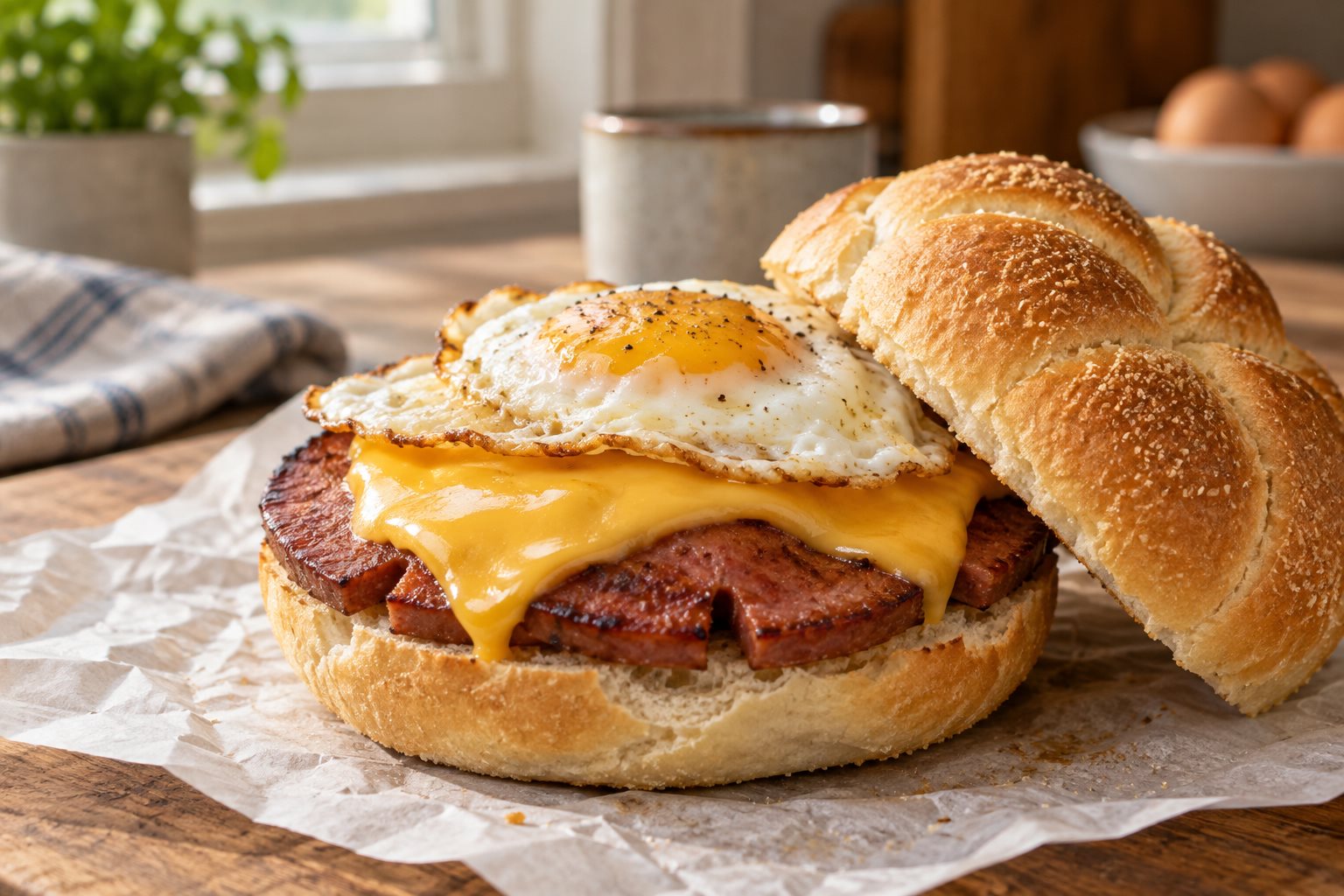
A kaiser roll open on paper, holding two browned slices of pork roll with curled crisp edges, a fried egg and a melted slice of American cheese
The dark rim on each slice is where the cure caramelised. The notches are what kept the middle flat against the pan. AI-generated illustration.

Four cuts in the edge of each slice, a hot dry pan, and a cheese slice laid on the meat rather than on the bread. Everything else about this sandwich is assembly.

The meat has a paper trail, and it runs through a federal court. In Taylor Provision Co. v. Gobel, 180 F. 938, decided on 15 August 1910 in the Circuit Court for the Eastern District of New York, Judge Chatfield set out the history as a finding of fact: the preparation "was known as 'Taylor's Prepared Ham,' but with the passage of the pure food law by the Congress of the United States it became necessary to change the label of this article," after which the company sold it "under the name of 'Taylor's Pork Roll,' or 'Trenton Pork Roll,' the preparation still being sold in cotton bags, and having red letters in outline printed upon the bags." The same company was in the New Jersey Court of Chancery a year later against another rival, in The Taylor Provision Company v. Andrew H. Edwards, 79 N.J. Eq. 142, decided 17 December 1911 by Vice-Chancellor Walker, arguing again over who could label a brand "pork roll". So the quarrel over the name is not a modern internet argument. It is litigation, it is more than a century old, and the federal Pure Food Act is the reason the word ham came off the label.

The newspapers fill in what the courts leave out, and they complicate the story everyone tells. The Burlington County Historical Society's digitised run of the Mount Holly papers — 1818 to 1960, searchable through Advantage Archives — shows the New Jersey Mirror advertising "PREPARED HAM, An entirely new article, for sale at the store of E. B. Murray & Co." on 25 January 1855, with no maker named. By 8 February 1905 a Mount Holly grocer is listing "The Taylor Ham, 16c. lb."; on 3 January 1906 another says the prepared ham he sells is made by Taylor and is "the same to-day and forever", "quality not equalled by any other make", at sixteen cents a pound; on 5 March 1913 Phil Karg of 15 and 17 King Street offers "TAYLOR'S PORK ROLL, 25c lb.; pork goodies, 24c lb.; nice for boiling or slicing"; and on 4 January 1922 Wollner's of 23 Main Street prices "Pork Roll or Prepared Ham, 23c, By the Bag" as one item with two names. Mount Holly is deep in South Jersey, where the folklore says only pork roll is spoken — and it printed Taylor Ham in 1905. The tidy north-south line does not survive its own newspapers. Two things I could not verify and will not assert: the founding date of 1856, which appears in no court record or advertisement I could reach, and any standard of identity for the product. There is none. The entire Code of Federal Regulations names pork roll exactly once, in the ingredient table at 9 CFR 424.21, where a lactic starter or culture of Pediococcus cerevisiae is permitted "to develop flavor" in "dry sausage, pork roll, thuringer, lebanon bologna, cervelat, and salami", capped at 0.5 percent. Federally speaking it is a fermented, cured sausage that keeps company with cervelat.

Why this version works

The notches. A slice of pork roll is a disc of cured meat with a casing edge that shrinks faster than the middle. Left alone it pulls itself into a bowl, the centre lifts off the pan and only the rim browns. Four shallow cuts from the edge toward the centre let the rim shrink without dragging the middle with it, and the whole face stays down on the metal.

A dry pan and a hot one. The meat is already cured and already cooked through; nothing here needs cooking, only browning. It carries enough fat to grease its own pan within thirty seconds, and added oil only steams it. Medium-high, dry, and let it sit.

Cheese on the meat, not the bread. Laid on hot pork roll off the heat, the cheese melts into the ridges and seals the slices into one piece that lifts as a unit. Laid on the roll it slides, and the sandwich comes apart on the second bite.

The egg is fried in the pork roll fat. What renders out is salty, faintly sweet from the cure and slightly smoky, and it seasons the egg completely — no salt needed. Cooking the egg in a separate clean pan with butter throws that away and makes the sandwich blander for no gain.
Ingredient notes

Eggs: large, fried over easy unless someone asks otherwise. A firm yolk turns the sandwich dry, because nothing else in it is wet — there is no sauce, and the ketchup question is a matter of house policy rather than of cooking.

Rolls: a plain kaiser, split and lightly toasted on the cut side. It has to be sturdy enough for a runny yolk and neutral enough not to argue with the cure. A brioche bun is too sweet and an English muffin is too small to hold two slices flat.

Cheese: American, in slices, and this is not a compromise. It melts to a sauce at the temperature of hot meat instead of breaking into oil and strings, which is exactly the job. Sharp cheddar seizes and slides off.

Pork roll: sold in a cloth-wrapped cylinder, whole or half, or ready-sliced at a deli counter. Ask for a quarter inch — thicker than bacon, thinner than a pork chop. Thin slices dry out before they colour and taste only of salt; at a quarter inch the inside stays juicy while the face darkens.

Step by step

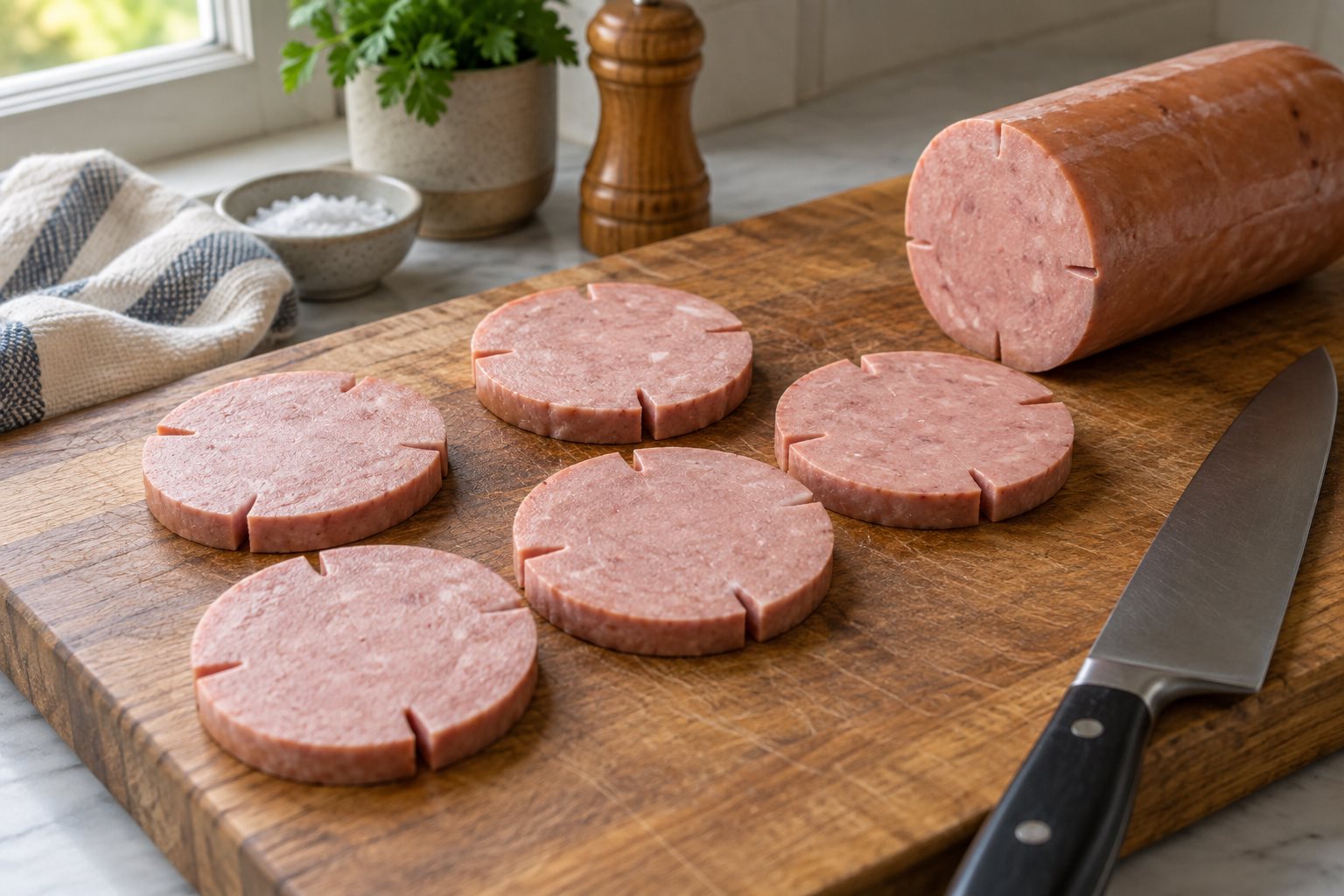
  1. Notch the slices. Cut the pork roll into 8 slices a quarter inch thick if it is not already sliced. With the tip of a knife make 4 shallow cuts around the edge of each slice, about half an inch long, evenly spaced like the points of a compass.
    Pork roll slices with four shallow cuts around each edge
    Four shallow notches help each slice stay flat against the pan. AI-generated illustration.
  2. Brown the meat. Heat a dry 12-inch skillet over medium-high. Lay the slices in without crowding and cook 2 to 3 minutes a side, until the faces are deep brown and the notched edges have curled and crisped. Work in two batches if the pan is full.
  3. Melt the cheese on it. Stack the slices in pairs in the pan, off the heat, lay a slice of cheese over each pair and cover the pan for 45 seconds. The residual heat is enough; direct heat at this point burns the cheese onto the metal.
  4. Toast the rolls. Split the kaisers and press them cut side down into the rendered fat left in the pan for 30 seconds, until just gold. Set them aside open.
  5. Fry the eggs. Return the pan to medium. Crack the eggs into the remaining fat and fry 2 minutes, until the whites are set and the edges lace. Grind pepper over them and leave the salt alone.
  6. Build and press. A cheese-capped pair of slices on the bottom half, the egg on top, the lid on, and a firm press with the flat of your hand to seat it. Eat it within two minutes, in paper if you have it.
If the slices cupped anyway, the notches were too shallow or the pan was too hot at the start — take them out, cut the notches deeper, and put them back for a minute; they will flatten. If the cheese pooled in the pan instead of on the meat, the pan was still on the burner. If the sandwich tastes only of salt, the slices were cut too thin and there was no interior left to balance the cure; go thicker next time and it is a different sandwich.

Storage and make-ahead

This is not a make-ahead sandwich and refrigerating a built one ruins all three components at once. The uncooked meat is the thing that keeps: a whole cloth-wrapped roll holds for weeks unopened in the fridge, and slices keep 5 days once cut.

Browned pork roll left over from a big batch is worth keeping 3 days and is better diced cold into a potato hash than reheated as slices, which go leathery the second time around.

What to serve with it

Coffee, black, and nothing else on the plate. This is a counter breakfast and it does not want a side.

If it is going to be lunch instead, the New Jersey answer is a salt bagel in place of the kaiser and a paper cup of pickles on the side.

A kaiser roll open on paper, holding two browned slices of pork roll with curled crisp edges, a fried egg and a melted slice of American cheese

From the recipe box / New Jersey

Pork Roll, Egg and Cheese

Thick slices of cured, smoked pork roll notched at the edge so they fry flat, a fried egg, American cheese melted on the meat in the pan, all of it on a kaiser roll.

Prep
5 min
Cook
15 min
Total
20 min
Serves
4
Calories
748 per sandwich

Ingredients

Scale

Instructions

  1. Cut the pork roll into 8 quarter-inch slices and make 4 shallow half-inch cuts around the edge of each.
  2. Brown the slices in a dry skillet over medium-high, 2–3 minutes a side, until the edges curl and crisp.
  3. Off the heat, stack the slices in pairs, cap each pair with cheese and cover the pan 45 seconds.
  4. Press the split rolls cut side down in the rendered fat for 30 seconds to toast.
  5. Fry the eggs in the remaining fat over medium for 2 minutes, then pepper them.
  6. Build each sandwich meat, egg, lid, and press it flat with your hand before eating.

Nutrition

Fat48 g (18 g saturated)
Sodium2350 mg
Protein34 g
Serving1 sandwich
Calories748
Cholesterol280 mg
Carbohydrates35 g (3 g sugar, 2 g fiber)

Nutrition is an estimate calculated from the listed ingredients and is provided as a courtesy, not as dietary advice.

Questions readers ask

Is it pork roll or Taylor ham?

Both names are old and both are in print. A federal court in 1910 recorded that the product had been sold as Taylor's Prepared Ham and was relabelled Taylor's Pork Roll or Trenton Pork Roll after the federal pure food law; a Mount Holly grocer was still advertising "The Taylor Ham" in 1905, and another was pricing "Pork Roll or Prepared Ham" as one line in 1922. The geographic rule people quote does not hold up in the papers of Burlington County, which are as South Jersey as it gets.

Do I really need to notch the slices?

If you want a flat sandwich, yes. Without the cuts the casing edge contracts, the slice domes, and only the rim touches the pan. Four cuts take five seconds and are the single technique in the recipe.

Can I substitute Canadian bacon or ham?

You can make a sandwich, but not this one. Pork roll is fermented and cured — federally it sits in the ingredient tables beside cervelat and thuringer — and it tastes tangy and smoky in a way that a lean loin cure does not. Spam is closer in fat and salt than Canadian bacon is, though it browns quite differently.

Salt, pepper, ketchup — where does that come from?

It is a counter order, spoken as one word, and it means the sandwich with salt, pepper and ketchup on it. I leave the salt off because the cure and the rendered fat already carry it; the ketchup is genuinely contested and nobody in New Jersey will settle it for you.