The regional table / Minnesota
Pan-Fried Walleye
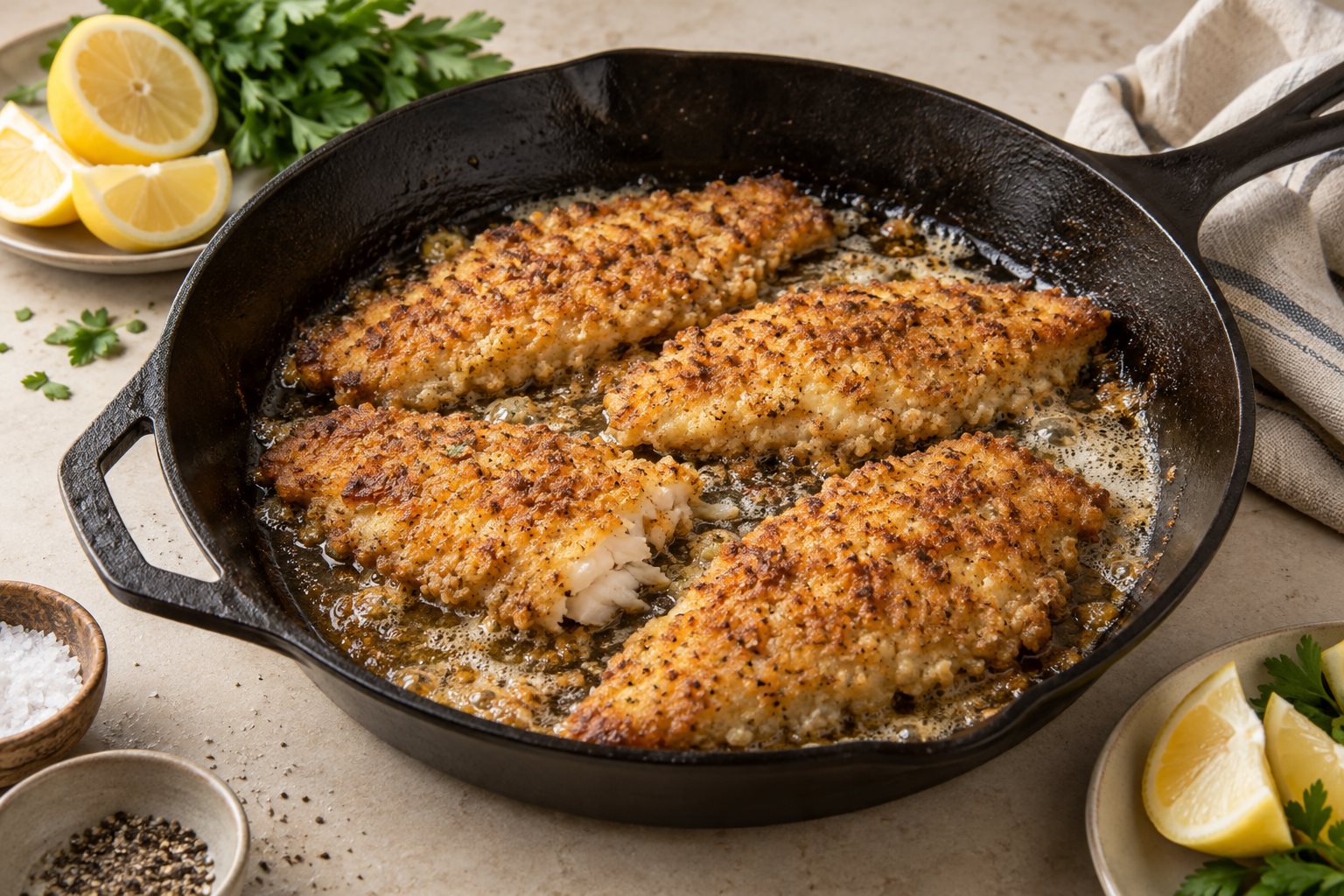
The state fish of Minnesota is a lean, thin, mild fillet, which means the whole job is heat, a dry surface and getting out of the way.
Minnesota named the walleye its state fish in 1965, and the statute is two sentences long: Minn. Stat. § 1.146 provides that "the walleye, Stizostedion v. vitreum, is the official fish of the state of Minnesota", and that a photograph of it shall be preserved in the Office of the Secretary of State. The Latin in the law is now out of date — the fish is Sander vitreus today — but the law has not been rewritten, which is its own small pleasure. The Minnesota Historical Society's encyclopedia notes that the legislature made the choice on the opening day of the 1965 fishing season, and is honest about the grounds: walleyes are "neither the state's biggest fish nor its most abundant", they are simply the favourite. The same entry supplies the fact every visitor should be told and few are: "Most walleyes served in Minnesota pubs, restaurants, and fairground booths are caught and processed in Canada." Commercial fishing for walleye inside Minnesota is largely closed, in order to protect the population, honour treaties and leave the fish to anglers. The walleye on a Minnesota plate is usually a Canadian fish, frozen; the walleye in a Minnesota memory is one somebody caught.
The commercial history that did happen in the state is on the federal record in detail. Special Scientific Report — Fisheries No. 229, published by the Fish and Wildlife Service of the Department of the Interior in 1957, is John Van Oosten and Hilary J. Deason's history of the Red Lakes fishery from 1917 to 1938, and it opens on a lake so full of fish that "each year vast quantities of various species died and were beached along the shores", with walleyes small and scrawny — "razor-backed" is the report's word — and the flesh poor. A commercial enterprise "was begun on the Red Lakes during the fall of 1917 with a basic fund of $1,000 appropriated by the Minnesota Public Safety Commission"; the first pound-net lifted in Lower Red Lake took 9,657 pounds of fish, "approximately 80 percent of which were walleyes". The state superintendent's numbers show what thinning a crowded lake did to the size of the fish: "In 1918 it required from 125 to 137 walleyed pike to fill a box of 150 pounds, whereas during the season of 1922 the number required for the same sized box is from 70 to 85." The report records that the shore areas inside the reservation boundaries were inhabited "exclusively" by Ojibwe people, and that on 27 March 1929 the Red Lake Fisheries Association was "organized and incorporated under the laws of Minnesota by the Red Lake Tribe, in order that the commercial fisheries of the Red Lakes might be exploited judiciously and profitably by the Indians". That claim is still live in the rulebook: Minnesota Rules part 6262.0575, headed "Treaty lakes", allows the commissioner to change seasons and limits "to accommodate tribal declarations for fish harvest in the 1837 Ceded Territory in compliance with the court ruling in Mille Lacs Band of Chippewa v. Minnesota, 119 S.Ct. 1187 (1999)". Lake by lake, part 6264.0400 then fixes what may be kept — an 18-to-24-inch protected slot on some waters, a 16-inch minimum on others — which is why a home recipe for this fish is written for a pound and a half of fillets and not for a trophy. No printed north-woods recipe old enough to be public domain could be found for it, so the quantities below were worked out for this page.
Why this version works
Saltines beat breadcrumbs. Crushed soda crackers are already baked, already salted and already fat-containing, so they colour fast and stay shatteringly crisp rather than softening into a pad. Crush them to something between sand and gravel: too fine and you have flour, too coarse and the pieces fall off in the pan and burn in the oil.
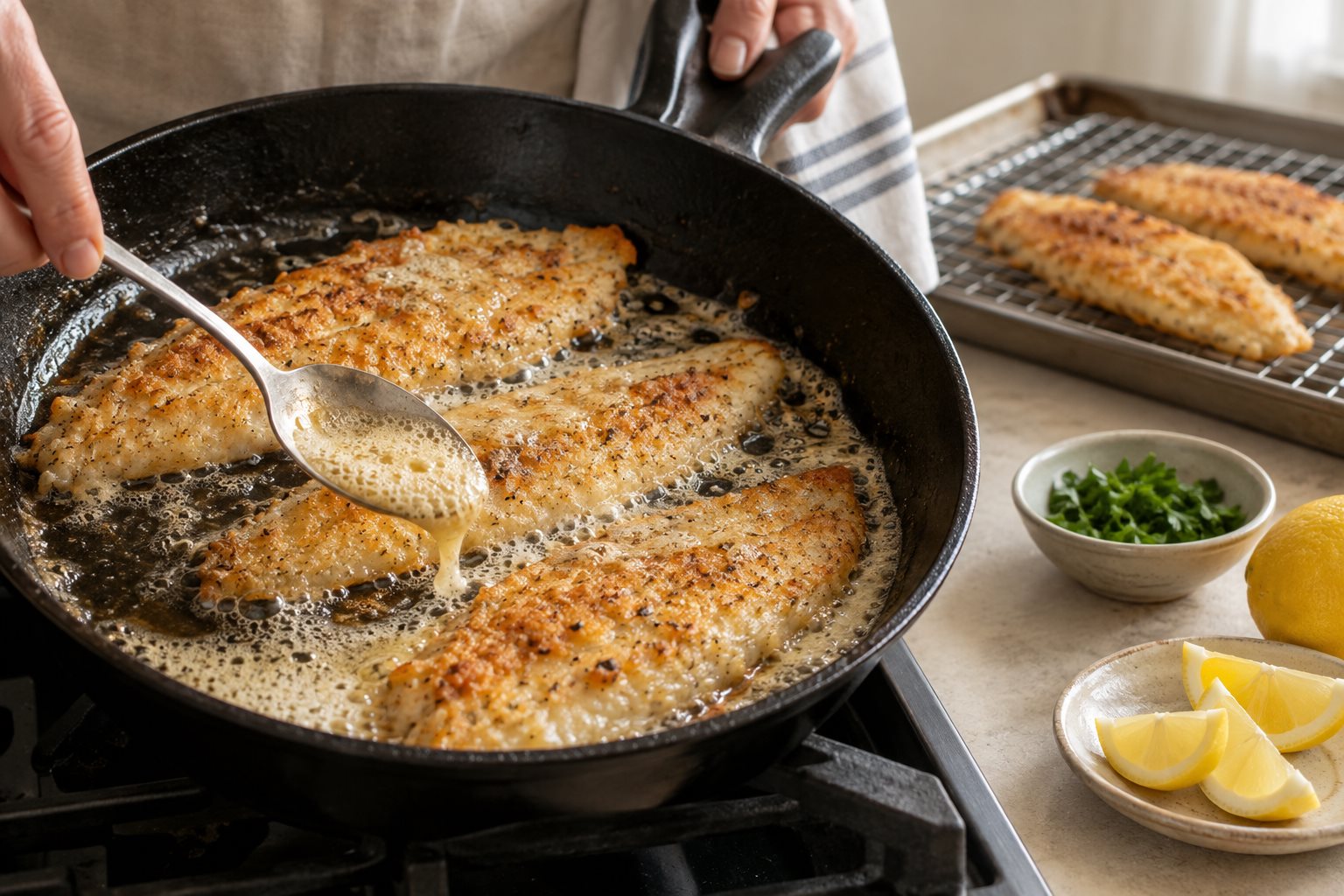
Oil for the frying, butter at the end. Butter has the flavour and the milk solids that go with freshwater fish, and it burns at about 300°F, well below where this crust needs to form. Fry in neutral oil hot enough to sizzle hard on contact, then add butter in the last minute and baste. You get the browning from the oil and the taste from the butter, and nothing tastes scorched.
The coat is thin because the fish is thin. A walleye fillet off a keeper-sized fish runs half to three-quarters of an inch at the thick end and tapers to nothing. It is cooked through in six minutes. A batter needs longer than that to set and colour, so it either stays raw or it drives the fish past done — which is why every version of this that works uses a dry coat of flour or crushed cracker that browns in the same time the fish takes.
The fish is dried and salted before it is coated. Walleye is lean — there is almost no fat in the flesh to protect it — and any surface water turns to steam under the crust and lifts it off in sheets. Pat it properly dry, salt it, let it stand ten minutes while the oil heats, and pat it dry again. That second drying is the difference between a crust that clings and one that slides off onto the spatula.