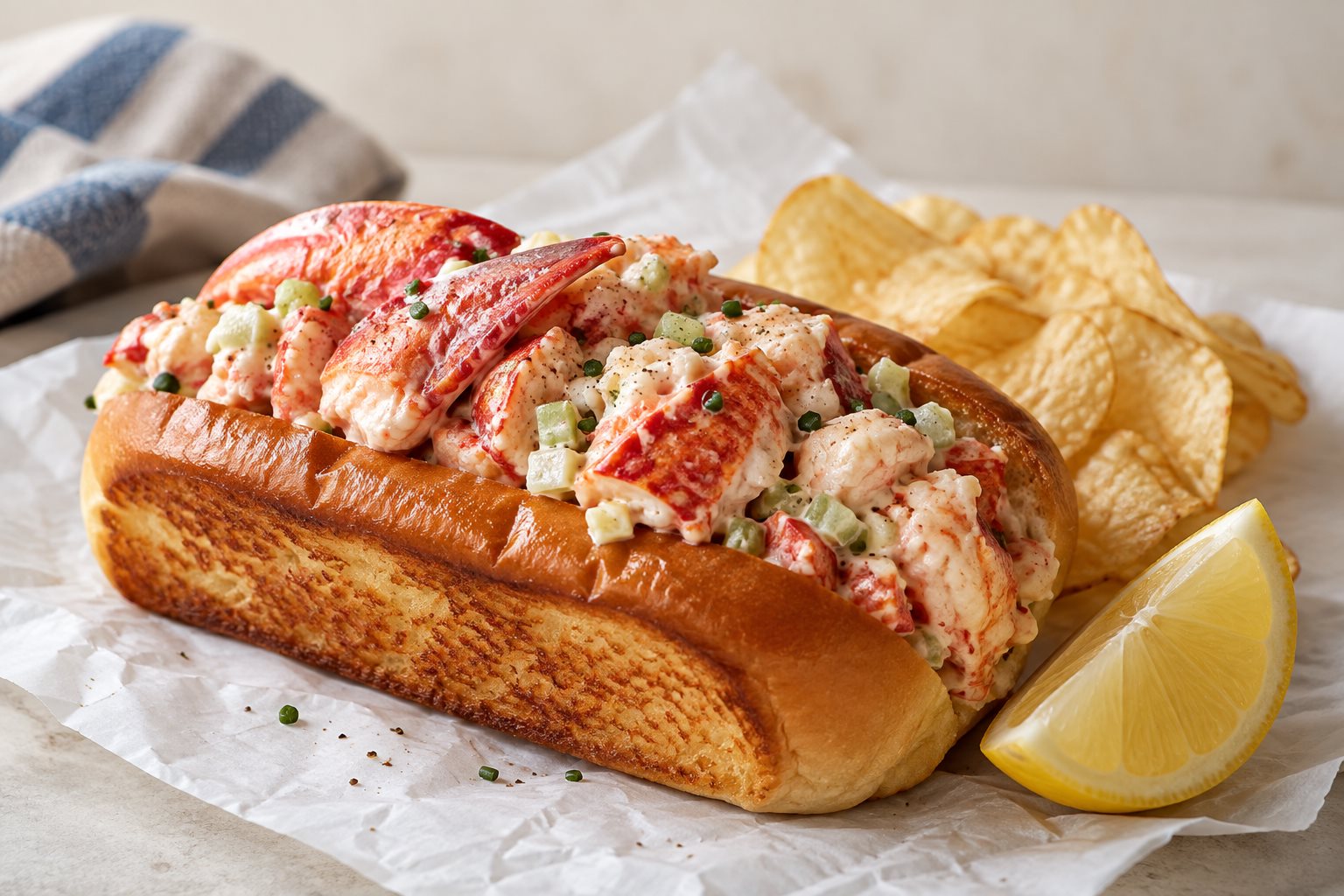
The meat should look like lobster, not like salad. If you cannot see the seams of the claws, there is too much mayonnaise in it. AI-generated illustration.
A Biddeford advertisement of 11 August 1944 prices the whole argument in five words: LOBSTER SALAD ROLL 30c.
That line is worth reading slowly, because of what it is doing. The Biddeford Daily Journal of 11 August 1944 carries it on page eight, in a column of small advertisements that also holds Fournier's Grill, 185 Pool St., Tel. 776, selling large live lobsters at 35c a pound. The scanned column is a jumble and I will not swear whose counter the salad roll was sold over. What I will swear to is the word. Through that same summer the plain article in Biddeford was going for twenty cents; this one is thirty, and the extra ten cents buys a noun. Somebody had to say salad, in print, to mark this roll off from the other one.
That is the whole of what the Maine record will carry, and it is less than the internet will tell you. The tidy modern rule — Maine cold with mayonnaise, Connecticut hot with butter — is not in the earliest printings on either side. Biddeford's Fournier's Grill listed a lobster roll among live lobsters, freshly shucked clams and clams for steaming in a display advertisement of 23 February 1943 and said nothing about dressing; its small advertisement through the summer of 1944 called the roll toasted and priced it at twenty cents, and said nothing about dressing either. Up the coast the Camden Herald of 27 September 1945 ran a prescription pharmacy's advertisement offering a lobster roll and fresh lobster meat daily — again, silent. In the whole reachable Maine run before 1950 the phrase "lobster salad roll" surfaces exactly once, in August 1944. So the honest claim is not that Maine invented the mayonnaise roll in some documented year. It is that Maine is where somebody first bothered to write the difference down.
Why this version works
Acid at the end. Lemon squeezed over the finished roll reads as brightness. Lemon stirred into the mayonnaise early reads as sourness and thins the binder so it slides. Same juice, same quantity, entirely different sandwich, and the difference is about ninety seconds.
Cold meat, warm bread. The contrast is the sandwich. Meat straight out of the refrigerator against a roll that has just come off the griddle gives you two temperatures in one bite, and it also keeps the mayonnaise from slackening and running. Dress the lobster while it is cold and griddle the rolls last, in that order, every time.
Butter on the bun, not in the bowl. The split-top roll is crustless on both flat sides, which is the whole reason it exists: both sides take butter and both sides griddle to a crisp wall that holds four ounces of wet filling without going to paste. Butter belongs there. Butter in with the mayonnaise sets into little cold beads and tastes of nothing.
Mayonnaise as a binder, not a sauce. A third of a cup for a pound of meat is about a quarter of what a delicatessen uses. At that ratio the mayonnaise coats the seams and holds the pieces to each other and does nothing else — you still taste lobster first, cold and slightly sweet, with the egg and oil arriving a beat later. Double it and you have made lobster salad, which is a fine thing and a different one.
Ingredient notes
Rolls: New England split-top frankfurter rolls, day-old for preference. If you cannot buy them, take a tall soft roll and shave the crust off both flat sides with a serrated knife — the crust is what stops a side-split bun from griddling.
Lobster: a pound of picked meat, which is roughly three lobsters of a pound and a quarter. Maine law makes this easier than it sounds: under 12 MRSA §6431 nobody may buy, sell, give away, transport, ship or possess a lobster shorter than 3 1/4 inches or longer than 5 inches, measured on the carapace. The double gauge is why Maine lobster arrives in a narrow size band, with claws you can pull out whole.
Mayonnaise: a third of a cup, and use one you actually like, since at this ratio there is nothing to hide behind. Hellmann's and its regional cousins are what these are built with in Maine; a lemony homemade mayonnaise is better still but wants half the added lemon juice.
Celery and chives: one small inner rib, cut to a fine dice, is the most any of this wants, and plenty of Maine counters leave it out. Chives are for colour and a faint onion note. Anything past that — dill, tarragon, paprika, diced pickle — turns the sandwich into a deli salad on a bun.
Step by step
Cut the meat cold. Cut the tail meat into 3 or 4 chunks each and leave the claws whole; break the knuckles in half with your fingers. Keep everything large and keep it in the refrigerator until the moment you dress it.
Dress it lightly. In a cold bowl, fold the mayonnaise, salt and pepper through the lobster with a rubber spatula, turning rather than stirring, until the pieces are coated and no more. Fold in the celery and chives. Do not let it sit and weep; if you must hold it, chill it and drain off any water before it goes in the rolls.
Butter the rolls on the outside. Spread the softened butter over both flat sides of each roll, right to the edges. This is the only butter in the recipe and it belongs entirely on the bread.
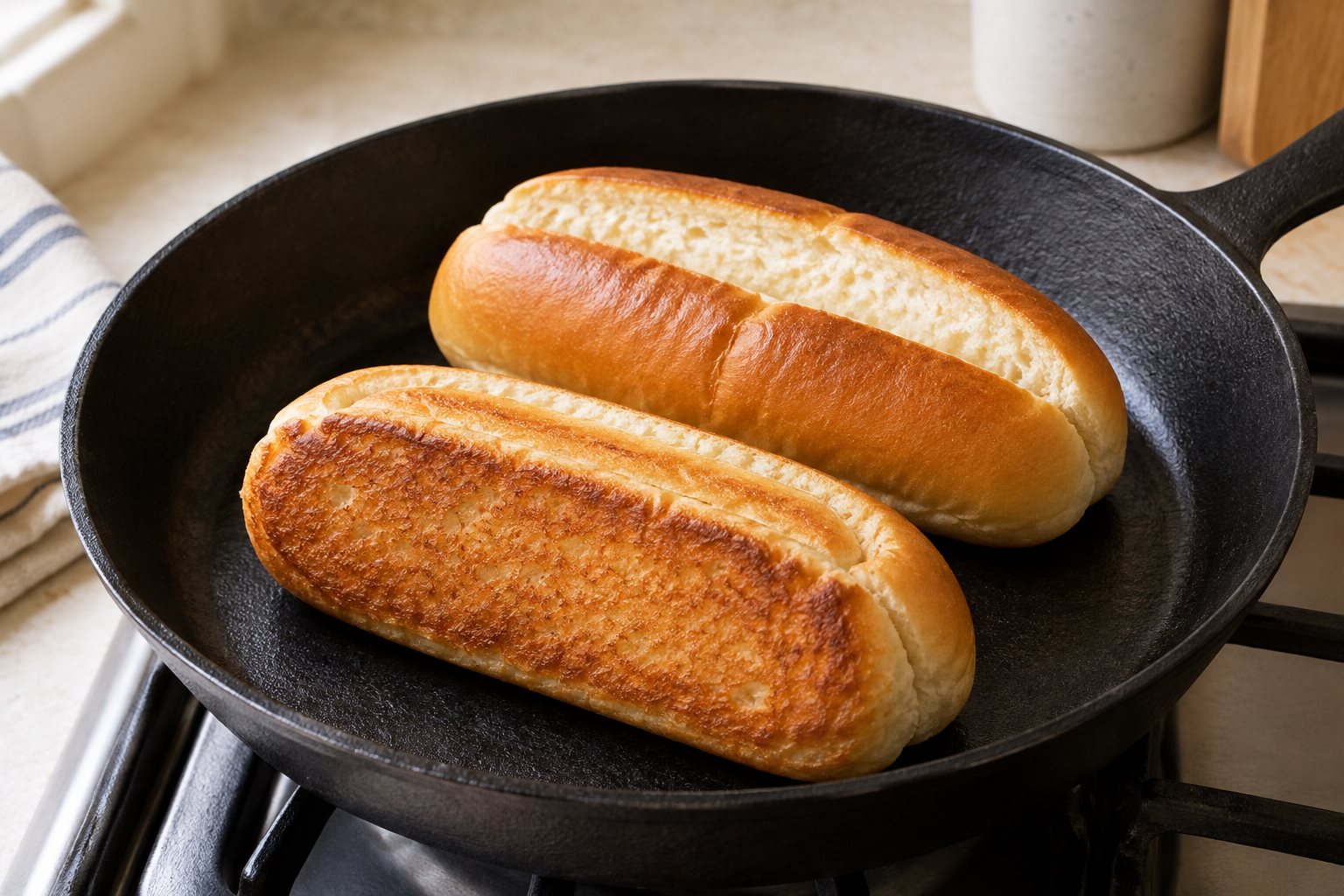
Griddle them. Lay the rolls on their flat sides in a dry skillet over medium heat and press lightly. Cook 1 to 2 minutes a side until deeply golden and crisp, then stand them open on a board so the cut faces do not steam.
Griddle the buttered flat outsides of the rolls until deeply golden, then fill them while hot. AI-generated illustration.
Fill and finish. Pile the lobster into the hot rolls, letting the claws sit proud on top where they can be seen. Squeeze lemon over each one, grind on more black pepper, and eat them standing up if the weather allows.
If the salad has gone slack and milky, water has come out of the meat and thinned the mayonnaise — usually from meat that was not drained, or from dressing it an hour early. Tip the whole thing into a sieve, let it drain two minutes, return it to a dry cold bowl and fold in a fresh tablespoon of mayonnaise. If the rolls came out limp rather than crisp, the pan was not hot enough or they went into the pan already damp with butter melting off them; wipe the skillet, raise the heat a notch and give them another minute a side before filling. The one fault nothing repairs is over-dressing. Once a pound of lobster has half a cup of mayonnaise through it you cannot take it back out, so start short — you can always fold in another spoonful.
Storage and make-ahead
Undressed picked lobster keeps 2 days refrigerated in a covered container, and that is the way to store it. Dressed lobster salad is at its best within the hour and tired by the next morning, when the meat has given up water and the mayonnaise has gone thin around it.
Never freeze a dressed roll or a dressed bowl. If you have more meat than sandwiches, freeze the plain meat in its own liquid, thaw it overnight in the refrigerator, and drain it hard before it meets any mayonnaise.
What to serve with it
Potato chips out of the bag and a dill pickle, which is what actually comes on the paper plate in Maine, with iced tea or a cold lager. If you want a proper side, boiled new potatoes dressed in vinegar while warm go better than any creamy slaw, which only puts a second bowl of mayonnaise on the table.
From the recipe box / Maine
Maine Lobster Roll with Mayonnaise
Cold picked lobster barely dressed with mayonnaise and lemon, piled into a split-top roll whose flat sides have been buttered and griddled crisp.
Prep
20 min
Cook
5 min
Total
25 min
Serves
4
Calories
442 per serving
Ingredients
Scale
Instructions
Cut the tail meat into 3 or 4 chunks each, break the knuckles in half and leave the claws whole, keeping everything cold.
Fold the mayonnaise, salt and pepper through the lobster with a spatula until just coated, then fold in the celery and chives.
Spread the softened butter over both flat sides of every roll, right to the edges.
Griddle the rolls flat side down in a dry skillet over medium heat, 1–2 minutes a side, until crisp and golden.
Fill the hot rolls with the cold lobster, claws on top, and finish with lemon and more black pepper. Serve at once.
Nutrition
Fat
25 g (7 g saturated)
Sodium
900 mg
Protein
26 g
Serving
One filled roll
Calories
442
Cholesterol
130 mg
Carbohydrates
25 g (4 g sugar, 1 g fiber)
Nutrition is an estimate calculated from the listed ingredients and is provided as
a courtesy, not as dietary advice.
Questions readers ask
How much lobster do I need to buy?
About a pound of picked meat for four rolls, which is roughly three lobsters of a pound and a quarter. Yield runs near a fifth of live weight for hard-shells and less for soft-shells, which carry more water in the shell, so buy on the generous side and pick the body and legs too — those scraps go straight into the bowl.
Can I use frozen or claw-only meat?
Yes to both, with one rule: drain it. Thaw frozen meat overnight in the refrigerator, never under water, then leave it in a sieve for ten minutes before it meets the mayonnaise, because the liquid it sheds is exactly what turns a dressed roll into soup. Claw-and-knuckle packs make a sweeter, softer roll than one with tail in it; add a little more black pepper to give it some edge.
Should it be cold or at room temperature?
Cold, and dressed at the last minute. The sandwich is built on the gap between cold filling and a hot griddled roll, and lobster salad that has stood out for an hour has both lost that gap and begun to weep water into the mayonnaise. Dress, griddle, fill, eat — the whole sequence is about five minutes.
Is the mayonnaise roll really the older Maine one?
The record will not say that, and I am not going to pretend it does. The earliest Maine printings I could reach name no dressing at all: a Biddeford grill advertised a lobster roll in February 1943 and a toasted lobster roll at twenty cents through the summer of 1944, both silent on what was in it. The first Maine printing that names anything is the LOBSTER SALAD ROLL at 30c of 11 August 1944 — the first written admission that two different rolls existed, not a birth certificate for either.