The regional table / Idaho
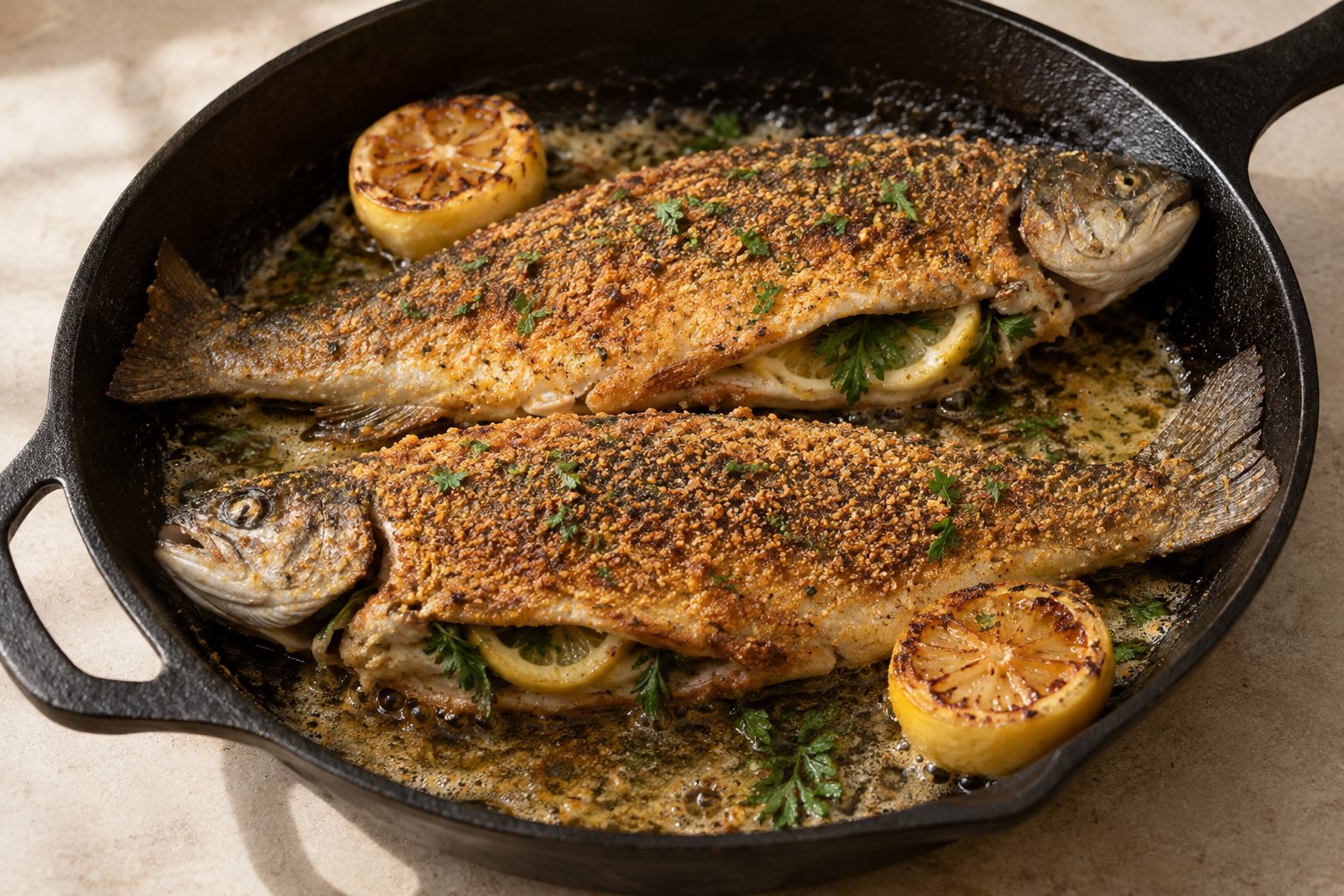
Pan-Fried Hagerman Trout
Fifty-six per cent of all the farmed table trout in the United States comes out of twenty farms, nearly all of them strung along about thirty miles of one Idaho river canyon.
The 2018 Census of Aquaculture, released by the National Agricultural Statistics Service on 19 December 2019, counts 300 farms in the United States selling food-size trout, and among them they sold 49,316,000 pounds live weight. Twenty of those farms are in Idaho, and those twenty sold 27,588,000 pounds — fifty-six per cent of the national weight and sixty-one per cent of the fish. The same table quietly hands you the cooking instruction: the average American food-size trout weighed 1.3 pounds, and the average Idaho one weighed 1.2. Nobody is filleting a fish that size. It is a skillet fish, and the whole industry is built around producing it.
Why here is a question with a federal answer and a land-grant answer. The federal one is temperature. USGS Open-File Report 02-185 measured nineteen springs discharging into the Snake River between Twin Falls and Hagerman every March from 1994 to 1999, and recorded Box Canyon Spring near Wendell at 14.0 to 15.0 degrees Celsius, Blue Heart Spring at 14.1 to 15.0, and the Blue Lakes outlet at 15.2 to 15.8 — the same water, the same temperature, year after year, in the first week of spring. The report also notes in passing that at several springs "the flow was diverted for use by fish hatcheries". The land-grant answer is in Aquaculture in Idaho and Nationwide, written by George W. Klontz and John G. King for the Idaho Water Resources Research Institute at the University of Idaho and issued in March 1975. It says the growth of the industry rests on large quantities of water at about 58 degrees Fahrenheit, which is the optimum for rainbow trout, and it dates the beginning precisely: "In 1928 Jack Tingey started the Snake River Trout Farm, the first food fish farm and hatchery using the Hagerman Aquifer water." Tingey marketed his first crop in 1929.
Why this version works
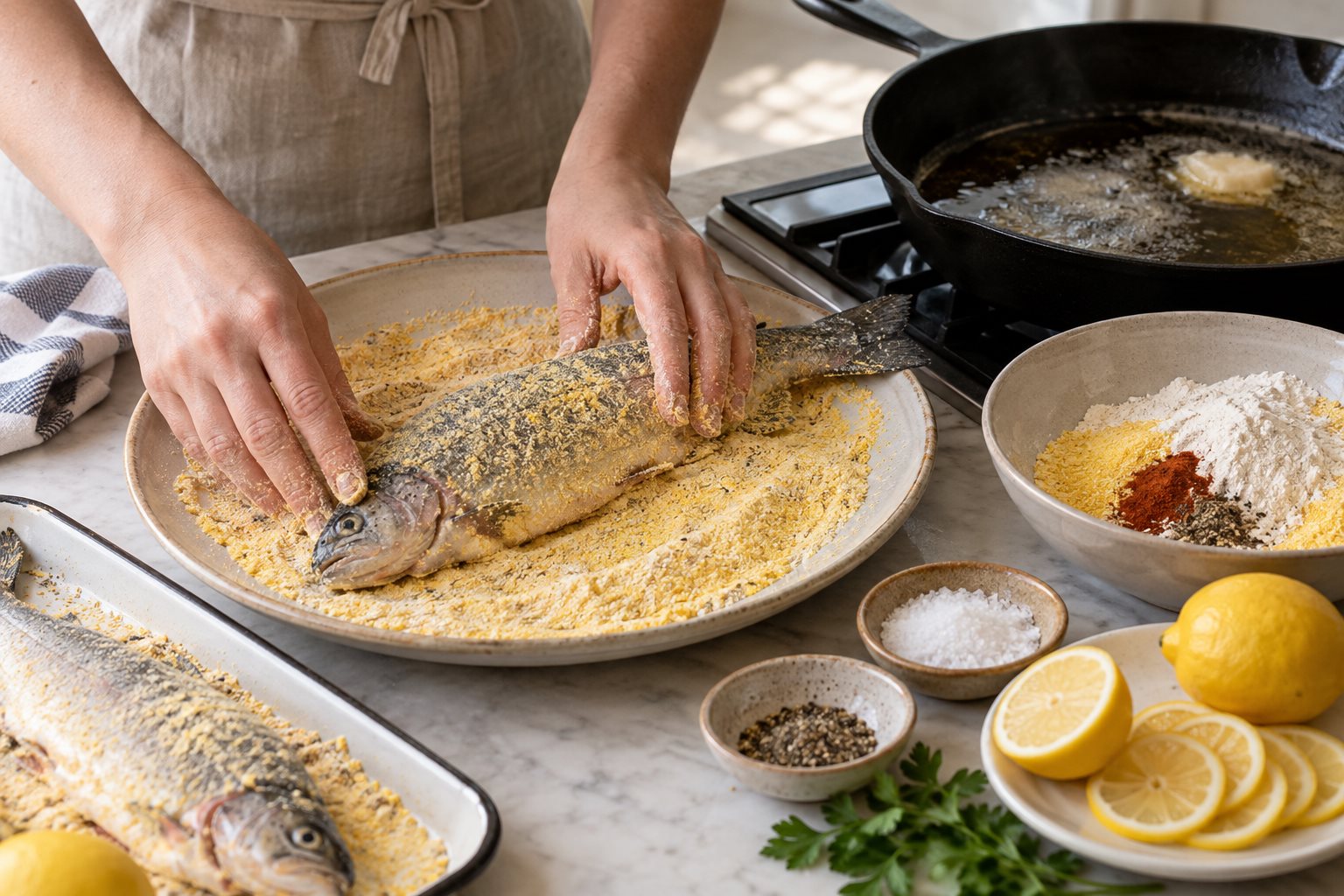
Cornmeal, not flour. Medium-grind cornmeal does not gelatinise the way wheat starch does. It stays granular against the skin and fries into something closer to a crust than a coating, and because the grains sit apart from one another steam escapes between them instead of lifting the crust off the fish.
Bacon fat and a hot skillet. Trout has almost no connective tissue and very little of its own fat in the skin, so it will stick to anything that is not properly hot and properly greased. Rendered bacon fat has a higher smoke point than butter and it seasons the crust; the butter goes in at the end, off the heat, where it browns but does not burn.
Whole fish, head and tail on. The Klontz and King report prints a dress-out table for an 11.3-inch rainbow: 8.6 to 9.9 ounces round, averaging 9.25, and 6.9 to 7.9 ounces once the gills and viscera are out. That is a fish built to be cooked in one piece. The head holds the front end together and the collar meat behind it is the best bite on the animal; take it off and you are down to two thin fillets that overcook in a minute.
Four minutes, then four minutes. A fish weighing about a pound is cooked through at eight minutes total in a skillet at medium-high, and it is dry at eleven. Start it presentation side down, turn once, and stop. There is no second stage and no oven, which is why this dish belongs to people who caught or bought the fish that morning.