American cooking Recipes & regional stories

Skillet & Sage

A culinary journey through the fifty states

The regional table / Connecticut

Connecticut Hot Lobster Roll with Butter
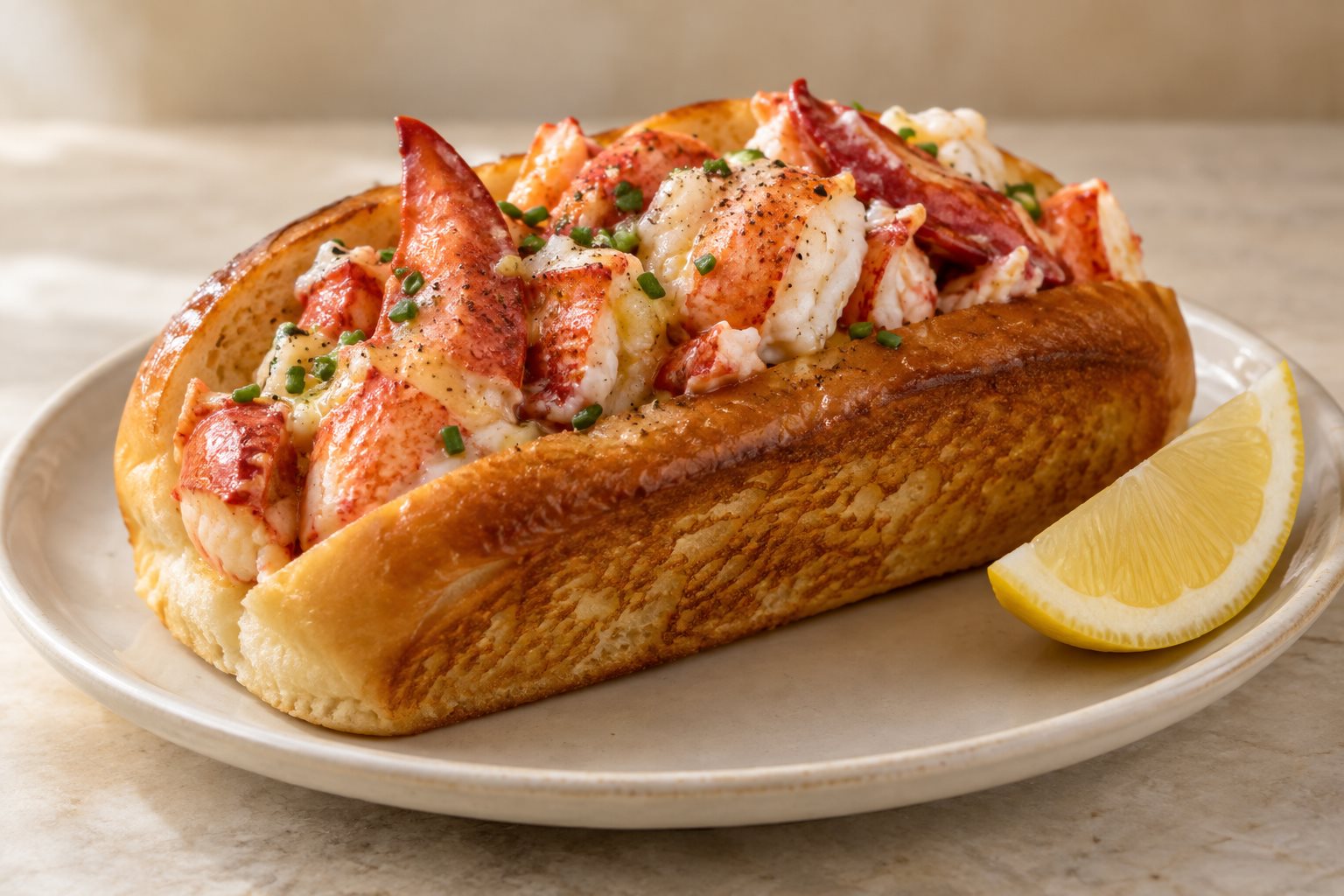
A split-top bun griddled golden on both flat sides, overflowing with large pieces of warm lobster meat glossy with butter, a wedge of lemon beside it
The butter should coat rather than pool. If there is a puddle in the paper under the roll, the pan was too hot and the butter has broken. AI-generated illustration.

A Connecticut restaurant menu of August 1962 prints it as one item in a take-out list, hyphenated and priced: HOT-LOBSTER ROLL 85c.

That menu is the anchor, and it is worth quoting in its setting. The Branford Review of 16 August 1962 carries an advertisement for Deacon's Restaurant, 225 Montowese Street, "Serving Quality Foods at Minimum Prices". Under the heading Thursday & Friday Take-Out Specials it lists New England clam chowder at 50c a pint, fried Ipswich clams at 75c a pint, a soft shell crab sandwich at 95c, french fries at 20c, and then HOT-LOBSTER ROLL 85c. Hot is printed into the name, hyphenated onto it, on a Long Island Sound shore-town menu, as a normal item priced between the fries and the dinners. The word reaches Connecticut print earlier than that, though without the adjective: the Stonington Mirror and Mystic Journal of 26 June 1942 ran an advertisement for the Rogers, Bindloss dock asking readers whether they had "tried our fresh lobster roll?" and telling them "Better do it." That is a lobster roll sold at a working dock on the Connecticut shore in the first summer of the war, and the copy describes it as fresh and nothing else.

The split that everybody states as settled — Connecticut hot with butter, Maine cold with mayonnaise — does not appear in the earliest dated printings on either side, and this article will not pretend otherwise, particularly since Maine's roll has not been written here yet and deserves its own documents rather than being used as a foil. What the Maine record actually says at the same moment is this: the Biddeford Daily Journal ran a small advertisement through the summer of 1944 reading "TOASTED, LOBSTER Roll 20c. Inquire Fournier's Grill, 185 Pool St.", and the same grill's display advertisement of 23 February 1943 lists Lobster Roll among live lobsters, freshly shucked clams and clams for steaming. Toasted, twenty cents, and silent about dressing. So in the 1940s both states are selling something called a lobster roll and neither one is telling the reader what is in it. What is dated is the adjective: toasted in Maine in 1944, hot in Connecticut in 1962. The rest of the argument for butter is the lobster itself, and the federal record is good on that. The Fisheries and Fishery Industries of the United States, Government Printing Office, 1887, says Connecticut's lobster interests "date back to the early part of the present century, and certainly to before 1810", that the fishery inside state waters was never very extensive, and that the long-running lobster trade between Cape Cod and New York City "was largely due to their enterprise" — Connecticut smacks, out of Noank and New London, carrying other people's lobsters to somebody else's market. The same volume prints the size laws side by side, and they are not close: Connecticut's law of 1878 prohibited taking lobsters under six inches, while Rhode Island in 1882 set ten and New York in 1880 set ten and a half. A state whose legal lobster was six inches long was a state in which the meat came in small, sweet pieces from soft-shell lobsters, and a small sweet piece of lobster does not want to be buried in mayonnaise.

Why this version works

Nothing else in the bun. No celery, no onion, no herbs beyond a pinch of chives if you must, and above all no mayonnaise alongside the butter. The single argument of this sandwich is that a good lobster tastes better warm than cold and that butter carries that flavour where mayonnaise covers it. Adding both makes the case for neither.

Butter off the heat, not butter in a pan. Lobster meat is already cooked when it is picked, and the second cooking is what makes it squeak against the teeth. Melt the butter, pull the pan off the burner, let it drop below a simmer, and then turn the meat through it for a minute or two. You are warming it to about the temperature of a bath, not cooking it again.

A split-top bun, because the sides are the plate. A New England split-top roll is crustless on both flat sides, which means both sides can be buttered and griddled to a crisp golden wall. That wall is structural: it is what stops a bun holding four ounces of buttered lobster from collapsing into the paper. A side-split hamburger or hot dog bun has crust where you need griddle, and it goes limp.

Claw and knuckle for the body of it, tail for the bite. Claw and knuckle meat is looser, sweeter and more absorbent; tail is firm and holds its shape. A roll of pure tail eats like a rubber sandwich and a roll of pure claw eats like a paste. Roughly two thirds claw and knuckle to one third tail, cut in large pieces, gives you both textures in one mouthful.
Ingredient notes

Rolls: New England split-top frankfurter rolls. If you cannot find them, buy tall soft rolls and slice the crust off both flat sides yourself with a serrated knife — the crust is the problem, not the shape. Day-old is better than fresh; a very soft new roll tears when you griddle it.

Butter: six tablespoons of good unsalted butter for four rolls, four of it for the meat and two for the griddle. Use unsalted so you control the seasoning, because lobster carries salt of its own and the roll is easy to overshoot.

Lobster: a pound of picked meat, which is roughly three one-and-a-quarter-pound lobsters. If you are cooking them yourself, steam rather than boil — eight minutes for a chicken lobster, ten to twelve for a pound and a half — and cool them just enough to handle before picking. Soft-shell lobsters give sweeter, wetter meat and less of it; hard-shells give more meat and firmer.

Lemon and pepper: a squeeze of lemon and a good deal of coarse black pepper, both added at the last second. Lemon put into warm butter early turns the sauce cloudy and dulls it; lemon squeezed over the finished roll brightens the whole thing without touching the butter at all.

Step by step

  1. Pick and cut the meat. If starting from whole lobsters, steam them, cool briefly and pick out the claw, knuckle and tail meat. Cut the tails into 3 or 4 chunks each and leave the claws whole. Keep the pieces large — this sandwich is about the size of what you bite into.
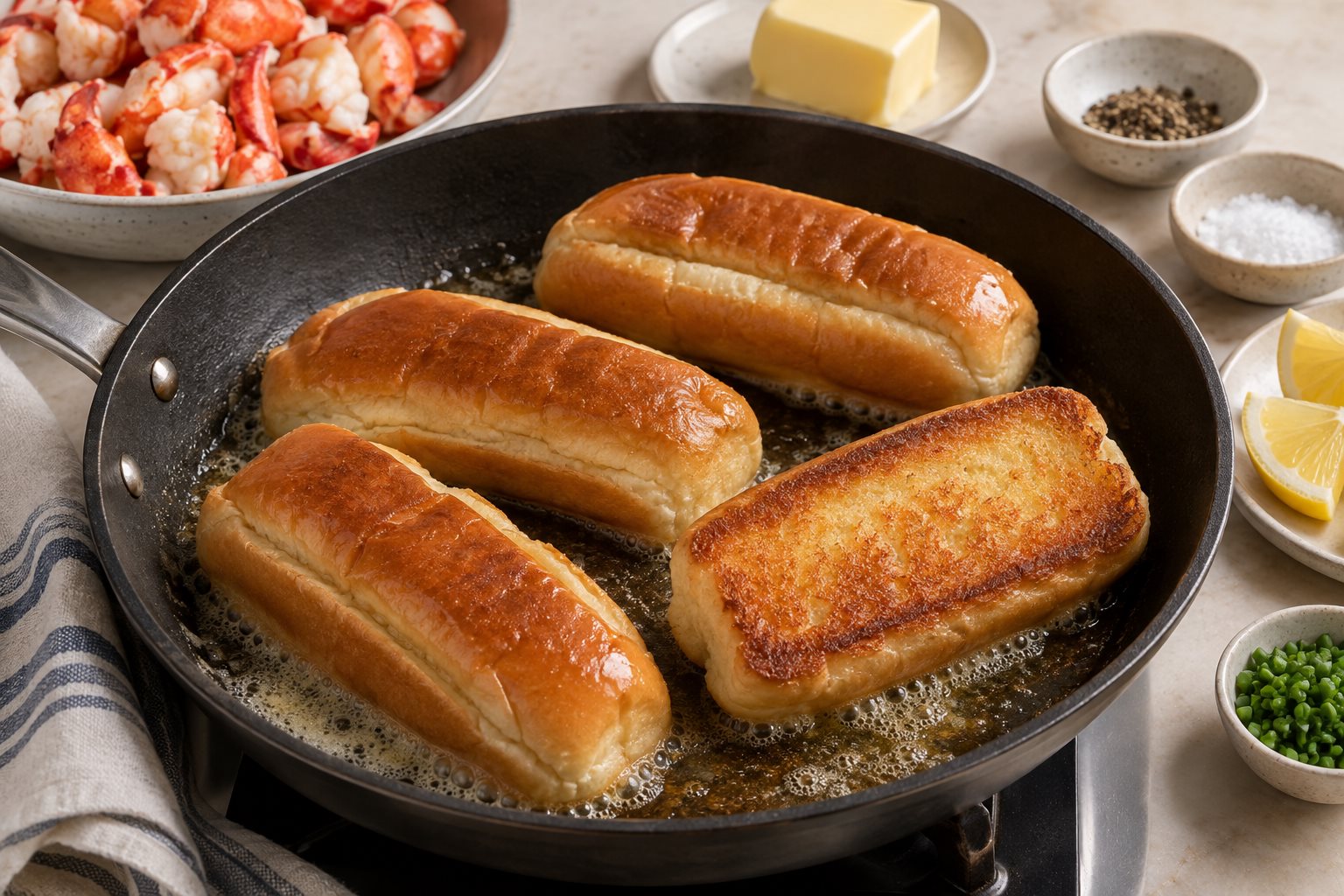
  2. Griddle the rolls. Melt 2 tablespoons of the butter in a wide skillet over medium heat. Lay the rolls on their flat sides and press lightly; cook 1 to 2 minutes a side until deeply golden and crisp. Take them out and keep them open.
    New England split-top hot dog rolls lying on their flat outer sides in a skillet with melted butter, one turned to reveal an evenly golden crisp rectangular side. Empty rolls, no lobster in the pan yet.
    Toast the flat sides of the split-top rolls in butter until deeply golden. AI-generated illustration.
  3. Melt the rest of the butter and take it off the heat. Wipe the pan, add the remaining 4 tablespoons of butter and melt it over low heat until just liquid. Pull the pan off the burner entirely. It should be warm enough to coat and nowhere near bubbling.
  4. Warm the lobster through. Add the meat to the butter with a pinch of salt and turn it gently for 2 to 3 minutes, returning the pan to the lowest heat for a few seconds at a time if it cools too far. The meat is ready when it is warm all the way through and glossy — not steaming, and not sizzling.
  5. Fill and finish. Pile the meat into the griddled rolls, spoon over any butter left in the pan, and finish each roll with a squeeze of lemon, plenty of coarse black pepper and, if you like, a scatter of chives. Serve immediately, with paper under them.
If the butter breaks into an oily layer and a milky one, the pan was too hot. Take it off, drop in a tablespoon of cold butter and swirl hard; it will usually come back together, and if it does not, lift the lobster out with a slotted spoon and spoon a little fresh melted butter over it in the roll. If the meat has gone tough and squeaky it was warmed too far, and nothing brings it back — serve it cold with lemon and call it something else. The one fault worth real care is a soggy roll, which comes from filling the bun before it is griddled or from letting the rolls sit face up and steam. Griddle last, fill immediately, serve at once.

Storage and make-ahead

Do not build these ahead. Picked lobster meat keeps 2 days refrigerated in a covered container, and it is the only component worth storing; the roll must be griddled and filled within a minute or two of eating. Keep the meat dry and unbuttered until you want it.

Buttered lobster does not reheat. Yesterday's leftovers are better turned cold into a small salad with lemon and pepper, or dropped into a hot cup of chowder at the last moment, than sent back through a pan.

What to serve with it

Salt-and-vinegar potato chips straight out of the bag and a dill pickle, which is what these are actually served with on the Connecticut shore, plus something acidic and cold to drink. If you want a side that earns its place, make it a sharp cabbage slaw with cider vinegar and no mayonnaise — keeping mayonnaise off the plate entirely is the point.

A split-top bun griddled golden on both flat sides, overflowing with large pieces of warm lobster meat glossy with butter, a wedge of lemon beside it

From the recipe box / Connecticut

Connecticut Hot Lobster Roll with Butter

Warm picked lobster turned through melted butter off the heat and piled into a griddled split-top roll — no mayonnaise, no celery, and nothing else in the bun.

Prep
15 min
Cook
10 min
Total
25 min
Serves
4
Calories
615 per serving

Ingredients

Scale

Instructions

  1. Cut the lobster tails into 3 or 4 chunks each and leave the claws whole, keeping all the pieces large.
  2. Melt 2 tablespoons butter in a wide skillet over medium heat and griddle the rolls on both flat sides 1–2 minutes a side until crisp and golden.
  3. Wipe the pan, melt the remaining 4 tablespoons butter over low heat, and take it off the burner.
  4. Turn the lobster gently through the warm butter with the salt for 2–3 minutes, until warmed through and glossy but never sizzling.
  5. Pile into the rolls, spoon over the pan butter, and finish with lemon, black pepper and chives. Serve at once.

Nutrition

Fat35 g (21 g saturated)
Sodium990 mg
Protein29 g
ServingOne filled roll
Calories615
Cholesterol255 mg
Carbohydrates27 g (4 g sugar, 1 g fiber)

Nutrition is an estimate calculated from the listed ingredients and is provided as a courtesy, not as dietary advice.

Questions readers ask

Can I use frozen lobster meat?

Yes, and it is a reasonable choice for this sandwich specifically, because the butter and the warming step forgive a good deal. Thaw it overnight in the refrigerator, never in water, and drain it very well — frozen meat sheds liquid, and liquid in the pan will split the butter and soak the roll. Expect the texture to be a little looser and the flavour a little flatter than fresh.

How much lobster do I need to buy?

About a pound of picked meat for four rolls, which is roughly three lobsters of a pound and a quarter, or two of about two pounds. Yield runs near twenty percent of live weight for hard-shell lobsters and appreciably less for soft-shells, which hold more water in the shell — buy on the high side, since the offcuts from the body and legs are worth picking and go straight into the rolls.

Butter or mayonnaise — which one is correct?

Both are real and this is the butter one. The tidy modern rule that assigns hot butter to Connecticut and cold mayonnaise to Maine is not supported by the earliest dated advertisements on either side, which describe the roll as fresh or as toasted and say nothing at all about dressing. What can be dated is the word hot printed into a Connecticut menu item in August 1962, and that is the sandwich made here.

Is the Connecticut roll really older than the Maine one?

Nothing reachable from here proves that, and the dates found run the other way by a whisker. The earliest Connecticut printing traced is an advertisement in the Stonington Mirror and Mystic Journal of 26 June 1942; the earliest Maine one traced is in the Biddeford Daily Journal of 23 February 1943, with "TOASTED, LOBSTER Roll 20c" running through the summer of 1944. Both towns are small and both archives are partial, so those are the earliest verified printings and not the first occurrences. The much-repeated 1920s Connecticut origin story could not be tested against any archive that answered.