American cooking Recipes & regional stories

Skillet & Sage

A culinary journey through the fifty states

The regional table / Illinois

Chicago Hot Dog, Dragged Through the Garden
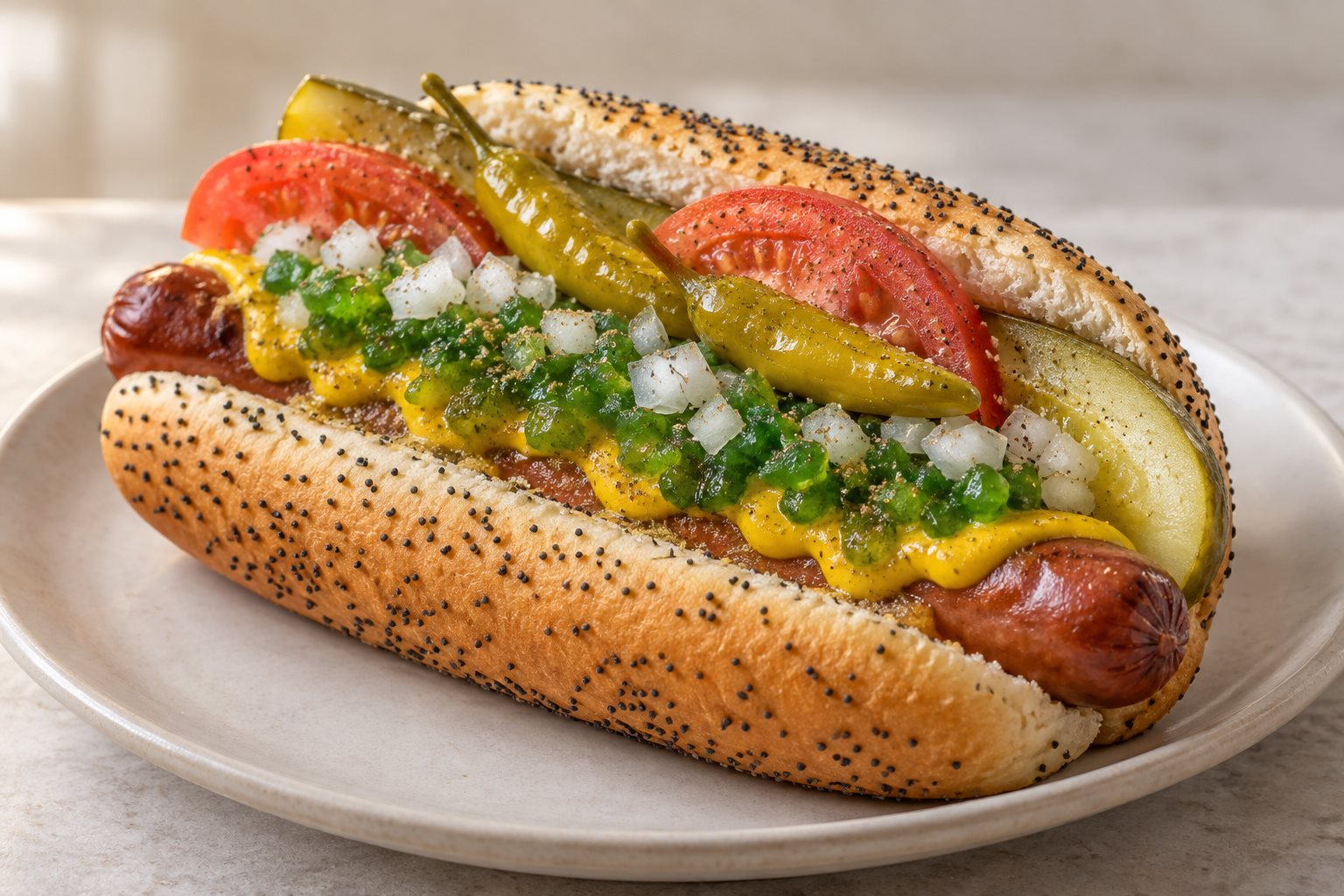
A natural-casing frankfurter in a poppy seed bun under a yellow mustard stripe, green relish, chopped onion, tomato wedges and a pickle spear along the sides, two sport peppers and a dusting of celery salt
Tomato and pickle go down the sides against the bun, not on top. That is what stops the whole load rolling off. AI-generated illustration.

Seven toppings, one order, no ketchup. Every part of that sentence has a history behind it, and none of the history involves anybody inventing this sandwich.

This is another dish younger than any public-domain cookbook, so the quantities here were worked out for this page and nothing on this page pretends a document exists. The history is unusually well handled all the same, because Bruce Kraig, professor emeritus at Roosevelt University and the author of Hot Dog: A Global History, has spent years refusing to hand anyone the credit. Abe Drexler, who founded Fluky's, claimed he invented the Chicago dog near Maxwell Street in the late 1920s; Kraig, interviewed by WBEZ's Curious City, said flatly that there is not really any evidence for that. What Kraig will say is how it assembled itself: the style came together out of many of Chicago's immigrant communities between about 1920 and 1950, stands were serving something like it by the 1930s though not always with everything, and the fixed form settled after the Second World War. Told to WTTW in July 2024, his division of labour is the neatest summary anyone has written — if Jews made hot dogs, then Greeks, Macedonians, Bulgarians, Italians and Mexicans dressed them. The sausage and the bun came with German immigrants, the poppy seeds on the bun with Eastern European Jews, the relish with the English, the sport peppers with Mexicans, and the onion, tomato and cucumber off the produce carts of Italian, Greek and Jewish sellers at the Maxwell Street Market around Halsted Street and Roosevelt Road.

The sausage itself is one of the few parts of this with a federal paper trail, and it is worth reading before you buy any. Title 9 of the Code of Federal Regulations, section 319.180, sets the standard of identity for what it calls frankfurter, frank, furter, hotdog, weiner, vienna, bologna, garlic bologna, knockwurst and similar products — the word vienna sits in the legal name of the product, which is a coincidence Chicago has enjoyed for a century. The rule says these are comminuted semisolid sausages made from raw skeletal muscle meat, seasoned and cured, which may or may not be smoked, and that the finished product shall not contain more than 30 percent fat and no more than 40 percent of fat and added water combined. Then comes the paragraph that tells you what you are actually holding: a sausage labelled with byproducts or with variety meats need only be 15 percent skeletal muscle meat, the rest being organ meat and defatted fatty tissue. Vienna Beef, whose own account traces its family recipes to Emil Reichel and Sam Ladany selling all-beef frankfurters at the 1893 World's Columbian Exposition, states on its own site that it is USDA Establishment #1, the first meat plant inspected. Both of those are the company's claims and are printed here as such.

Why this version works

Steam, never boil. A natural casing splits somewhere around a hard simmer and the fat walks out through the split, which is how a good frankfurter turns into a grey tube. Held over steam at about 170°F for eight minutes the casing tightens instead of tearing, and the snap survives to the table. The federal composition rule is the reason this matters: at up to 30 percent fat, there is a great deal in there to lose.

The order is structural. Mustard directly on the sausage, because it is the only topping that has to touch the meat. Relish and onion next, into the trough. Then tomato and pickle down the two sides, wedged between sausage and bun where they act as walls rather than as a slippery top layer. Sport peppers last, on top, where you can see how many you are in for. Reverse any of that and you are eating it off the paper.

The bun is steamed too, and never toasted. This sandwich carries a quarter pound of wet vegetables. A toasted bun cracks along the hinge under that load and dumps everything; a bun held two minutes over the same steam goes pliable and folds around the load like cloth. Poppy seeds are not decoration — they are the one textural dry note anywhere in the thing.

Celery salt goes over everything, at the end. It is the seasoning of the finished sandwich, not a garnish on one component, and a quarter teaspoon shaken across the top reaches the tomato, the onion and the sausage in one pass. Mixed in early it disappears; left off, the whole thing tastes oddly flat and most people cannot say why.
Ingredient notes

Buns: soft poppy-seed side-hinged buns, the kind that opens like a book rather than splitting from the top. Failing that, any soft bun plus a teaspoon of poppy seeds pressed into the crown before steaming will get you most of the way.

Relish: the sweet pickle relish dyed an implausible green that Chicago calls neon. It is sweeter and finer-cut than ordinary dill relish, and the sweetness is doing real work against the mustard and the sport peppers. Ordinary sweet relish is a fair substitute; dill relish is not.

Frankfurters: all-beef, natural casing, about 1/8 pound each and roughly the length of the bun. The casing is the point — skinless franks are the same meat in a peeled plastic tube and they have no snap at all. If the label says with byproducts or with variety meats, the federal rule quoted above means it is 15 percent muscle meat and you should put it back.

Sport peppers: small, pale green, pickled and medium hot, sold in jars in brine. Pepperoncini are milder and larger and will do at a pinch, halved lengthwise. Two per dog is standard and is enough to be felt without ending the conversation.

Step by step

  1. Set the steam. Bring an inch of water to a bare simmer in a wide pan with a steamer basket or a rack in it. You want steam, not a rolling boil — the water should shiver.
  2. Prep the garden. Chop the onion fine. Cut each tomato into 4 slim wedges. Have the pickle spears, the relish, the sport peppers and the celery salt lined up and open. Once the sausages are hot this goes fast and there is no time to be opening jars.
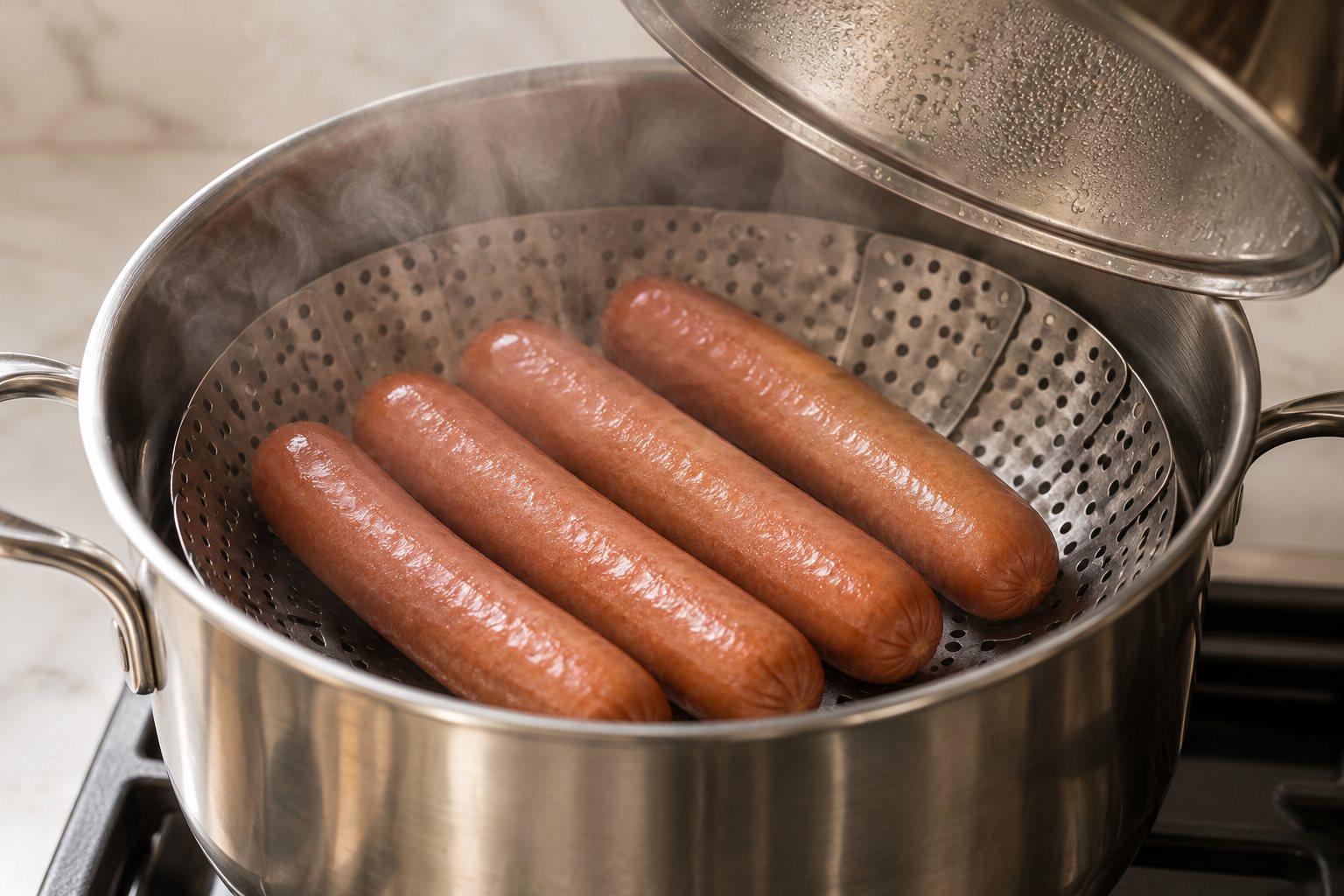
  3. Steam the frankfurters. Lay them in the basket, cover, and steam 7 to 8 minutes, until they are plump and taut and read about 160°F. Do not let them touch the water and do not let them burst.
    Four frankfurters steaming in a basket above the water.
    Steam the frankfurters above the water until plump, keeping their casings intact. AI-generated illustration.
  4. Steam the buns. Lift the sausages to a plate, set the buns cut side down over the steam, cover and give them 60 to 90 seconds, until they are soft and warm right through. They should give when pressed and not tear.
  5. Build, in order. Sausage into the bun. A stripe of yellow mustard down its length. A spoonful of neon relish. A scatter of chopped onion. Two tomato wedges tucked down one side between sausage and bun, the pickle spear down the other. Two sport peppers on top.
  6. Finish with celery salt. Shake a good pinch over the whole assembled sandwich and eat it immediately, before the onion and tomato start giving up water into the bun.
If a casing split in the pan, the water was boiling rather than steaming — drop the heat and accept that one as the cook's dog. If the bun tore as you loaded it, it was under-steamed and still stiff at the hinge; give the next one another thirty seconds. If the whole load slid off at the first bite, the tomato and pickle went on top instead of down the sides, which is the one structural mistake this sandwich does not forgive.

Storage and make-ahead

A built Chicago dog has a working life of about four minutes and cannot be made ahead. Chopped onion and cut tomato should both be done within the hour, since tomato wedges cut early go watery and take the bun down with them.

Frankfurters keep to their own package date, unopened; once the package is open, use them within a week. Everything else in the list is pickled or dry and keeps for months in the fridge.

What to serve with it

Fries, salted hard, and nothing else on the plate. If you want a second thing, make it another dog.

Cold lager, or a fountain drink with enough carbonation to cut the fat. Anything sweet doubles up on the relish.

A natural-casing frankfurter in a poppy seed bun under a yellow mustard stripe, green relish, chopped onion, tomato wedges and a pickle spear along the sides, two sport peppers and a dusting of celery salt

From the recipe box / Illinois

Chicago Hot Dog, Dragged Through the Garden

An all-beef natural-casing frankfurter steamed rather than boiled, laid in a steamed poppy-seed bun, and buried under seven things added in a fixed order, finishing with celery salt over the lot.

Prep
15 min
Cook
10 min
Total
25 min
Serves
4
Calories
420 per serving

Ingredients

Scale

Instructions

  1. Bring an inch of water to a bare simmer under a steamer basket.
  2. Chop the onion, cut the tomatoes into wedges, and line up the relish, pickles, sport peppers and celery salt.
  3. Steam the frankfurters, covered, 7–8 minutes until plump and taut, about 160°F.
  4. Steam the buns cut side down over the same water 60–90 seconds, until soft all through.
  5. Build each one in order: sausage, mustard, relish, onion, two tomato wedges and a pickle spear down the sides, two sport peppers on top.
  6. Shake celery salt over the whole sandwich and eat at once.

Nutrition

Fat24 g (9 g saturated)
Sodium1550 mg
Protein15 g
Serving1 hot dog with all toppings
Calories420
Cholesterol45 mg
Carbohydrates34 g (8 g sugar, 3 g fiber)

Nutrition is an estimate calculated from the listed ingredients and is provided as a courtesy, not as dietary advice.

Questions readers ask

Why steamed and not grilled?

Steaming is the stand method and it protects the casing, which is the whole reason for buying a natural-casing frank. Chicago does grill them too — a char dog is cooked over flame until the casing blisters and splits deliberately, and it is a different and also excellent sandwich. What you should not do is boil them, which splits the casing without giving you any char in exchange.

Is the no-ketchup thing a joke?

No, it is a real and documented habit, though its origin is younger than people assume. The seven-topping build was codified and promoted by Vienna Beef, taught at the company's Hot Dog University and pushed out to stands across the city and suburbs, and that is where a loose local custom hardened into a rule. The reason given by both Kraig and the company is flavour architecture: the dog already runs hot, sour, salty and sweet at once, and the sweetness ketchup brings is the sweetness the relish is already carrying. The other story you will hear, that ketchup was banned because it hid spoiled meat, is folklore — nobody has produced anything behind it, and it is not repeated here as fact.

Who invented the Chicago hot dog?

Nobody, as far as the record goes. Abe Drexler of Fluky's claimed it for himself near Maxwell Street in the late 1920s and Bruce Kraig, who has looked hardest, says there is no evidence for that claim. What the evidence supports is slower and better: a sausage from German butchers, a bun seeded by Eastern European Jewish bakers, and a garden of toppings handed up by Italian, Greek, Mexican and Jewish vendors in the same market, settling into a fixed form somewhere between 1920 and the end of the Second World War.

What if I cannot find neon relish or sport peppers?

Ordinary sweet pickle relish stands in for the neon, and the colour is the only thing you lose. For the peppers, pepperoncini split lengthwise are the closest widely stocked thing; they are milder, so use three. Do not reach for jalapeños, which are hotter and taste raw and green against the celery salt.