American cooking Recipes & regional stories

Skillet & Sage

A culinary journey through the fifty states

The regional table / Kentucky

Beer Cheese
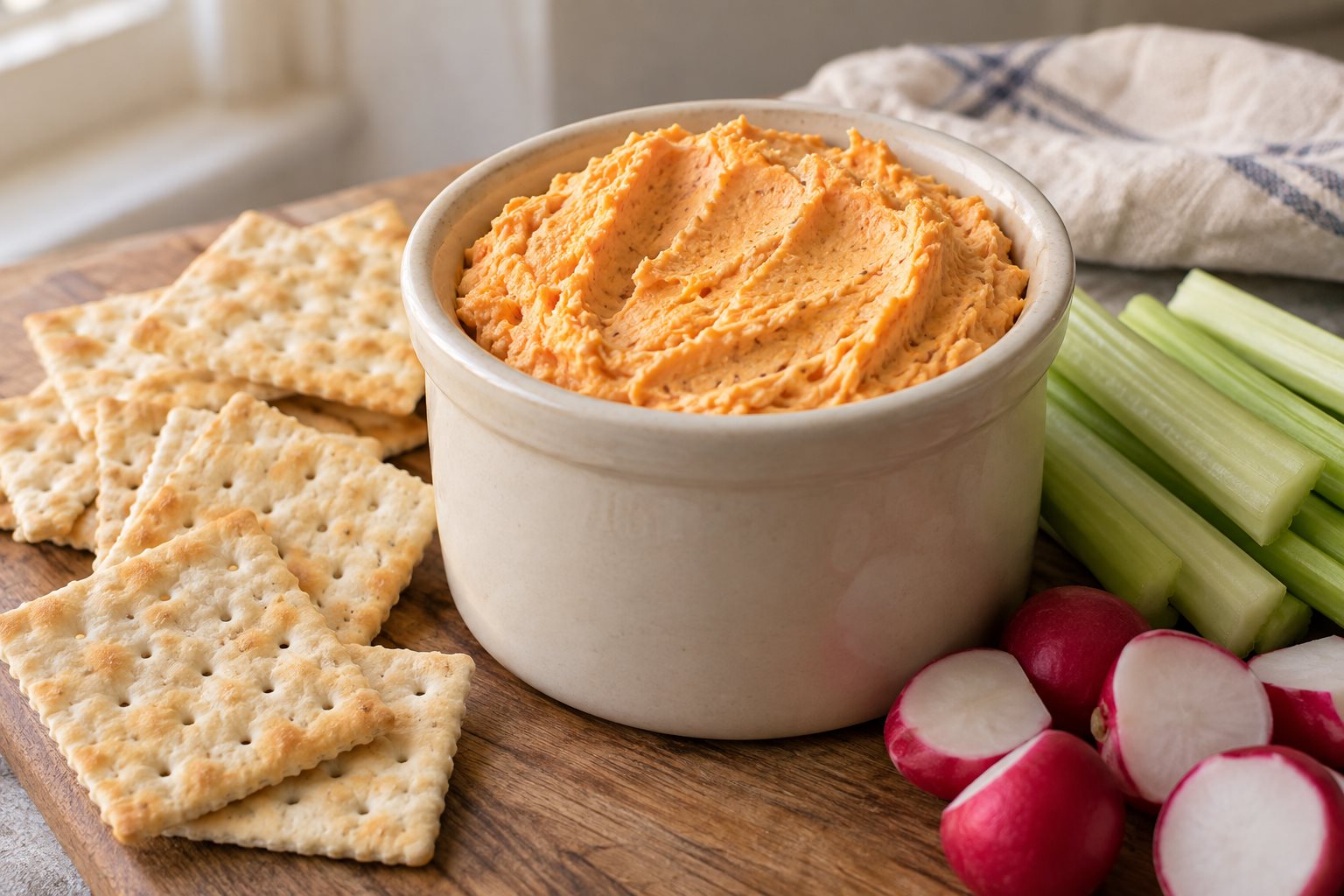
A crock of thick orange beer cheese with saltines, celery sticks and sliced radishes.
Saltines, celery and radishes are not styling. That is the plate the Driftwood Inn is said to have put it on. AI-generated illustration.

Everything about this spread is designed to make you thirsty, and it was designed that way on purpose.

Beer cheese belongs to a specific stretch of road. Athens Boonesboro Road runs southwest out of Winchester, in Clark County, down to the Kentucky River near Boonesborough, and the river road houses along it are where the spread got famous. The claim to have invented it is a family claim, and the family still makes it and still sells it, which is worth knowing before you weigh the claim. Allman's Beer Cheese tells the story on its own history page: Johnnie Allman, a Richmond man who had risen to captain in the Kentucky State Police, went into restaurants late in life, and "It all started in the late 1930's on the banks of the Kentucky river near Boonesborough where he opened his first restaurant, The Driftwood Inn. This was the restaurant where Johnnie Allman first served his cousin Joe Allman's now famous 'Snappy Cheese'." He moved up the road in the mid-1940s to the site where Hall's on the River stands today, at 1225 Athens Boonesboro Road, and sold the business to Carl Johnson; Hall's still traces its ownership from Captain John Holder to Johnny Allman to Carl Johnson to George and Gertrude Hall, and still sells Hall's Snappy Beer Cheese.

The official line is thinner than it sounds. The Beer Cheese Festival states that "Clark County was officially recognized by the Commonwealth of Kentucky as the birthplace of beer cheese in 2013," while Kentucky Educational Television, writing on 7 October 2019, says "Winchester, Kentucky, is the official birthplace of beer cheese. That's according to a proclamation made by Governor Steve Beshear in 2013." Those are two different instruments, and I could not settle which is right: legislature.ky.gov refused every request on 22 September 2026 and the apps subdomain that holds the bill records did not answer at all, so the 2013 text stayed out of reach. Against the single-inventor story, the same KET piece quotes Fiona Young-Brown, author of A Culinary History of Kentucky, pointing at German beer halls where cheese, stale beer and spices were worked together: "It was a way of using up some of the beer. The spiciness, the saltiness, makes people thirsty, and therefore makes them drink more beer." Kentucky bars in the early twentieth century were full of German owners. What is not in dispute is that Johnny Allman was among the first to sell the stuff by name. The quantities below are this site's own; this is a dish far too young to have an old book behind it.

Why this version works

The beer has to be flat. Carbonation whips air into the spread and gives you foam that collapses overnight into something loose and weeping. Pour the beer out an hour ahead, or stir it hard until it stops fizzing. Flat beer also tastes less sour, which matters when a whole bottle goes into three cups of cheese.

Grate the cheese yourself. Pre-shredded cheddar is dusted with potato starch or cellulose to stop it clumping in the bag, and that coating is exactly what stops it going smooth in a processor. It stays grainy no matter how long you run the machine. Buy a block, grate it on the coarse side, and let it come to room temperature first — cold cheese seizes into pellets instead of a paste.

It is not ready until tomorrow. Fresh from the machine it tastes like salty cheese with beer in it. Overnight the cayenne comes up through the fat, the garlic spreads out, and the texture tightens to something you can spread rather than pour. A full day in the fridge does more for this recipe than any ingredient in it.

Raw garlic and dry mustard, not cooked aromatics. Nothing in this is heated, so every flavour has to work raw. Dry mustard brings a sinus heat that fresh mustard loses, and raw garlic brings a bite that mellows across the first day into something rounder. Cooked garlic in here tastes flat and faintly sweet, which is the opposite of what you want.
Ingredient notes

Beer: a plain American lager or a pale ale, room temperature, flat. Nothing roasted and nothing very hoppy — stout turns the colour to mud and a heavily hopped IPA goes bitter as the spread sits, because the bitterness does not fade while everything around it does.

Salt: go carefully. Aged cheddar, Worcestershire and hot sauce all bring salt, and the spread concentrates as it firms. Season at the end, after the first rest, not while the machine is running.

Cayenne: this is the "snappy" in snappy cheese, and Kentucky versions run hotter than visitors expect. Start at the half teaspoon here, taste the next day, and add more then. Heat added on day two disperses in a couple of hours.

Cheddar: sharp or extra-sharp, a block, aged at least nine months. Federal standard 21 CFR 133.113 fixes cheddar at a minimum 50 percent milkfat by weight of the solids and a maximum 39 percent moisture, and that low moisture is the reason cheddar behaves here: a wetter cheese thins the spread and breaks when it sits. Mild cheddar tastes of nothing once the cayenne is in.

Step by step

  1. Flatten the beer. Pour the beer into a jug an hour ahead and leave it on the counter, or stir it briskly until the head collapses and no bubbles rise. It should be at room temperature when it goes in.
  2. Warm and grate the cheese. Take the cheddar out of the fridge 30 minutes early and grate it on the coarse holes. Cold cheese and a food processor make rubble.
  3. Start dry. Put the cheese, garlic, dry mustard, cayenne and black pepper into a food processor and run it in ten-second pulses until the cheese looks like damp sand, about a minute. Scrape the bowl down twice.
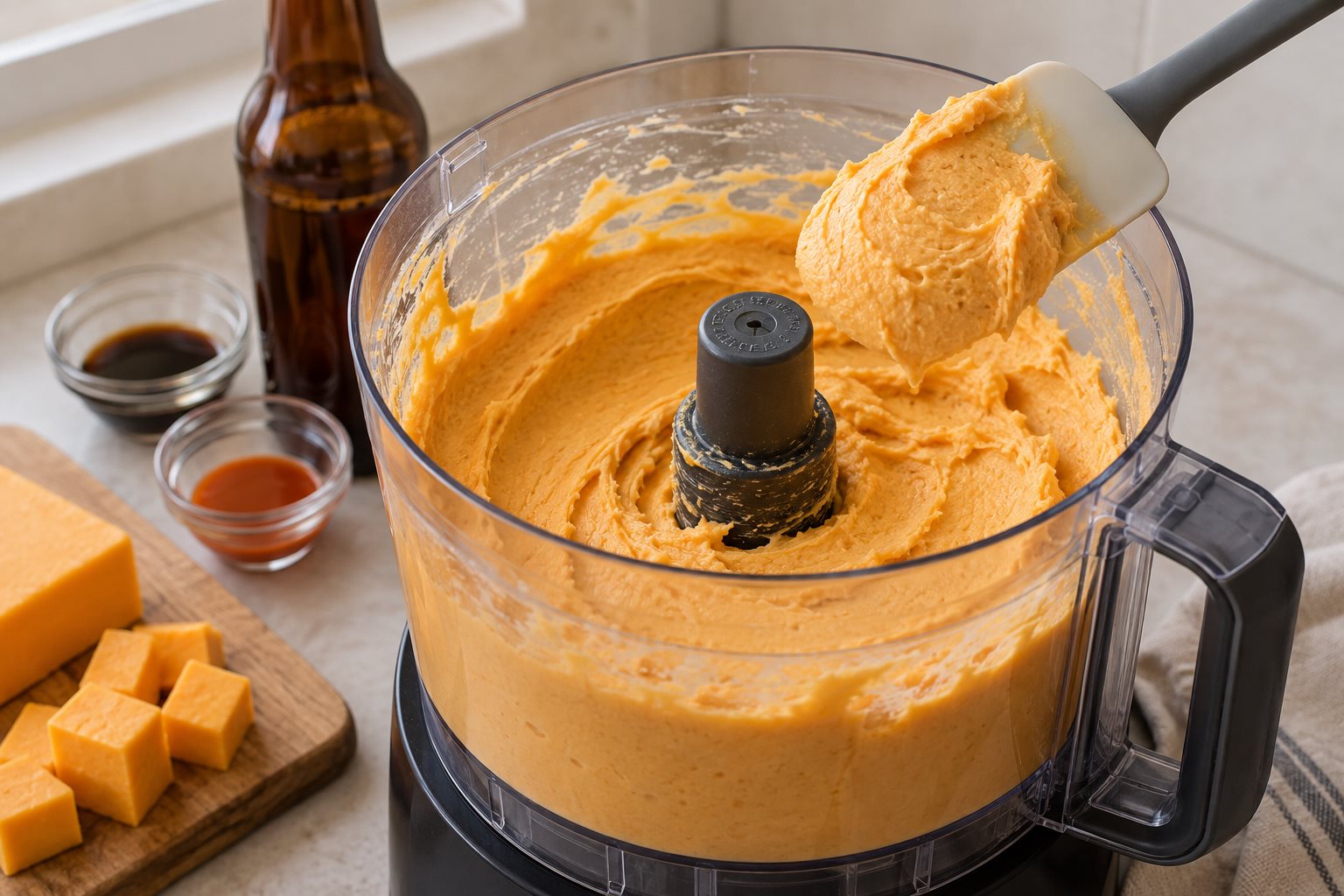
  4. Stream in the beer. With the machine running, pour the beer in slowly, then the Worcestershire and hot sauce. Keep going until the mixture turns from crumbs to a single smooth paste, 2 to 3 minutes. Stop, scrape, and run it another 30 seconds — the difference between good and grainy is almost always another half minute.
    A spatula lifting thick smooth orange cheese paste from an open food processor bowl.
    Process until the cheese forms one smooth paste; scrape the bowl and blend again if it is grainy. AI-generated illustration.
  5. Season and rest. Taste and add salt only if it needs it. Pack it into a crock or jar, press the surface flat, cover it and refrigerate at least overnight and up to 2 days before you serve it.
  6. Bring it back to the table. Take it out 30 minutes before serving. Straight from the fridge it is too firm to spread and the heat and garlic are muted; at cool room temperature both come back.
If it comes out grainy, it is nearly always cold cheese or pre-shredded cheese, and both are fixable in the same way: keep the machine running and add beer a tablespoon at a time until it comes together, then let it rest overnight, where it will tighten again. If it has gone loose and soupy, you added the beer too fast — grate in another two ounces of cheddar and process briefly. If it weeps liquid after a day in the fridge, the beer was still carbonated when it went in; pour off the liquid, stir the spread hard and it will hold from there.

Storage and make-ahead

It keeps 2 weeks in a covered crock in the fridge and improves for the first three or four days, then holds steady. If the top dries or darkens, scrape a thin layer off and stir the rest.

It does not freeze. The emulsion breaks on thawing and no amount of beating brings it back to a spread — you get oily curds in a puddle. Make a smaller batch instead; it takes ten minutes.

What to serve with it

Saltines, celery sticks and radishes, which is how the river road houses are said to have sent it out, free, to make the beer go down. It also belongs on a burger, stirred into grits, or spread on rye under a broiler until it blisters. And beer, obviously — the whole construction is an argument for another one.

A crock of thick orange beer cheese with saltines, celery sticks and sliced radishes.

From the recipe box / Kentucky

Beer Cheese

Sharp cheddar ground smooth with garlic, dry mustard, cayenne and flat beer, then left overnight so the heat comes up — the snappy cheese of the road houses on the Kentucky River.

Prep
15 min
Cook
0 min
Total
15 min, plus overnight
Serves
12
Calories
168 per serving

Ingredients

Scale

Instructions

  1. Pour the beer out an hour ahead and let it go flat at room temperature.
  2. Bring the cheddar to room temperature and grate it on the coarse holes.
  3. Pulse the cheese, garlic, mustard powder, cayenne and black pepper in a food processor about 1 minute, until it looks like damp sand.
  4. With the machine running, stream in the beer, then the Worcestershire and hot sauce, and process 2–3 minutes to a smooth paste.
  5. Taste, salt only if needed, pack into a crock, cover and refrigerate overnight.
  6. Let it stand 30 minutes at room temperature before serving with saltines, celery and radishes.

Nutrition

Fat13 g (8 g saturated)
Sodium310 mg
Protein10 g
Servingabout ¼ cup
Calories168
Cholesterol40 mg
Carbohydrates2 g (1 g sugar, 0 g fiber)

Nutrition is an estimate calculated from the listed ingredients and is provided as a courtesy, not as dietary advice.

Questions readers ask

Hot or cold?

Cold, traditionally, out of a crock with saltines. Warm beer cheese is a different and newer thing — good on a burger or poured over fries, but heat it gently and expect it to separate if it boils. A spread that has been melted will not go back to being a spread.

Who actually invented it?

The Allman family says Joe Allman made it for his cousin Johnnie, who first served it at the Driftwood Inn in the late 1930s, and that is the family's own account on its own website. Kentucky recognised Clark County or Winchester as the birthplace in 2013, by a resolution or a proclamation depending on who is telling it, and I could not read the 2013 document because the state legislature's site refused every request. Set against that, a food historian quoted by KET puts the idea in German beer halls long before any of it, arriving in Kentucky with German bar owners. The safe statement is that Winchester is where beer cheese became a named, sold, local thing.

Should I use processed cheese?

Plenty of Kentucky versions do, and they are smoother and more stable than this one. They are also flatter. Block cheddar gives you the sharpness the cayenne needs to push against, at the cost of a spread that has to be helped along in the processor and rested overnight. If you go the processed route, cut the beer by a couple of tablespoons, because it melts looser.

Can you get drunk on beer cheese?

No, and the festival has had to say so out loud. Jenny Bailey of the Beer Cheese Festival committee told KET that "You would probably get sick before you ingested enough beer to get drunk on it!" Three quarters of a cup of beer spread across three cups of cheese, none of it heated, comes to a trace per cracker.