The regional table / Arkansas
Arkansas Cheese Dip
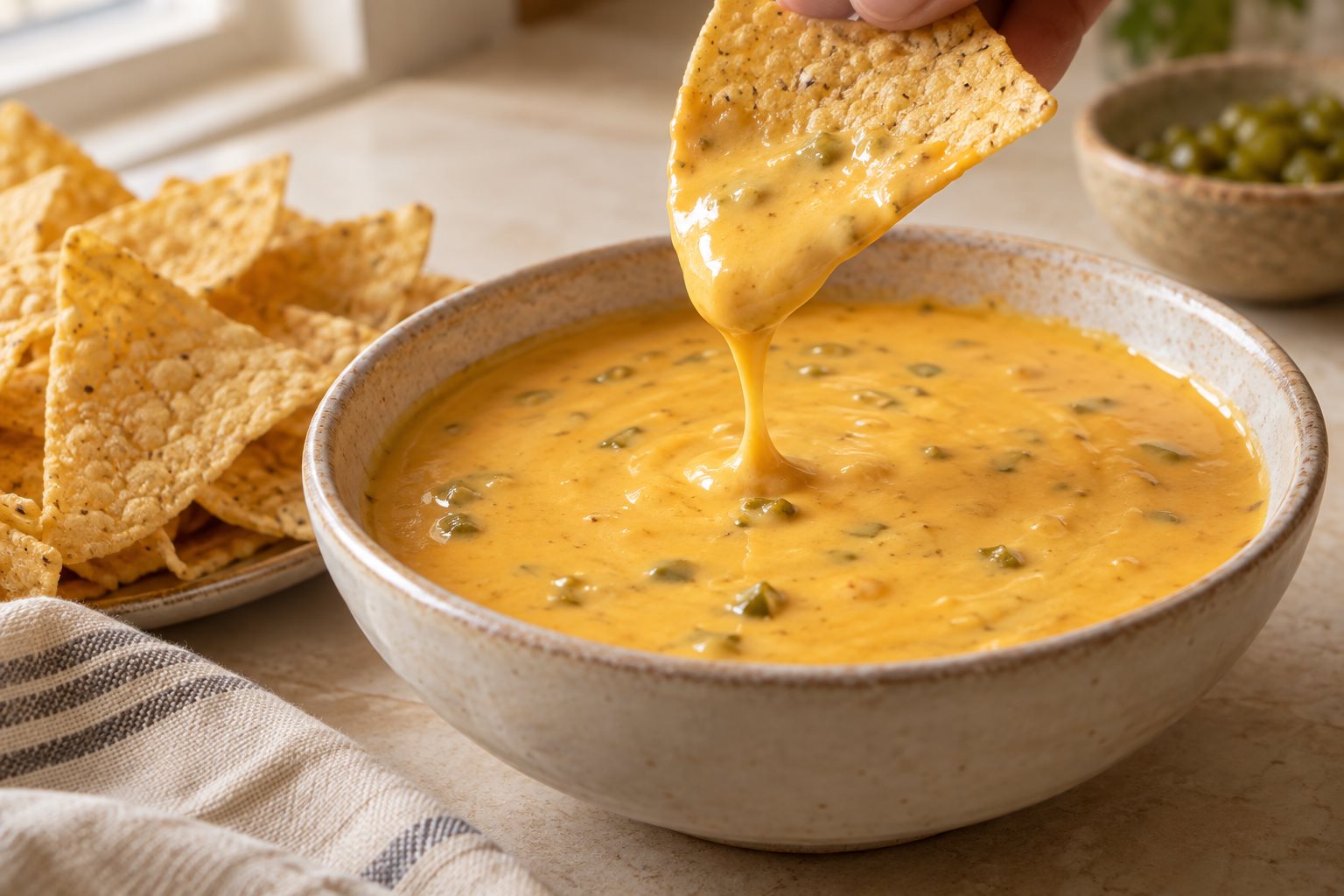
It is not queso and Arkansans will tell you so. It is orange, it is mild, it pours, and it is made of a cheese that was engineered in a laboratory to do exactly this.
The primacy fight is real and the evidence is thinner than the dip. The claim that Arkansas invented cheese dip traces to a twenty-minute documentary of 2009, In Queso Fever, made by Nick Rogers, who went on to found the World Cheese Dip Championship in Little Rock. The Encyclopedia of Arkansas, the Central Arkansas Library System's reference work, tells the story and then declines to close it: the Mexico Chiquito restaurant was opened by Blackie Donnely and his wife in North Little Rock in 1935, and "Whether or not Donnely's cheese dip was the first is hard to say." Its own entry lists the rivals in the next breath — a Mexican restaurant in Hot Springs, Texas, Mexico itself. Phil McCausland, writing in the Southern Foodways Alliance journal Gravy in the spring of 2016, went looking for the document and came back without it: the film places the genesis in Hot Springs rather than North Little Rock, the family details are the kind of thing that "would elicit a nervous laugh from an academic", and the menu that would settle the date is reported only as an allegation — allegedly there is a Mexico Chiquito menu from 1935 that offers it. Two accounts, two towns, two spellings of the man's name, and no menu. Arkansas's own newspapers are shut to a script, and the Butler Center's digitised collections, which do answer, hold the phrase in high-school yearbooks and Central High Museum files and nowhere near the 1930s. I did test the other side, and that side has a document. The Covington News of Covington, Georgia, on 31 May 1923, printed the account of a Mexican-themed social whose flags and draperies "were sent direct from San Antonio for the occasion", and recorded that "The menu was a reproduction of that served in the Mexican cafe and consisted of the following: Chile Con Queso, Chicken and Rice, Mexican style." That is twelve years before 1935, in a Georgia weekly, copying a San Antonio café. It does not prove that Texas invented the bowl you put a chip in — a course on a banquet menu is not a dip — but it puts the Texan name in print while the Arkansas claim is still an unproduced piece of paper. As for the legislature: the Arkansas General Assembly's own measures are full-text searchable back to 1987, and the phrase cheese dip occurs in none of them. The word cheese occurs in four, every one of them about milk or the food code. The same search turns up Act 255 of 1987 in a second — "AN ACT TO DESIGNATE THE SOUTH ARKANSAS VINE RIPE PINK TOMATO AS THE STATE FRUIT AND THE STATE VEGETABLE" — so the state does legislate its food when it means to. It has never legislated this one. The nearest thing to a written definition anybody has adopted is the championship's own rule, quoted in the Encyclopedia of Arkansas: "a dip made of primarily cheese(s) or processed cheese product, with or without additional ingredients, not limited to meats, vegetables, or dairy additives, served warm or hot and eaten primarily by dipping a hard tortilla or chip into said product."
What is documented to the last decimal is the cheese. Process cheese is not an old food that got cheapened; it is an engineered emulsion with a federal specification, and 21 CFR 133.169 writes it down: cheese comminuted and mixed with heat and an emulsifying agent into a homogeneous plastic mass, the agent being citrate, phosphate or tartrate salts capped at three percent of the finished weight, and any acid used held to a floor, "in such quantity that the pH of the pasteurized process cheese is not below 5.3." Those salts are the reason this dip exists as a restaurant item rather than as a sauce somebody has to babysit, and what they actually do is take the cheese apart. Casein in milk is packed into micelles held together by calcium; the salts are monovalent cations with a polyvalent anion, they sequester that calcium, and as Deshwal and colleagues put it in Molecules in 2024, "CSS can also dissociate the casein micelles, thereby resulting in increased hydration and voluminosity of the casein micelles." A dismantled, swollen casein is no longer a curd trying to hold its shape. It is a protein with a water-loving end and a fat-loving end, free to stand at the surface of every fat droplet, which is the definition of an emulsifier. That is the whole difference between this dip and a cheddar sauce that splits if you look at it. The dish itself is younger than the public domain and no old book holds its quantities, so the ones below were worked out for this page.
Why this version works
It reheats, and that is the tell. A flour-thickened cheese sauce is a one-shot thing; reheat it and the starch weeps and the fat comes up. This does not, because nothing here is holding by starch. The same salts that let it pour on Tuesday let it come back on Friday. If a dip you have made cannot survive its own leftovers, it was not built like this one.
The cheese brings its own emulsifier. A block of cheddar is fat trapped in a calcium-bonded protein net, and heat makes the net contract and wring the fat out. Process cheese has had that calcium sequestered by citrate and phosphate salts before it ever reached you, and the casein released by it is what surrounds each fat droplet. You are not emulsifying anything here. You are melting something that is already an emulsion and thinning it without wrecking it.
Acid goes in last and in small amounts. The federal standard puts a floor under the acid for a reason: below about pH 5.3 the casein is heading for its isoelectric point, where it stops repelling itself and clumps. Pickle brine and tomato are what make this dip taste like a restaurant's rather than like warm cheese, and they are also the fastest way to turn it grainy. Add them off the heat, at the end, and taste before you add more.
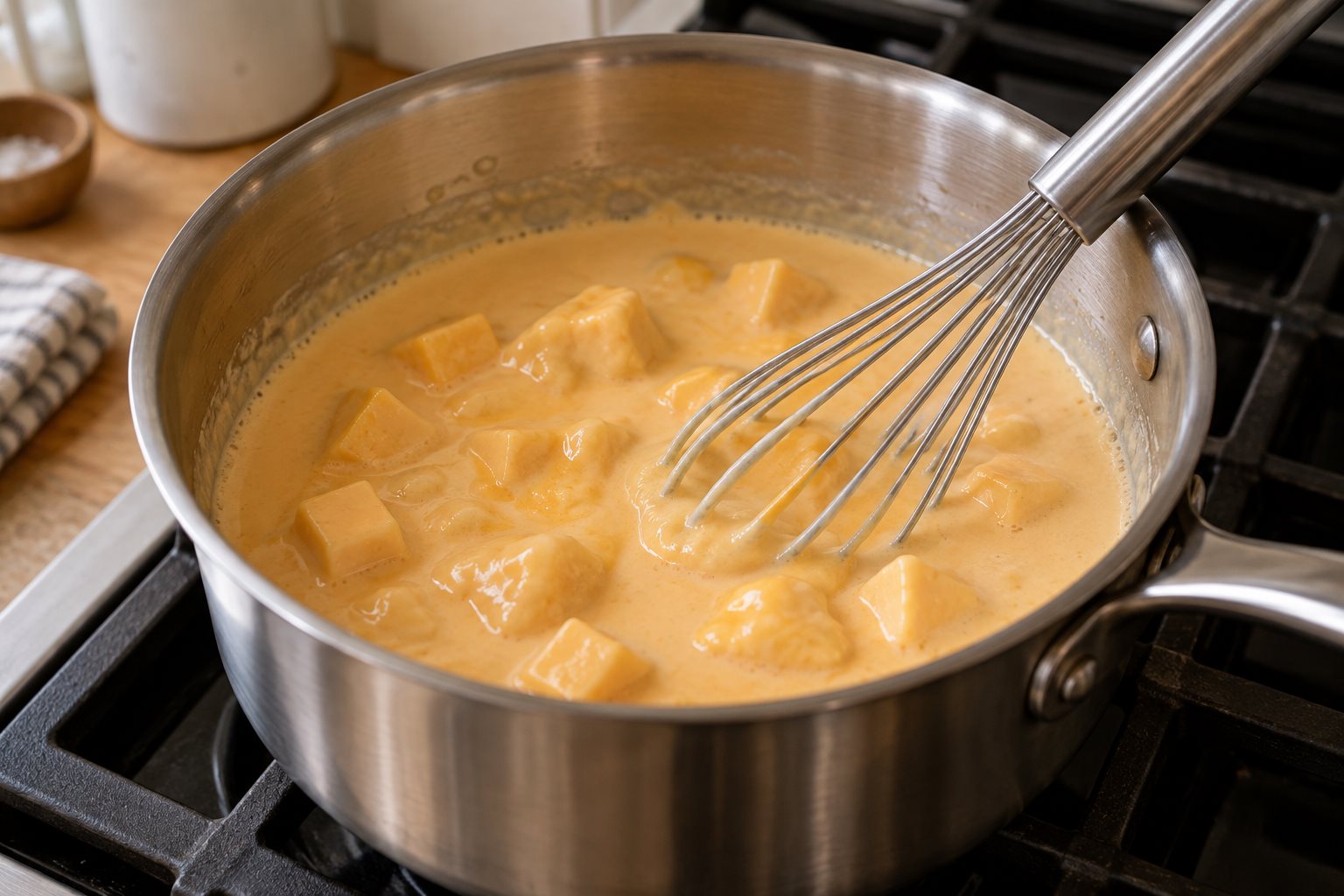
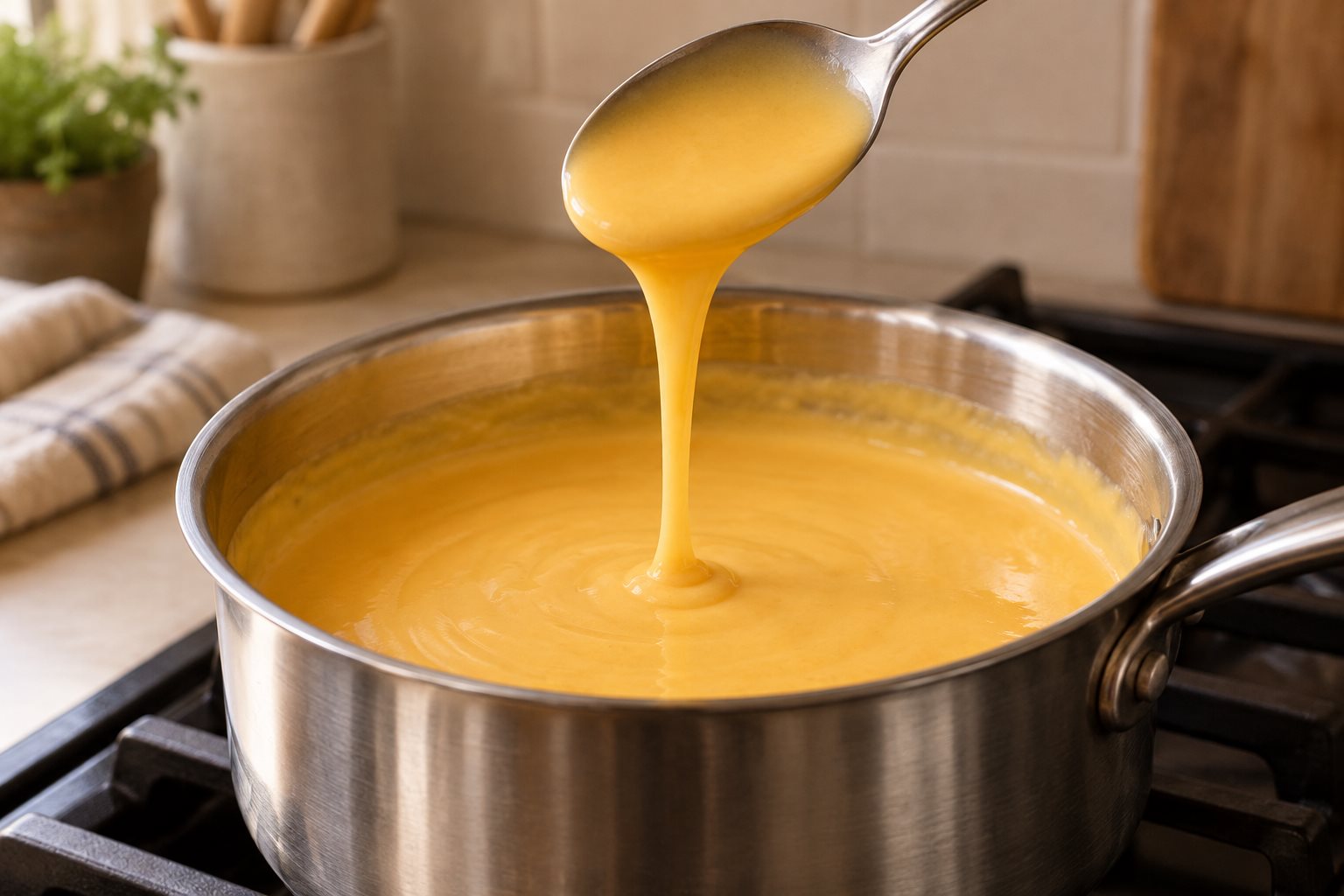
Pourable is a water problem, not a heat problem. Restaurant dip and a slice of American cheese are the same material at different moisture. All you are doing is adding water back, and the casein has to take it up rather than just sit in it. Liquid in two or three additions, each one whisked until it disappears, gives you a dip that pours; the whole can poured in at once gives you cheese suspended in milk that will settle into a skin and a puddle by the time it reaches the table.